Seated at a makeshift office table at Cama Baug, she presides. The setup is fuss free — registers, a calculator, a red pen, car keys, a water thermos. So is her attire — a Charagh Din shirt, Guess watch, a sturdy Nokia handset. Accounts with the fish supplier have been settled. Rather than naming his price he asks for an amount that would suit her. "Méré ko to saab kuch parvaréga (everything is affordable to me),” she responds in her Bambaiya lingo. He has been a dependable source, even when others absconded in favor of a lucrative export trade. The phone rings. "Téra kal rumali hai. Colaba.” Her terse and to-the-point conversations inform another caller that he will be required to supply rumali roti the next day at the Colaba Agiary (Seth Jeejeebhoy Dadabhoy Agiary). Between the calls, that average one every four minutes, she confides that lately nothing scares her, "I’m thinking jara confident thai gaich (I’ve become confident).” A man in a blue shirt approaches in the distance. He, she notes, will carry tidings that the price of rice has risen.
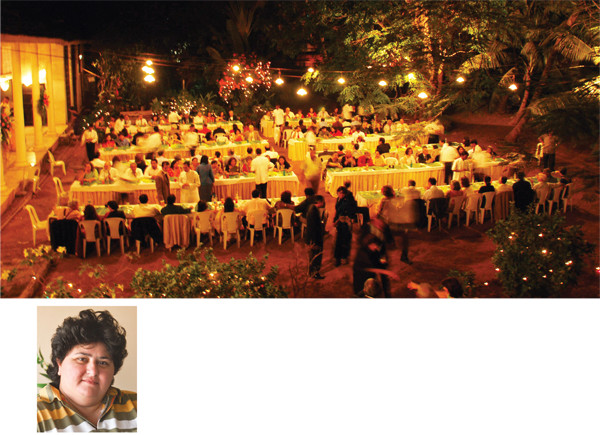
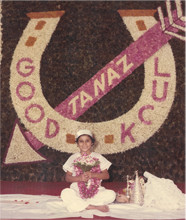
A one-woman empire: Tanaz Godiwalla today (Photo: Kainaz Amaria) and at her navjote (below)
Caterer Tanaz Godiwalla has a lot to be confident about. Her hold over Parsi festive catering is undisputed. She has steered a family business into a one-woman empire. Of the 26 functions held at the popular wedding and navjote venue, Colaba Agiary, in December 2010, she was caterer to 25. Her calendar is booked for celebrations as distant as December 2013. In a divided, litigation loving community she is an unexpected unifying force for the liberal and orthodox, elite and ordinary, priesthood and laity, Parsi and Irani, all at least have a caterer in common. It doesn’t pay to take sides, she explains. A lingering look at the guests who offer their salaams at her worktable (at the Colaba Agiary most evenings) confirms an array of clientele.
Her competitors may reason that "Parsi log Parsi ké peechhé hi bhagéga (Parsis will patronize Parsi caterers),” but to reduce her success to such affiliations would mean missing the point. It is to consistent standards of high quality, that fine balance of spices, the choicest cuts, affordable pricing and of course the discerning culinary tastes of the community that we may attribute her monopoly over the trade. During the last decade she has consolidated her hold over catering Parsi food to large, mid-size and small events — navjote, wedding and New Year celebrations; pre-wedding meals, engagements; parties or even a dinner for two.
With that reassuring rosy-cheeked smile, you’d think nothing could faze her. But even the outward demeanor was hard work. From her mother she learnt diplomacy: The client is seldom incorrect. Her own mechanisms for dealing with an awkward situation — two families of a wedding party asking which of their menu selections she prefers — include excusing herself for a toilet break. ‘Side kaunni lévani, taplaa mané paré (If I take sides, I’ll get the blame)!” Another unpleasantry with which she copes daily is the loss, by her staff, of approximately a 100 napkins and broken glasses, 40 pieces of cutlery, crates of soft drinks. Uninformed non-Parsi guests leave the cutlery within, rather than on top of the folded, used patra. Her managers Yazdi Captain and Sohrab Elabadi complain, "Tanaz ai su tu joti nathi (you’re not looking into this wastage).” Minoo Todywalla, the eldest member of her staff, also chides her for her negligence. These losses are factored into the budget. Why, she asks, have her diabetes rise when clients, if assured of quality cuisine, are willing to pay? Her parents, Freny and Rohinton, would have shied from taking these risks. Theirs were careful listings and calculations, and a tighter hold on the staff. But Godiwalla believes in occasionally treating them to a breakfast of vada pav (spicy potato fritter in a mini loaf of bread) costing Rs 3,000. In her model, the economies of scale encourage a pound wise and penny foolish approach.
More challenging are the clients that come in clusters — from the Dadar Parsi Colony or Colaba’s Cusrow Baug, for instance. Having grown up, married and had children at about the same time, celebrations therefore coincide and despite an outer congeniality, the competition is stiff. Each menu must outdo the other. Clients ask for "something different,” then mention that saas ni machhi (fish in piquant white sauce) and pulau dal are non-negotiable items. So Godiwalla has devised a "base Parsi menu” over which variations are possible. For a high-end example, paratha may be served along with rotli. The usual Bharuchi akuri (a form of scrambled eggs with dry fruits) may be replaced with leela lasun na charvella eeda (fresh garlic in scrambled eggs) and garlic brun (crisp bread). Both paatraa ni machhi and saas ni machhi are offered (non-Parsi guests prefer the former, Parsis the latter). Tawa butter masala bheja (spicy buttered brain), lobster dari, pulau dal and custard follow. Even those with the tightest budgets will insist that pomfret is served. She suggests, in vain, that if the fish were omitted the menu could accommodate so much more.
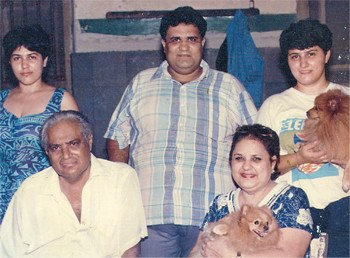
The Godiwalla family: (seated) Rohinton and Freny; (standing, from left) Roxanne, Neville and Tanaz
Newer trends in Parsi catering include serving an array of starters that precede the sit-down patra meal. Godiwalla explains that the snacks are beneficial to the caterer on two counts — first, they are made from the smaller pieces of meat unused in the main cooking and secondly, guests arrive hungry, munch on them and are likely to eat less of the patra food. Wafers traditionally served at the beginning of the patru have made their way to large trays at the bars. The days of the wafer/saria wars are over; the latter now holds pride of place on the patru. (The senior Godiwallas charged Rs 2 or 3 more if sarias were chosen over wafers.) Serving food to seated diners is preferable to the buffet arrangement which invariably results in wastage. Weary of making their way through the buffet traffic, diners pile their plates with food they seldom finish. With the patra option, "Fish, to my last piece, I can save,” mentions Godiwalla. It is cooked as the guests are seated and served fresh and piping hot.
She is an old hand with the tricks of the cold drink suppliers. Mangola, Rasberry and Ginger are the most popular beverages. The Pepsi distributor quips, "Tanaz you serve such bad Mangola,” in a bid to increase his company’s supply. Likewise, the other distributors find fault with their rival products by pointing out the particle content in them. But the Godiwalla staff have been trained to spot particles in any cold drink and are rewarded with Rs 100 for each bottle they detect. These bottles are then carefully stored in her car dickey till one sunny day when she has a score to settle with the concerned supplier. Or it may happen, that an old particle ridden bottle breaks in the car after many a ride on Bombay’s mean streets. "If they think they are all doodh na dhoéla (without any flaws) wait till they come across me.”
To her staff, she is both ‘baby’ and ‘big boss.’ Migrants from Uttar Pradesh have, like her, grown up working in the senior Godiwallas’ business. Old pet names have stuck. "The ‘baby’ trend is still continuing,” she reveals. Sachidananda Bhandari aka Dadoo is her ‘right hand man’ and Illiyaas, aka Gadda is now a competent cook and manager. After her mother’s demise in 1998, she called a staff meeting announcing, "I am in charge. I am alone. Every 1st and 15th of the month salaries will be given. If I have committed, I will pay.”
She likes being "the only lady” with an entourage of male staff. Men, she says, have the physical stamina and mental ability to cope with the long hours. The pitted copper utensils in which they cook weigh a good 35 kg. A cook’s wife, who prepares the Parsi vegetarian fare, is the only other woman on site. "I share a good rapport with my staff, they are more my friends.” Stationed at her office table she asks a passing cook, "Saas ka kya haal hai (What is the position regarding the sauce)?” Before the five-month festive season ends with the Navroz celebrations in March, the staff’s familiar departure rhetoric is heard: "Maa mar gaya (my mother died),” they claim. "Kitni baar mar gaya (how many times)?” she asks. "Sach mooch is baar (honestly this time).”
Early hiccups are fondly remembered. In the days when diners washed their hands at the table in a small portable plastic tub, green liquid soap was dispensed from empty vanilla essence bottles. She recalls one occasion when the lagan nu custard was being prepared. The cooks informed ‘Baby,’ standing somewhere in the distance, that the essence was going to be added to the dessert. But before she could alert them, three bottles of brown fluid and one of green had been mixed with the sweetened milk! Liters of fresh milk were hastily reordered and boiled on a wood fired flame.
Tanaz Boyce (left) and Tanaz Godiwalla at their vineyard
She recollects that her parents worked very hard but couldn’t enjoy their money. A holiday abroad with them and her siblings Neville and Roxanne was a treat, but for the most part they were tied to Bombay, originally running their canteen in Cusrow Baug, coming home to Mazgaon only in time to sleep. Her uncle Hormuz Godiwalla would feed her papéta per eedu (eggs on potato) and put her to bed narrating the same comforting story night after night. The day was spent at St Agnes High School; the evenings playing marbles with the boys from her building after which she’d run up all 13 floors to her house. Thin and athletic then, she won several medals in sports, though none for academics. On the day Godiwalla’s exam results were due she’d curl up in bed till a family member announced, "Come on, come on, you can get up, you have passed.” She joined St Xavier’s College for two years and graduated in Economics via a correspondence course from Bombay University. Godiwalla almost applied for an MA degree but the demands of the family business discouraged her. Ill health plagued her parents and then her brother and many years were marked with endless trips to hospitals. Personal setbacks caused her to withdraw socially. She was misunderstood as introverted and even snobbish. A dentist friend, Tanaz Boyce, helped to get her life back on track.
Come summer, Godiwalla leaves the city for sojourns across the globe — to Paris to meet Roxanne and her family, for water sporting adventures, a day spend with an African tribe. In India, she drives to Deolali (rally driving was her second professional choice) to unwind at her newly built home, atop a hill. On the surrounding land of around 50 acres, Boyce and she have invested in grape cultivation. Both the climate and soil of the area in and around the Nashik district of Maharashtra make it ideal for grape growing. They cultivate five kinds of table grapes — Thompson, Sonaka, Kalli, Clone Two and Satra Bar Teen, a lychee flavored variety. Since Maharashtra is flooded with the fruit it produces it is wiser to retail in other states. The two Tanazs have been advised to wait for a few crops to pass before venturing into international exporting. Till then they ply their new trade and solicit expertise. A South African scientist with a busy schedule was whisked from Bombay at midnight (after Godiwalla had finished work at a baug) to reach Deolali at 3 a.m. On the remaining property Godiwalla hopes to eventually construct a ‘party deck’ and a few residential rooms to let out to holiday-goers.
The villagers in the district watch Godiwalla zooming in and out of her premises and presume she is a ‘rich madam:’ a possible patron for their many temples. In Bombay everyone thinks she’s as solid as the hard-back registers she maintains. A closer look reveals butterfly and heart stickers on the book covers.