Nearly 700 to 900 guests enjoyed the free vegetarian dhansak served at a stall by the Zoroastrian Trust Funds of Europe (ZTFE) at the Indian Independence Day celebrations facilitated by the Indian High Commission in the UK on August 26, 2018. Since the inception of the event in 2010 when the then High Commissioner Ranjan Mathai sought to showcase the diversity and solidarity of the Indian diaspora in the UK, the ZTFE has been annually sponsoring a dhansak stall, mentioned ZTFE president Malcolm Deboo. The dhansak stall was one of the 72 that were put up at the venue.
"The celebrations are advertised widely and open to all, including non-Indians. Depending on the climate, annually around 2,000 to 2,500 persons attend,” Deboo responded to Parsiana’s queries. As per the guidelines, the participating organizations must not sell but distribute their specialities free of cost. At the request of the organizers and in the spirit of interfaith harmony, since last year they have been serving only vegetarian fare, leaving out the meat kebabs and kachumber too.
"Most Zoroastrians in the UK originate from India… ZTFE founding fathers were from India and it is the oldest Indian faith based voluntary organization in the UK,” Deboo cited the reasons for joining in the event and serving "dhansak, a primary Parsi Sunday lunch dish!”
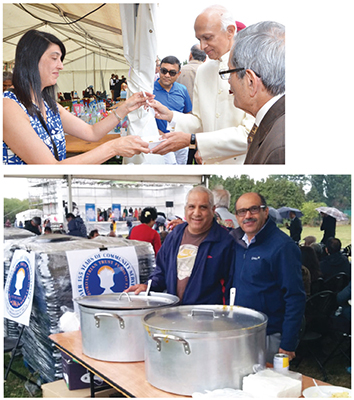
Above: Gav Buhariwala (l) and Mehernosh Billimoria at the dhansak stall, 2018;
top: Benaifer Buhariwala serves Ranjan Mathai as Rusi Dalal (r) looks on, 2015
Three young Zoroastrians sponsored by ZTFE and The Zartoshty Brothers Fund for Zoroastrian Studies were felicitated at the Shahenshahi Navroz function organized at the Zoroastrian Centre in London on August 17, 2018. ZTFE’s resident mobed Ervad Yazad Bhadha and Ruzbeh Hodiwala had earned their MAs and Dr Mehrbod Khanizadeh his PhD from the School of Oriental and African Studies (SOAS), University of London.
An alumnus of the Dadar Athornan Institute in Bombay, Bhadha’s studies at SOAS were made possible with the funds provided by ZTFE, the Faridoon and Mehraban Zartoshty Fund for Zoroastrian Studies, the Erach and Roshan Sadri Foundation and "the wider membership who have sustained him since he joined the ZTFE as our resident priest in 2014 and all who have invited him to perform Zoroastrian ceremonies for them and their families,” stated Deboo. ZTFE is now supporting Bhadha to attend chaplaincy training classes in an NHS (National Health Service) hospital to develop his pastoral skills. He also participates in interfaith activities organized by Harrow Interfaith and the Faith Communities Council, Inter Faith Network for the UK.
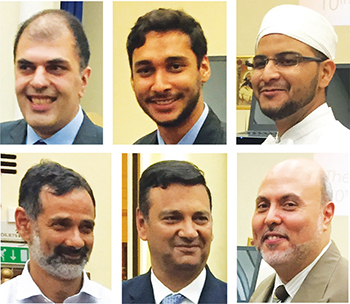
From l, 1st row: Dr Mehrbod Khanizadeh, Ruzbeh Hodiwala, Yazad Bhadha;
2nd row: Prof (Dr) Persis and Dr Zarthustra Amrolia, Malcolm Deboo at the ZTFE Navroz function
Hodiwala from Ahmedabad completed his MA in Iranian Studies with distinction from SOAS in 2016-17, writing his postgraduate thesis on "The origins and continuity of Neo-Zoroastrian Movements in Europe.” He is now preparing to apply for a PhD course at SOAS for the September 2019 intake, his focus area being "Neo-Zoroastrian movements across the globe” and "History, Culture, Politics of Iran and the Middle East,” as notes his bio data. Assisting Dr Homi Dhalla, founder of the World Zarathushti Cultural Foundation, for nearly a decade, he initially worked on the preservation of Bahrot Caves project and has subsequently been active in the interfaith arena. He also serves as national general secretary at Human Rights Resource Centre (HRRC, Bangalore) and as state president of the HRRC Gujarat chapter; and as assistant to Gujarat MLA Jignesh Mevani.
For his PhD, Khanizadeh researched "the Avesta and Pahlavi versions of chapter nine (Hom Yasht) of the important Zoroastrian text, the Yasna,” stated Deboo, in his brief profile on the achiever. After his graduation in the field of veterinary medicine and MSc in animal pathology from the Netherlands, Khanizadeh opted to pursue his interest in the history, culture and languages of Ancient Iran. He completed his MA from the University of Shahid Beheshti Iran in the field of ancient culture and languages before joining SOAS for a masters program in religions, followed by a doctorate.