A two-day seminar examined the Mughal contribution to Indian art and culture
Farrokh Jijina
"The history of modern Indian art starts with Mughal art,” according to Dr Som Prakash Verma, retired professor of history at Aligarh Muslim University. "Mughal art, as a new phenomenon,” introduced the management of light and shade to the world of Indian art, he said. Verma was delivering the inaugural address at the two-day seminar on "The art and culture of Mughal India” at The K. R. Cama Oriental Institute (KRCOI) on January 7 and 8, 2017. Art of that period "became lifelike” with the inclusion of elements from the European Renaissance movement and therefore represents the best of the East and West, according to Verma. Mughal artists and their patrons "were never reluctant to accept innovations,” he said. Earlier schools of art, particularly the Rajasthani and Pahari schools, emphasized ideological interpretations of religious themes only. The Mughals, especially from Akbar onwards, emphasized physical beauty. The emphasis "was on authenticity, so much so that Akbar actually sat for the portraits he commissioned,” said the professor. With the decline of the Mughal Empire, several other schools of art came into existence (Bengal, Punjab, Murshidabad, Oudh and East India Company) but these could never compete with the beauty of the art of the Mughals, he emphasized.
Earlier, Roda Ahluwalia, independent scholar of South Asian art, who served as the academic advisor to the seminar, mentioned that Mughal art is an amalgam of Indian, Middle Eastern and Islamic art. She pointed out that, as elaborated in the beautifully produced seminar brochure, the working sessions of the two-day seminar would cover painting, architecture, the decorative arts and artistic relations with the Safavids (of Persia) and the Ottomans (of Turkey), two large Islamic empires that were contemporaneous with the Mughals.
Dr Nawaz Mody, joint honorary secretary of KRCOI welcomed the audience on behalf of the trustees of the Institute and Muncherji Cama, president. In the seminar brochure, Cama expressed thanks to the ministry of culture, N. M. Wadia Charities and the Late Ervad Hormusji Pestonji Antia and Dinamai Antia Trust for their grants for the holding of the seminar.
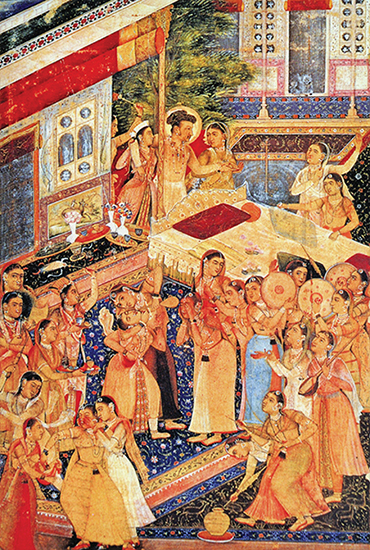
Visual of Jehangir celebrating Holi
Exterior of tomb of Itimad-Ud-Daula;
Depiction in book arts
Writing in the theme paper published in the seminar brochure, Ahluwalia credits Humayun, the second Mughal emperor with the introduction of two Persian artists into his court at Agra. It was Humayun’s son Akbar who encouraged "an innovative painting style which evolved throughout his reign of 49 years.” Mughal paintings reached their peak during the reign of emperor Jehangir, she said, but declined with his grandson Aurangzeb’s rule when "the arts suffered a blow” due to his preoccupation with expanding the empire. Painting as an art form continued in later years "with styles responsive to Emperor-patrons.”
Ahluwalia’s paper titled "A noteworthy ustad (expert) in the imperial Mughal kitabkhane (libraries and painting ateliers) of Akbar and Jehangir” featured a "relatively unknown” artist called Nanha "the only senior artist to span the rules of the two emperors.” Retained by Jehangir to train newer artists in his studio, Ahluwalia said that he may have even accompanied the young Jehangir when he set up a parallel court in Allahabad. Bishndas, the artist’s nephew and protégé churned out many portraits from the parallel court, she said. The training Bishndas received was responsible for his being sent to Persia to capture the likeness of the Safavid emperor Shah Abbas. Nanha’s style was responsible for combining "the aesthetics of Persian refinement with European realism.” He could "capture personalities” with finesse, because "he got into the psyche of the sitter,” she concluded.
Partly due to their connections with Renaissance Europe, portraiture became a flourishing art form in Mughal times, according to Dr Mika Natif, whose talk was focused on "Portraits of Mughal women in illustrated historical texts from the time of Akbar and Jehangir.” The assistant professor of art history at George Washington University in Washington, D.C. said that in early Mughal times, women were portrayed more in group paintings rather than solo; it was only in the times of Jehangir that portraits of solo women came into vogue. "A small number of portraits exist… there are no inscriptions… they cannot be studied in detail, perhaps due to the purdah system,” she rued. Women in portraits are recognizable more by the context they are depicted in, rather than actual characteristics, said the assistant professor. Natif illustrated her talk with portraits of Hamida Banu, a wife of Humayun who appears in 10 pictures. She was a senior member of the court, and even wielded power when the emperor was away on campaigns, according to Natif. Another powerful woman of the time was Maham Angha who, the scholar said, quoting historian Abul Fazal, was the de facto prime minister of Akbar. "The women of Turko-Mughal lineage took precedence in portraiture of the time,” she said. Hindu wives were not portrayed, unless they had given birth to a male heir. Even then, the birth mother was never the focus of the portrait, she said.
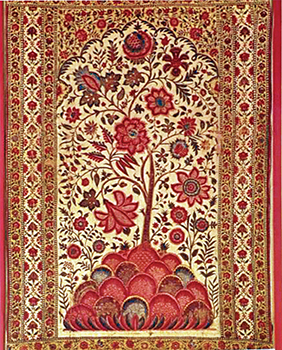
Floral bedspread, Burhanpur
Jagat Shiromani Temple, Amer
Audience Hall, City Palace, Jaipur
"Did the calligraphers and the painters who worked companionably in Mughal kitabkhanes ever disagree?” asked Dr Kavita Singh, professor, School of Arts and Aesthetics at Jawaharlal Nehru University. Divergence between the words and the images could not have been accidental, said the academician who spoke on "Mughal chronicles: words, images and the gaps in-between.” For her paper, Singh studied the Akbarnama, the Jehangirnama, the Padshahnama "as these are some of the most celebrated works of Mughal art.” In many cases, the images varied significantly from the words. "Sometimes, they offered an alternative interpretation of events.” Demonstrating a picture of Jehangir capturing a supporter of his brother and rival for the throne Khushraw, Singh pointed out that historians have proved that the buildings in the background, two tombs and a church, were built much later than the occurrence of the event.
Texts and design were "not intended to dovetail into each other … both were depicted individually,” she said. Calligraphers were held in higher esteem than painters, she informed the audience. "The cheapest elephant was worth more than the most highly regarded painter,” she quoted. The articulate professor speculated that the gaps between the narratives and the paintings had stories of their own to tell — "a gap filled with meaning,” which needed to be probed by art historians.
The art of construction
"It is a myth that in Mughal India temple construction was replaced by temple destruction,” claimed Dr Catherine Asher of the department of Art History at the University of Minnesota. Her paper was titled "Muslim kings, Hindu temples: the legacy of India’s multicultural history.” While some temples may have been destroyed, many of these were rebuilt said Asher. Royal patronage was "widespread across the continent and sometimes focused on tirthas (places of pilgrimage) like Braj and Varanasi,” according to Asher. Demonstrating a picture of Akbar watching a group of sanyasis (Hindu holy men) fight, Asher reiterated that the emperor promoted the Ramayan and even composed Hindu poetry. Akbar favored certain Shaivaite (devotees of Shiva) groups and encouraged them to build their temples. Of the Mughal allies who were Hindus, Raja Man Singh the trusted aide of Akbar was the most prolific builder, according to Asher. She gave the example of the Jagat Shiromani Temple in Amer built by him in the early years of the 17th century, and called it the "largest temple project since at least 13th century India.” Other Hindu allies of the Mughals like the Kachhwahas and the Sisodiyas tried to duplicate the temples of Rajasthan in far off areas of the Mughal empire. She illustrated that the Jai Mandir in Amer Fort, with its exquisite embellishment of glass inlaid panels were inspired by the architecture in Agra Fort.
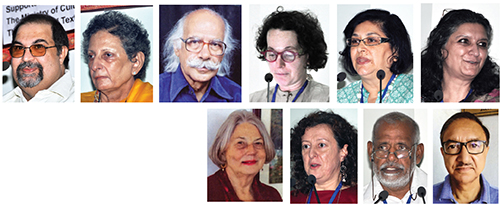
(1st row from left): Muncherji Cama, Dr Nawaz Mody, Dr Som Prakash Verma, Dr Mika Natif,
Roda Ahluwalia, Dr Kavita Singh; (2nd row from left): Dr Catherine Asher, Dr Laura Parodi,
Dr Subhash Parihar, M. Saleem Beg
Dr Laura Parodi, independent research scholar from Genoa who has taught at the universities of Oxford and Dublin believes that to the Mughals, their gardens were "a cosmic diagram of paradise.” The idea of planned gardens originated in Persia, she said, while introducing her paper on "Mughal garden typologies reconsidered.” Gardens that surrounded tombs of royal personages were called charbaghs (formal gardens with four courtyards associated with paradise in Islamic literature). However, Parodi expostulated that Mughal charbaghs functioned mostly as residences for the court in winters. Most Mughal gardens were "productive estates” planted with peach and pomegranate trees, walled compounds for the ladies, stables and a devankhaneh (state rooms) where the court met. Conversely, she said, most Mughal funerary gardens (those surrounding tombs) were not built in the classical four-part styles prevalent in, say, Herat in Afghanistan, the only pure example being the gardens around Akbar’s tomb in Agra. Time to re-examine the way scholars classify Mughal gardens, she smiled.
Very few murals survive from Mughal times and they have to be studied from the miniatures that they were depicted in, rued Dr Subhash Parihar. The principal of the Gandhi Memorial College at Kot Kapura in Punjab who has served as associate professor of museology at the Central University of Punjab was speaking on "Figurative Mughal murals: evidence from miniature paintings.” Murals from the Mughal period are largely studied from the accounts of Western travelers like Sir Thomas Roe, he said. The earliest evidence available that the Mughals pursued murals as an art form is available in the Babarnama, where several are portrayed in geometric patterns. Later murals even introduced human forms, even European characters and some painters included Christian iconography of the Madonna and Child in their murals.
"Don’t call it a ‘country,’ call it a garden,” Jehangir is believed to have said of Kashmir, according to M. Saleem Beg, who has served as the whole time member and chairperson of the National Monuments Authority in the ministry of culture. In his talk titled "Mughal gardens of Kashmir,” the erstwhile convener of INTACH (Indian National Trust for Art and Culture Heritage) for Jammu and Kashmir rued that "in the last 30 years not much has changed in the state” by way of protection to the fabled gardens, as is being done with, say, the Taj Mahal at Agra. He was happy that their gardens have been listed on UNESCO’s (United Nations Educational Scientific and Cultural Organization) tentative list of world heritage sites. The slides he showed depicted haphazard conservation of the water channels in the gardens, and masonry work that was incongruous with the rest of the architecture. "The first vandalization of the gardens happened during the Afghan invasions in the late Mughal period, in Nishat Bagh.” The gardens are anyway "symbolic of the Mughal concept of paradise on earth, with their built (manmade) and landscape elements,” said Beg.
The second day’s proceedings will appear in a forthcoming issue of Parsiana.
The Mughal line
The Mughal emperors built and ruled an empire on the Indian sub continent from the early 16th century to the mid 19th century. 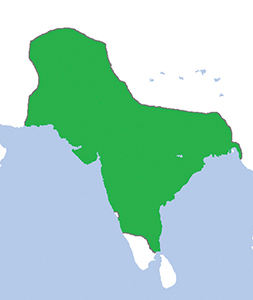 The dynasty was of central Asian origin from an area now part of Uzbekistan. The emperors claimed direct descent from warrior leaders Timur and Genghis Khan of Central Asia. In the late 17th and early 18th centuries, they controlled much of the Indian subcontinent, from Bengal in the east to Kabul in the west, Kashmir in the north to the Kaveri basin in the south. Their power rapidly dwindled during the 18th century and the last of the emperors was deposed in 1857, with the establishment of the British Raj.
The dynasty started with Babar (reigned 1526-1530) and continued through Humayun (1530-1540 and 1555-1556) and Akbar (the Great, 1556-1605); Jehangir (1605-1627) succeeded Akbar, after whom Shah Jahan (1627-1668) ascended the throne, followed by Aurangzeb (1668-1707). The last to rule was Bahadur Shah Zafar (1837-1857).
.