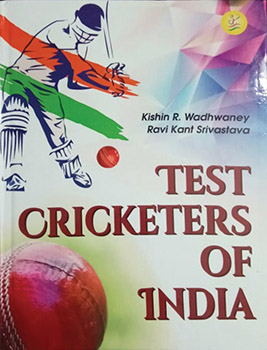
Test Cricketers of India by Kishin R. Wadhwaney and Ravi Kant Srivastava. Published in 2018 by Sports Educational Technologies, 7/26, Ground Floor, Ansari Road, Darya Ganj, Delhi 110002. Pp: 761. Price: Rs 1,995.
Kishin Wadhwaney, the seniormost sports journalist in India, despite being nearly 90 years old still has the concentration and willpower to write books. This mammoth volume co-authored with the Calcutta based Ravi K. Srivastava has profiles of every male player who has played Test or international cricket for India. The crisp profiles interspersed with anecdotes and averages are arranged alphabetically.
Wadhwaney has delved into memory and provided interesting autobiographical information about many stars of yesteryears who only played unofficial Tests or just a solitary Test. The authors’ research work is commendable. Pages have been written on well-known Parsi Test cricketers like Rusi Modi, Polly Umrigar, Nari Contractor, Rusi Surti and Farokh Engineer.
Modi is revealed as an enigma. Over six feet tall, slim and immaculately dressed, he was an attacking batsman who rarely let an opponent bowl a maiden over. Besides being an accomplished Test player he also excelled in badminton, table tennis and tennis. In old age he became temperamental and lonely. It is believed, according to Wadhwaney, that he committed suicide by jumping off the second floor of the Cricket Club of India (CCI).
Umrigar, with 12 Test centuries including a magnificent 172 not out in the fourth Test at Port of Spain in 1962, is described as the most successful Parsi cricketer. His involvement with cricket till his death in 2006 is lauded. He was captain of Bombay when they won five Ranji trophy titles on the trot, a manager, a selector, curator and executive secretary.
The grit of Contractor has also been commended. In 1959 at Lord’s he played an epic knock of 81 against Freddie Trueman and Brian Statham who were at their peak, despite batting with a fractured rib. In the days before helmets, Contractor was hit on the head by a Charlie Griffith bouncer at Bridgetown, Barbados in March 1962 and only recovered because of an emergency operation. As captain he led India to its first ever series win over England in 1961-62. A phlegmatic captain and complete team man, Contractor once slept on the floor of a compartment during a train journey during the home series against Australia in 1959.
There is a detailed portrait of the debonair wicket keeper batsman Engineer, renowned for his swashbuckling batting, acrobatic work behind the stumps and how he narrowly missed India’s captaincy in 1974-75. Surti, a left arm bowler and stylish left-hand batsman and India’s finest fielder in the 1960s, is described as a "poor man’s Gary Sobers.”
Wadhwaney also provides insights into a one-Test wonder like Rustomji J. D. Jamshedji, the oldest Indian to make a debut in Test cricket. A crafty left arm spinner, he was 41 years and 27 days old when he played against Douglas Jardine’s England at Bombay in 1933-34.
The articulate Keki Tarapore also played just one Test against West Indies in Delhi in November 1948. However, as Wadhwaney narrates, it was as a manager of the Indian team to the West Indies in 1971 that he became famous. During the flight on his debut tour Sunil Gavaskar developed a swelling on his finger which was diagnosed as a whitlow (an infection of the finger, especially the tip). The experienced Tarapore took a prompt decision. He and Gavaskar disembarked at New York, while the rest of the team proceeded to the Caribbean islands. A minor surgery was performed; Gavaskar recovered and missed just one of the Test series matches. He may have missed the entire series had the surgery not been performed immediately.
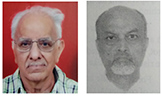
Kishin Wadhwaney (l) and Ravi Kant Srivastava
Wicket keeper batsman Jamshed (Jenni) Khudadad Irani who toured Australia in 1948 was born in Karachi in undivided India. He started his Ranji trophy career as a wicket keeper and number 10 batsman. Later, he improved so much that he opened the innings. Another stalwart of yesteryears was Phiroze (Pilloo) Edulji Palia, who was the youngest (22 years old) on the first tour to England in 1932. Palia had a long Ranji trophy career and continued playing till 1953 when he was 41 years old. Also on the historic 1932 tour was another Parsi, Sorabjee Hormusjee Colah, an athletic fielder who played in just two Tests.
There are also brief portraits of Parsi and other cricketers who played unofficial Tests. An outstanding fielder and competent batsman, Jamshed Nusserwanji Bhaya of Indore played two unofficial Tests against Australia and England in the 1930s. The hard-hitting batsman and medium pacer Dadabhoy Rustomji Havewala also played two Test matches against Lionel Tennyson’s touring England team in 1937-38. N. K.