Opposing the move to impeach the Chief Justice of India Dipak Misra, noted jurist Fali Nariman feared that the move would not only diminish the public faith but would open the door for the ruling party to move against a judge if it doesn’t like a particular judgment, reported The Indian Express (IE) of April 22, 2018.
"It is the blackest possible day. I have never seen a day like this. After 67 years, I have never seen anyone make such allegations. These are nothing. These are all election tactics,” Nariman told the newspaper. The Congress Party had, along with seven opposition parties in April, submitted a petition seeking Misra’s impeachment to the Vice President Venkaiah Naidu, with signatures from 71 parliamentarians. The petition was rejected by Naidu, primarily on the basis that the complaints were about administration and not misbehavior, and thus impeachment would seriously interfere with the constitutionally protected independence of the judiciary.
Nariman said that "impeachment of a judge, particularly a Chief Justice, can’t be on political considerations. It has to be on some merit. I find that there is nothing in the charges that have been made. The fact that the Chief Justice has imposed his orders on all the judges including the four judges who complain(ed) is not a matter of any charge at all. That is a matter between the Chief Justice and the four judges…There has to be one person who says which bench has to take what.” On January 12, four senior judges of the Supreme Court, Jasti Chelameswar, Ranjan Gogoi, Madan Lokur and Kurian Joseph addressed a press conference criticizing Misra’s style of administration and the allocation of cases.
Misra is the 45th Chief Justice of India and a former Chief Justice of the Patna and Delhi High Courts.
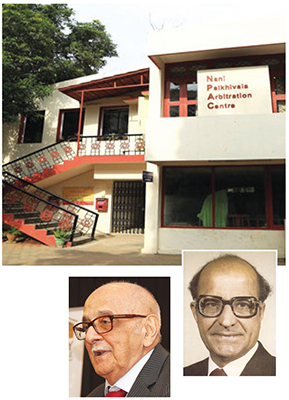
Top: Nani Palkhivala Arbitration Centre; inset Palkhivala; left: Fali Nariman (Photo: Jasmine D. Driver)
Speaking at the inauguration of the Delhi chapter of the Nani Palkhivala Arbitration Centre on April 27, the IE of April 28, 2018 quoted Nariman as stating that in the years after the emergency was lifted in 1977, lawyer-politicians could "truthfully” say that they were loyal to both institutions (Parliament and the court), but that is the case "no longer.”
"With the reemergence of a super-majoritarian government, as we had in the 1970s, things are different. Each MP (member of Parliament) who is a lawyer-politician has to (now) make a choice: loyal to (either) Parliament or loyal to the court. My suggestion is, they must be loyal to the Constitution,” Nariman counselled.
"If (the late noted constitutional jurist) Nani Palkhivala was a member of Parliament, he would not have been able to save the Constitution as he did,” Nariman added.