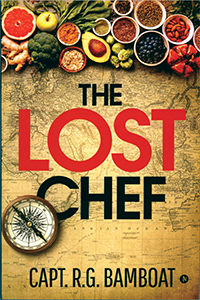
The Lost Chef by Capt R. G. Bamboat. Published in 2018 by Notion Press, Old No. 38, New No. 6, McNichols Road, Chetpet, Madras 600031. Pp: 284. Price: Rs 360.
 The blurb for The Lost Chef describes its author, Capt R. G. Bamboat (pictured), as a "boring, Indian, Parsi male. He captains a ship as a profession, and flies small planes (whenever he can) as his passion.” His varied interests include writing, sailing, planting trees, food and cooking.
Judging from this extraordinary work of fiction, the good captain also has a vivid imagination, a wry sense of humor and the ability to spin an engrossing yarn. As the title suggests, this is the story of an Indian chef who "gets lost in time and space.” The story is told by the nameless protagonist, working as a sous-chef in a five-star hotel in Bombay, who is excited about being transferred to "a remote location on some island close to Indonesia/Malaysia/Papua New Guinea.” Unfortunately for him, while flying to this unnamed destination, he wakes from restless sleep in mid-flight to discover that the plane is shaking violently, his fellow-passengers are screaming hysterically, and on regaining consciousness after the plane crashes, he finds himself on a dark, rain-drenched beach, still strapped in his aircraft seat, surrounded by debris from the plane.
After this promising beginning, the story meanders a bit as the hero, dazed and disoriented by his ordeal, gives us a blow-by-blow account of his struggle to stay alive on a small, uninhabited island, subsisting on raw fish, wild fruits and coconut water, using all the survival skills he vaguely remembers from television shows. Each minor triumph — such as succeeding in making a fire using driftwood and dried reeds to have his first cooked meal — is a major step towards survival. On the 68th day of his solitary struggle, his luck changes for the better: diving deep into one of the island’s lagoons for a refreshing swim, our hero retrieves from the seabed a piece of treasure that must have come from the crashed plane: a professional chef’s knife kit containing six knives of varying sizes and a meat cleaver. This discovery enables him to use the familiar tools of his trade to slice open coconuts, skin and fillet fish and makes his life much easier.
Unfortunately for him, his euphoria is short-lived as a few days later, a small sailboat lands on the island, with two short, dark brown men (referred to as Man-A and Man-B) on board, "clothed in nothing but a small loincloth around their waists.” Being in the wrong place at the wrong time, our hero is caught in the middle of a bloody battle between Man-A and Man-B, the latter seemingly hell bent on killing the former. While trying to defend himself from the spears and arrows that are being flung around by the two men, our hero accidentally kills Man-B, thus saving the life of Man-A. Instead of being grateful, Man-A takes our hero captive and sets sail for a neighboring island where Man-A’s father turns out to be the head of the tribe, whom our hero christens Old Chief Silver. Locked up in a cage, our hero is convinced he is being held captive by a tribe of cannibals and that the savages will made a meal of him soon. Served a succession of bland and tasteless meals by his jailers, the captive chef’s culinary instincts come to the fore as he fantasizes about the delectable treats he could dish out for his captors. Of course, as he reminds himself repeatedly, there is the ever-present danger that he could end up being the main course!
 The narrative gathers pace as our hero overcomes his misconceptions and begins to adapt to the tribesmen and they to him. The secret weapon in his arsenal is, of course, his culinary expertise, so he wins over the hearts, minds and tastebuds of the tribesmen with creative and delectable cuisine. He quickly learns the tribe’s language, falls in love with the chief’s "slim and trim” daughter, and becomes a valued and respected adviser to Old Chief Silver in peace and war. But then, the plot gets bogged down in detailing the ingredients and recipes the hero devises to serve up to the tribals and also dwells at great length on the intricacies of the bows, arrows, spears and other weaponry and strategies deployed when facing vicious attacks from warring tribes from neighboring islands. The focus on cookery and warfare detracts from the main question looming in the reader’s mind: how will this fantastical adventure end for the hero?
All in all, Bamboat has put together an inventive tale of survival against the odds in what appears to be a primitive culture trapped in a bygone age. The tone of mystery and wonderment is set in the book’s opening paragraph: "The year was somewhere in the future. At least I thought it was so, initially, when the plane crashed. Or the past. Truth is, I still do not know if I travelled through time, or that I simply got trapped in a lost civilization. Either ways, this is my story and, frankly, sometimes even I have difficulty believing it.”
Like all good writing, Bamboat builds up the reader’s curiosity and keeps us wondering — even at the end — as to how much of the tale is true and how much of it fantasy and whether it is possible to travel through time. All in all, it is a well told and captivating story which would have been far more effective if it had been more concise.
DELSHAD KARANJIA
Karanjia has worked as a journalist in India, UK, US and Saudi Arabia. Now settled in Poona, she continues to freelance as a writer and editor.