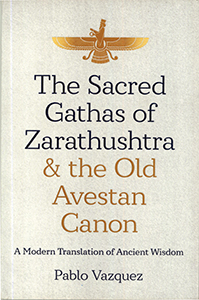
The Sacred Gathas of Zarathushtra & the Old Avestan Canon: A Modern Translation of Ancient Wisdom by Pablo Vazquez. Published in 2022 by Mantra Books, an imprint of John Hunt Publishing Ltd, No. 3 East Street, Alresford, Hampshire SO24 9EE, UK; email: office@jpbooks.com; website: www.mantra-books.net. Pp: 63. Price: UK £ 8.99; US $ 10.95.
Pablo Vazquez (pictured Photo: Ana Verahrami), who now lives in the US, became a Zoroastrian in 2018. In the preface to his book, The Sacred Gathas of Zarathushtra & the Old Avestan Canon, he says, "This translation is my gift back to Masdayasna as it is the source of not just my journey towards the path of Asha but also the very core of my ethics.” A beautiful thought.

His biography does not mention what undergraduate degree he earned from which university, but states that he obtained a master’s degree "in Religions of Asia and Africa from School of Oriental and African Studies (SOAS) University of London,” focusing on "Zoroastrianism, Kurdish studies, and new religious movements,” during the course of which he studied "Zoroastrian history, theology, and the Avestan language among other topics from some of the top scholars in the field.” And that he currently is working on a second graduate degree, "an MDiv at Starr King in the USA.”
According to the SOAS website, its masters’ degree requires one (academic) year to complete. With respect, I question whether studying Avestan for one year would give a student sufficient knowledge to translate the Gathas and other Old Avestan texts or the Yenghe Hatam (which is in archaic Younger Avestan) — especially since during that one year the Avestan language was not the sole, or even primary, focus of his studies.
In his book of 63 pages, author Vazquez offers "Translator’s Notes,” an "Avestan Glossary” (of approximately nine terms) and translations of the Yatha Ahu Vairyo, Ashem Vohu, Yenghe Hatam, the five Gathas, and the Airyema Ishyo.
First, some background.
In Zarathushtra’s society, there were no books, television, movies, etc. So songs, word games, riddles and puzzles, provided both knowledge and entertainment. One has only to recall the legendary Yoishta who (in the Aban Yasht) prayed that he might answer the 99 "hard riddles” that his adversary asked him "maliciously” to appreciate the entertainment value that riddles, puzzles and word games had for ancient Iranians. Zarathushtra’s teachings are simple, beautiful, profound — and revolutionary (for his time period). And his Gathas are full of word games and puzzles which would have entertained and provoked thought, as people sang these songs, resulting in "Eureka!” moments of discovery. Today, with the time pressures in our lives, (and other available entertainment) we look for Gatha translations that are simple, easy. In so doing, we miss a lot.
So the question arises: Do the simple, easy translations in this book reflect Zarathushtra’s thoughts, or of author Vazquez’s? I will offer a few highlights and readers can decide for themselves.
I like that the author calls the religion by its most ancient name — Mazdayasna (which means "worship of wisdom.” Avestan script has no capital letters). "Zoroastrianism” is an invention of modern scholars based on the founder’s name in Latin: "Zoroaster”). So kudos to the author for so doing.
In his "Translator’s Notes” the author "avoided using terms like ‘good’ or ‘evil,’” which he thinks reflect the cultural bias of "Abrahamic” thinking. But (with respect) that is not accurate. Avestan’s vohu-/vahu- "good,” has roots that go back to its ancestral languages that existed around roughly 4,000+ BCE — long before the advent of "Abrahamic” religions.
But even more important: "good” is at the very core of Zarathushtra’s teachings, which in ancient times was also called "(the) Religion of Goodness” (din-i-behi).
Instead of "good,” author Vazquez prefers "virtuous” which, in my view, lacks the generosity that in the Gathas is a part of vohu- "good.”
One of Zarathushtra’s most beautiful (and revolutionary) teachings is that we should be truthful for truth’s own sake. This idea appears throughout the Gathas in subtle and lovely ways; and also in the Ashem Vohu, translations of which vary greatly except they agree that it speaks of truth for truth’s own most-good sake. The Vazquez translation is eloquent. But this core idea is absent: "Asha is virtuous and magnificent, and joy upon joy is what Asha provides, for this is Asha Vahishta.”
A final example: Zarathushtra tells us to heal existence (with goodness, generosity, truth). And he concludes: "Therefore may we be those who shall heal this world!” (Y30:9, Dr Stanley Insler 1975). The Vazquez translation: "We thus desire to be those who will bring magnificence to what exists.” Y30:9.
What are we to make of translations that eliminate so many of Zarathushtra’s key teachings, even though such translations sound eloquent? The foregoing are just a few examples. There are many, many more. And that troubles me.
If more people followed Zarathushtra’s teachings, it would truly heal existence. So we should welcome, value, befriend, nurture, protect, new Mazdayasnis. But truth is an imperative.
In closing, I wish for Pablo Vazquez what is most good, in Zarathushtra’s own words (which you will not find in the Vazquez translation of this verse).
"(I wish) for this person [vahishta- ‘(the) most good’] of all things… (which)… place(s) a person of good purpose in happiness: to be understanding all his days, with the joy of long life, understanding (thaw…spenishta mainyu mazda) ‘through-thy most-beneficial way-of-being, wisdom’.” (Y43:2 Insler 1975).
DINA G. MCINTYRE
McIntyre, who studied science and law in the United States where she resides, became interested in Zoroastrian theology in the early 80s and has studied the Gathas on her own since 1982, relying primarily on Prof Dr Stanley Insler’s translations.