Nani A. Palkhivala: A Life by M.V. Kamath. Published in 2007 by Hay House Publications (India) Pvt Ltd, Muskaan Complex, Plot No 3, B-2 Vasant Kunj, New Delhi 110070, Pp: 524. Price: Rs 450.
Arnavaz S. Mama
Nani A. Palkhivala: A Life by M.V. Kamath. Published in 2007 by Hay House Publications (India) Pvt Ltd, Muskaan Complex, Plot No 3, B-2 Vasant Kunj, New Delhi 110070, Pp: 524. Price: Rs 450.
To those of us who grew up in Nani Palkhivala’s national shadow, his very presence created a sense of security — that his fertile mind would have an answer to any economic, fiscal or legal problem. For the younger generation to meet him, greet him, was a thrill. For Palkhivala acknowledged any one who did. As for Parsi businessmen discussing any new amendment, the question invariably would be, "Nani su kéch (What’s Nani’s opinion)?”
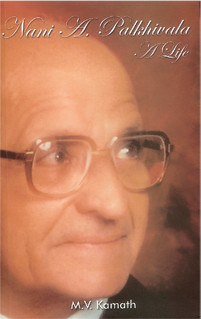
So it was with a happy sense of expectation that we perused Kamath’s recreation of one of the most potent careers in post Independence India. At the outset, the introduction by Yezdi Malegam, chairman of the Nani A. Palkhivala Memorial Trust board that commissioned the book notes, "Kamath’s book is not a biography in the conventional style of a chronological record of the significant events in Nani’s life. Rather, it is a journey that documents Nani’s contemporary perception of the critical issues that arose in the evolving national landscape… Many of the propositions he advocated may now be taken for granted, but when they were made, they were opposed to prevailing government policies and current thinking, and it needed courage to advance them… The ultimate tragedy was that when…India began to assume its rightful place in the world economy, his health betrayed him and rendered him oblivious to the resurgence which he had so eagerly anticipated and to which he had so significantly contributed.”
Kamath’s research reveals that at a time when the principal mode of transport in the city for the well-to-do was by palanquin, Nani’s ancestors were involved in the manufacture of palkhis, the best available, explaining both the family name and the penchant for excellence that was to be Nani’s hallmark. Then, as in later years, people were willing to wait their turn for a superlative product/service. Kamath quotes from an earlier interview when Nani was asked to explain his constant pursuit of excellence. Referring to the family’s history as palkhi builders, Nani told the interviewer, "The striving for excellence was something which was inculcated in me even as a small boy…My father’s was an emotional and sensitive nature. He taught me the rules of conduct which I have tried to follow…I had learnt when I was quite young that…there is no shortcut to excellence. It is just sheer hard work, dedicated work and the desire to do your level best.” As Nani was to reminisce when he was nearly 68, "I had a happy childhood…Circumstances compelled us to live frugally, to understand the value of money, and to experience some of the privations which are a part of humanity’s immemorial pain.” He grew up consuming books by the score, initially at the Popular Book Depot on Lamington Road – a free access that he recalled gratefully in later years; learning carpentry and the violin, playing with the Young Men’s Parsi Orchestra at navjotes and weddings; graduating in English and Persian from St Xavier’s College, meeting there his future wife Nargesh.
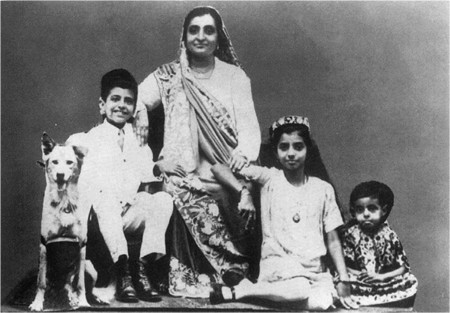
Above: Nani (ext L) with mother Sheherbanoo, sister Amy and brother Behram. Above: Cover of the book
Palkhivala’s prescience had an early start. In an article in the Jam-e-Jamshed (October 27, 1937) when he was all of 17 years, he wrote criticizing the introduction of prohibition in Bombay province: "The government which tries to do more than it ought to, will do less. Prohibition of toddy means the promotion of something worse…Politics is a bundle of policies and the Congress politics is a bundle of mistaken-for-profoundly-patriotic policies…” "Seventeen-year-old Nani’s regular columns ‘Mild and Bitter’ and ‘A Handful of Ashes’ were to become popular with the public,” notes Kamath.
Was Nani a fatalist? asks Kamath, asserting, "One suspects that he was.” The author quotes Nani from an interview: "I do believe there is a destiny that shapes our ends. I share the faith of Malcolm Muggeridge that in all the larger shaping of life, there is a plan into which one has no choice but to fit.” He is said to have consciously decided not to have children. Even prior to his marriage at the age of 25 he is supposed to have told Nargesh, "I don’t wish to have children. I love children and if I have them, it would be my responsibility to look after them and bring them up. But I will have no time. I know that I have to work for my nation, my country and the world, and that will take up all my time.”
"For all his aggressiveness, Nani wanted his clients to obey the law... (But he) did not need anyone to ask him to plead for justice. If he saw injustice being done, he was quick to respond to it as if the injustice were done to him personally,” writes Kamath quoting a press statement Palkhivala issued when he heard that Mother Teresa was likely to be charged income tax on the Nobel Prize she had received in 1979. At the end of a decisive argument Palkhivala noted, "In my opinion, the matter is so clear that the Finance Ministry should accept with grace the position that it is not entitled to any bite out of the moneys which are to go to the poorest of the poor. To drive Mother Teresa to litigation would be an act of national disgrace. The law may be an ass, but it is not asinine enough to seek to tax a prize which is a token of humanity’s gratitude to a saint.” Notes Kamath, "And that ended the matter.”
He fought the spiraling taxation not only for its own sake but for what it was doing to the national character. Witnessing tax evasion in a number of forms he expressed his dismay to the accounting professionals of whom he was a part: "This kind of thing is very reprehensible and if a professional man was party to it, frankly, I would be surprised if he can sleep well at night…a nation’s strength lies not so much in its wealth as in its character.” "As he saw it, black money was the offspring of the union of taxes and controls,” writes Kamath quoting Nani’s article in The Illustrated Weekly of India (October 25, 1981): "The termites of the black market have eaten grievously into the fabric of our national economy…Even more dangerous than black income is the public acceptance of it and of its concomitant political corruption.” Nani’s battles with the mandarins of the Finance Ministry did not stop at income and wealth tax. His potent arguments, doused with sarcasm, led to government rethink on road tax, octroi, service tax as well as attempts to tax Time magazine on the ground of business connection under income tax.
Similarly Kamath takes us through Nani’s years as director of Tata Sons, as chairman of the Associated Cement Companies (ACC) and Tata Consultancy Services (TCS), of the efforts to save the income of the Tata Trusts in the face of nationalization and amendments in the Companies Act. He was India’s counsel in the Sind-Kutch border dispute with Pakistan before the World Court but it is Palkhivala’s many performances before the Supreme Court of India, each time proving the malafides of government vis-à-vis the abolishing of Privy Purses, and later in the Golaknath and Kesavananda Bharati cases, which established the supremacy of fundamental rights in the Constitution, which captured the imagination of the Indian public.
In the Golaknath case, decided in February 1967, the Supreme Court’s verdict put a bar on Parliament’s right to take away or abridge any of the fundamental rights. But Parliament, after the mandate of the mid term poll, reasserted its right through the 24th Amendment and by the 25th Amendment sought to prevent any court from challenging social legislation that aimed at redistribution of wealth. Kesavananda Bharati challenged these amendments as also the 29th Amendment which protected the Kerala land reforms legislation. Nani argued that to grant Parliament unlimited amending power "is to make the creature of the Constitution its master.” He further argued that if Parliament has unlimited amending power, it could "abolish the judiciary and other organs of state, abrogate all basic human freedoms, and convert democracy into a dictatorship; or it can abolish all states and make India a unitary state…Parliament in exercise of its amending power cannot arrogate to itself the role of the Official Liquidator of the Constitution…” "His favorite method of laying bare the fallacy of an argument was to drive home the consequences of accepting that argument as correct,” notes Kamath.
When the majority judgment came in April 1973, a month after the close of arguments that spanned 67 days, it ruled that though the Parliament can amend any part of the Constitution it cannot alter its basic structure or framework. In 1975, at the height of the Emergency, Chief Justice A. N. Ray again convened a full bench of 13 judges on an oral application of the government to reconsider the limitation to Parliament’s amending power as defined by the Kesavananda Bharati case. Kamath quotes jurist Fali Nariman:
"This was Palkhivala’s finest hour. He argued for two days, eloquently protesting against the union government’s application for reconsideration of the Kesavananda decision: some of the judges accepted his argument on the very first day, the others on the next – except the chief justice, who, by the end of the second day, was almost reduced to a minority of one.
Budget analysis at the Brabourne Stadium
"When the court assembled on the morning of November 12, 1975 Chief Justice Ray threw in the towel: he tersely informed counsel appearing before the court that the bench was dissolved, and the judges rose: an inglorious end to an unmeritorious beginning. The brief proceedings do not find a place in any of the Law Reports nor, in fact, in the annals of the Supreme Court of India. There is no record of the order passed. Only a mention of it in that invaluable work by India’s leading constitutional historian, H. M. Seervai.
"But Justice Khanna was on the bench (the great Khanna whom we all love, respect and revere); and it is Khanna who recalls in his memoirs that ‘the height of eloquence to which Palkhivala had risen has seldom been equaled and has never been surpassed in the history of the Supreme Court.’”
Among Nani’s many acts of bravery the best known is his return of Prime Minister Indira Gandhi’s brief — she whom the Allahabad High Court had held guilty of corrupt election practice and invalidated her election. Nani had agreed to defend her in the Supreme Court but when overnight she imposed the Emergency and assumed sweeping powers under it, he opted out, telling the law minister, "This is not something that can be discussed and negotiated. I am just communicating the fact that I will not appear for her.”
Kamath records Nani’s two sterling years as India’s ambassador to the US which were followed by sorrow and despair at the "poor quality of the average Indian politician” as the shenanigans of the Janata Government laid the road open for the return of Indira Gandhi. He resumed his post-budget speeches which had been interrupted by his assignment in Washington. There was no stopping the surging crowds that gathered to hear his humor and anecdote packed dissection of the budget proposals at the Brabourne Stadium. An annual event that began in 1958 under the aegis of the Forum of Free Enterprise – the very name was anathema to the socialist Jawaharlal Nehru – continued until 1994. "On the night of November 1, 1994 Nani was awoken at 2.30 a.m. He sat up and heard his inner voice repeatedly telling him that from next year on, he should not give his annual budget lecture. It was practically a command, and Nani accepted it,” writes Kamath.
"In India today there are shortages of many commodities, but nothing is so scarce as intellectual integrity…The treason of the intellectual consists in his not speaking out loud and clear for the values that he, by his vision and the very nature of his personality, holds sacred,” he noted in his convocation address to Bangalore University in 1972. "What the country needs is dirtier fingernails and cleaner minds,” he told Karnataka University graduates in 1974. At the Xavier Labour Relations Institute in Jamshedpur he said, "It is important that citizens obey the law. It is even more important that citizens obey the high standards of decency which are not enforced by the law but are the hallmark of a truly civilized and mature democracy.”
But frustration and despair at the declining standards of public morality were eating into his vitals. "The country can never prosper or be saved through the efforts of ministers and civil servants. The people must be associated at all stages with the formulation and implementation of policies,” he contended. He felt the spiritual call and though he visited and honored spiritual leaders of all hues, his faith in Zoroastrian values was strong. Distinguishing between the teachings of the Prophet and contemporary ritualistic practice, he was wont to say, "Zoroastrianism has been tried and failed. The religion of Zarathushtra is yet to be tried.”
Kamath’s book is a memorial to the public persona. Though the latter chapters refer to Palkhivala’s depression in his final years, one wonders if the man would come alive to a reader who had not had a personal brush with Palkhivala. Kamath has concentrated heavily on his many battles with government. Were there no moments of self questioning? Of self doubt? What did he think of India’s runaway population growth that so preoccupied J. R. D. Tata? What was his reaction, for example, to the Bofors controversy? One wishes that Kamath could have laid bare the private Nani so that the reader could empathize with the personal conflicts as well as applaud the public triumphs.