Reflections on life, love and a day
Roy Wadia
On September 6, 2018, the Supreme Court (SC) of India read down key portions of Section 377 of the Indian Penal Code, effectively decriminalizing homosexuality — a milestone literally decades in the making. For millions upon millions of LGBTIQ (lesbian, gay, bisexual, transgender, intersex, and questioning) individuals in India, the development is life-changing.
Even as a child, growing up in the Bombay of the ’60s and ’70s, I knew I was ‘different.’
Others knew it too.
Bullied at school after school for my effeminate ways, I quickly learnt that survival meant subterfuge — hiding my mannerisms as best as I could, laughing with the other boys at jokes about sex, even trying to date girls in my teens and early 20s — all the while living a lie, thirsting to break free and eventually doing so by escaping to America in 1986, ostensibly for graduate studies in journalism, but really, to be myself.
Roy Wadia (l) and Alan Hsiung at their wedding in Vancouver, 2008
A poster of BOMgAY with Rahul Bose, 1996
As a youth exploring my sexuality in Bombay, 377 was just another layer added to the widespread homophobia that surrounded me — not within my liberal Parsi household headed by my grandfather Jamshed "JBH” Wadia, the pioneering filmmaker of early Indian cinema, but in practically every other sphere of life.
I came to realize as well that my own Parsi family was more the exception rather than the rule when it came to openness and acceptance of diverse lifestyles. I recall my parents discussing with me the theme of bisexuality in the adult-rated movie Cabaret, which they allowed me to watch when I was 14, smuggling me into Sterling cinema with my mother’s eye shadow used to paint false stubble onto my upper lip (I’m pretty sure the usher saw through the ruse, but we were frequent patrons and knew the manager)!
Other Parsi families — school friends’ parents or some of my parents’ acquaintances — were not as live-and-let-live. I recall jokes about "pansies” in Parsi Gujarati stage comedies and those I Love Bombay revues — the actors employing limp wrists and high-pitched tones to drive home the point.
There was also the example of the flamboyant Bomsi Nicholson who played the lead gay role in two productions of Ah, Norman! several years apart, the first (and even the second?) directed by Adi Marzban, Bomsi’s falsetto and camp personality milked to the hilt for laughs.
When Nicholson succumbed to AIDS (acquired immuno deficiency syndrome) a few years after returning to Bombay following a long stint overseas, I remember the callous, cruel remarks uttered by "high society,” including Parsis we knew, that he somehow "deserved” it, that it wasn’t really a surprise given the "way he was.” Homophobia and ignorance are universal, cutting across all communities, nationalities and borders. Being a Parsi in no way makes one immune to this scourge.
When I was a teen with hormones hopping, I heard of quite a few gay men who’d been entrapped and blackmailed by police or were otherwise targeted via rumors and innuendo. This seemingly doomed-to-loneliness life of furtive encounters wasn’t one that I wanted to lead — a far cry from the inspiring vision presented by the almost 60-year-long companionship my paternal grandparents enjoyed, a domestic ideal I yearned to achieve for myself.
Ironically, in the southern United States where I ended up, the state of Georgia specifically, anti-sodomy laws were also very much on the books, although the LGBT rights movement in the late ’80s was in full swing, heightened further by the rapid spread of a virus decimating our communities — HIV (human immunodeficiency virus).
Through meandering pathways to the US SC in the years that followed, landmark cases eventually succeeded in overturning legalized bigotry nationwide, striking down statutes that had no place in a country that billed itself a global leader — however imperfect — of human rights.
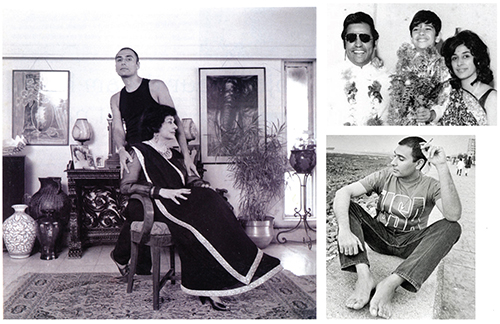
Clockwise from above l: Portrait of Riyad and Nargis Wadia by Dayanita Singh;
Roy with parents Vinci and Nargis at his navjote, 1972; Riyad Wadia, 2003
Having miraculously found my life partner while we were both international students in the United States, I was far more consumed with developments there than in the land of my birth, as every legal twist and turn impacted us in myriad ways — property ownership and taxes, hospital visitation rights in an emergency, health and life insurance, and, of course, the seeming (im)possibility of the ultimate vision for so many of us — same-sex marriage.
Eventually, we had to leave our country of naturalized citizenship, the US, for our neighbor up north, Canada, to realize our dream of marriage.
On a sunny June afternoon in Vancouver in 2008, with close friends as witnesses, both Alan Hsiung and I were unprepared for the wave of emotion that came over us as the marriage commissioner instructed us to repeat the vows after her, exchanging identical rings that had been purchased two decades earlier in Atlanta in anticipation of this very day.
Little did I know as we raised champagne glasses afterwards that I would be forced to return to Mother India later that year, to tackle urgent family and legal issues that landed in my lap when my father passed away.
Reconnected with a new generation of LGBTIQ activists and immersed in the world of HIV activism via the NGO (nongovermental organization) Heroes AIDS Project by serving as its executive director, I came face to face with Section 377 again, witnessing its debilitating impact on so many souls, including some of the most vulnerable among us – sex workers, men who have sex with men, transgender persons — a law that not only targeted sexual activity, but at its heart robbed human beings of their right to live and love, of their pride, of their dignity.
Ironically, as I fought court cases in Bombay, I realized that even I — "foreign-returned” and from a well-known Parsi family — wasn’t immune to the effects of 377.
My sexuality was used against me in not-so-subtle ways by certain opponents who sought to poison powerful politicians and other influentials against me, and even a dear friend who was a renowned lawyer told me that in the eyes of many judges and the police, I was "worse than the worst criminal.”
Indeed, when the SC reinstated 377 on December 11, 2013, my lawyer friend called me in a near-panic, recommending I remove all my Facebook posts that included references to my personal life. A well-known journalist from The Times of India contacted me as well, wanting to investigate related "complaints” that my "immoral lifestyle” went against the ethos of the "pure society” in which we lived.
Bemused, and yes, somewhat apprehensive, it struck me anew that if I, inoculated as I was in so many ways, could experience attacks like these, how must life be for millions and millions of others who had no support systems, no parents or friends who would shield them from barbs, and worse, no recourse to the resources I had.
Through my work, I also came into contact with many people who were HIV positive, but too afraid to reveal their status, in part because of 377 and its insidious impact. Yes, there were support groups that did amazing work, but to have to look over your shoulder day and night, to be paranoid about being caught or targeted – is that any way to live?
I left Bombay for Bangkok in 2015, to join the United Nations Population Fund (UNFPA, orginally United Nations Fund for Population Activities), an agency that has gender equality, rights and choice at its center. The work I’ve been doing here on sexual and reproductive health and other issues that touch upon the very core of our human experience, the most intimate and personal aspects of our lives, has been genuinely enlightening and inspiring.
In fact, when the news of the SC ruling broke on September 6, I was at a UNESCO (United Nations Educational, Scientific and Cultural Organization) sponsored conference in Bangkok on the importance of comprehensive sexuality education – life-skills for young people that go beyond sex, to build and strengthen a foundation for life and love.
The moment I read the headlines, I broke down, dissolving into tears of joy and, yes, pain as well.
Joy for what the ruling meant going forward, and pain for the countless lives damaged and destroyed by stigma and discrimination, including the worst form of them all – self-hatred, a feeling of worthlessness that so many individuals who’ve been targets of 377 feel, including my late, beloved baby brother Riyad — flamboyant and confident from the outside, but wracked with negativity, possibly even self-loathing, within, as he refused medication for his HIV, eventually succumbing to AIDS. His activism, as India’s first openly gay filmmaker, is one chapter in the book of struggle that’s contributed to the SC outcome. To him, and the many heroes who have been part of this amazing story, a huge thanks.
The work is far from over, however.
Changing an archaic law is relatively easy. Changing minds and hearts, including within our own Parsi community, will take more time until genuine acceptance and equality are universal.
We will need new laws that strengthen our status in society and protect our rights all the more, including, dare we dream, gay marriage.
We will need to be prepared to counter the backlash against our communities – a backlash that’s already being articulated by way of so-called religious leaders who’re vowing to continue their fight against equality for all.
Perhaps Section 377’s demise will give birth to newfound courage, as many who’ve been in the closet for so long may, just may, choose to speak out, thereby proving that we’re not the "minuscule minority” that an earlier SC two-judge bench dismissively referred to us as.
But, for the moment, let’s savor what’s occurred. September 6, was indeed a historic day — a day that has added to the ongoing transformation of Indian society, a transformation wrought by life and love.
I am very lucky to have experienced it.
Roy Wadia is currently the regional communications advisor for the United Nations Population Fund’s Asia-Pacific office in Bangkok. He is married to Alan Hsiung, his partner of almost 30 years.