Speakers and panelists at the 12th World Zoroastrian Congress reiterated the essence of religion is to spread happiness and not divisiveness
Text: Parinaz M.Gandhi • Photos: Jasmine D. Driver
Subject to public order, morality and health and to the other provisions of this part, all persons are equally entitled to freedom of conscience and the right freely to profess, practise and propagate religion.” Stressing on the words "all… equally… freely,” from Article 25 of the Constitution of India, Justice Rohinton Nariman (retd) explained to the audience at the 12th World Zoroastrian Congress (12WZC) in New York how a Parsi lady in India has the fundamental right "to equally and freely profess, practise and propagate her religion (to her children), no matter who she may be married to.”
Justice Rohinton Nariman (retd): "law seems to be clear"
Prof Kaikhosrov Irani: respected savant
Delivering his keynote address on the first day of the Congress, July 1, 2022, on "Gender Equality: The Rights of Parsi Women after the Advent of the Constitution of India,” the retired judge of the Supreme Court narrated in detail the landmark legal cases that continue to govern Parsi women in India. He was disappointed that archaic judgments continue to be applicable despite the preamble of the Constitution of India granting to every citizen "liberty, equality, fraternity” with "liberty of thought, belief, faith, worship” further expounded in the section on fundamental rights.
Considered an expert in comparative constitutional law and civil law, for his LLM degree from Harvard Law School, Nariman had submitted a thesis entitled "Affirmative Action: A Comparison between Indian and US Constitutional Law.” Access Now, an international human rights organization, has recently recognized him as one of the five "World Heroes” for his judgment declaring the right to privacy as a fundamental right under Article 21 of the Constitution of India.
Even though a woman may have the fundamental right to practice her religion, "constitutional pundits” may say fundamental rights can only be granted by "the state and not an individual.” Nariman therefore cited Article 13 which stipulates, "all laws in force contrary to the fundamental rights, shall be void and have no effect. If custom/usage recognizes only Parsi male, and not female, out it goes.” The applicability of Article 25 would be similar to untouchability (under Article 17) and beghar (slavery, under Article 23) being forbidden and in fact made punishable offences. "Post our 1950 Constitution, the law seems to be clear but unfortunately there is no clear judgment as yet” on Parsi women being entitled to equal rights, noted Nariman.
He traced the genesis of the archaic "ethno-religious laws” that are partial to Parsi males. In 1903, J. R. D. Tata’s father, Ratan, then a widower in his 40s, fell in love with a French woman Suzanne, nearly half his age, and decided to get married to her. Her navjote, with 60 priests in attendance, was done at the house of his friend R. D. Sethna. The wedding was performed the same evening. "There was a furor in the community as can be expected,” reported Nariman. "The Parsi Punchayet called a meeting of the entire community when it was decided to appoint a committee. That committee decided to adopt a subcommittee which in turn appointed an expert committee.”
This expert committee comprising high priests and scholars opined "by a majority of nine against two that Zoroastrianism is a proselytizing religion that believes in conversion.” It went on to state that if someone who has neither a Parsi father nor a Parsi mother wishes to be a Zoroastrian, the doors are not closed to her or him. The expert committee though recommended that the community should set up a committee to establish the bona fides of the person who wishes to be converted by "putting him on probation for a year and if found suitable, to perform the navjote after nine nights of bareshnoom.” The Parsi majlis (assembly) though "thumpingly turned down the expert committee report,” so the Punchayet decided that only children of both Parsi parents would be recognized as Parsis. It subsequently issued a corrigendum that as per prevailing custom and usage, even children of Parsi father and an "alien” mother could be recognized as Parsis.
R. D. Sethna went to court along with six others, including Ratan’s cousin, Sir Ratan Tata. The five trustees of the Punchayet were made defendants. This 1906 (Petit vs Jeejeebhoy) case in the Bombay High Court before Justices Dinshaw Davar and Frank Beaman had to decide on two issues: the validity of the trust and trustees; and who is a Parsi Zoroastrian? This case also bore reference to another couple, a navjoted Rajput mistress of a Parsi man who had borne him several children. Put before the court were three instances of conversion on Indian soil: In the Dhoop Nirang prayer (recited by an officiating priest during an uthamna ceremony when he offers loban to the fire) feature names of three Hindus (Bio Pandit, Djsul Pandit and Schobul Pandit) who were believed to be converts to Zoroastrianism. The second instance concerned King Akbar and his Ibadat Khana, the council of world religions, attended by Mahiyarji Rana. So impressed was Akbar by Mahiyarji that the emperor chose to have a fire burning in his court, adopted a Zoroastrian calendar, had Jamshedi Navroz celebrated like Diwali and was even said to be invested with the sudreh-kusti. Also on record are the 1882 Mazgaon converts when 11 individuals, aged between 35-70 years, born of Parsi fathers and dubra (low caste) mothers, were navjoted. While Davar debunked the theories of Hindu pandits and Akbar being converted, he was willing to accept the proof of Mazgaon navjotes for they were children of a Parsi father.
Although the suit stretched for a long time it was ultimately declared obiter dicta, not maintainable. This was because Suzanne was not made a plaintiff and hence not bound by the judgment/decree that followed. The three categories of Parsi Zoroastrians spelt out in the judgments were the same as those laid down in the written statement by the Parsi Punchayet: original descendants of those who came to India with both Parsi parents; descendants of Irani Zoroastrians who came to India, temporarily or otherwise; and children of Parsi fathers and alien mothers. "Thus race or ethnicity was brought into a purely religious matter,” pointed out Nariman.
Since the judges had remarked "put yourself in the place of the Parsi settlors,” Nariman declared, "If I were to put myself in the place of 18th century settlor (who created community institutions and facilities) I have not the slightest doubt that they would have admitted Suzanne. First and foremost she was the wife of an extremely prominent Bombay Parsi businessman. Further, she was French and so a Parsi would not look at her with the jaundiced eye of a caste Hindu. In the case of the Rajput lady, this problem could have arisen. So the baby was thrown out with the bath water. No one appealed to the Privy Council.” The verdict was thus sealed.
The other landmark case of Saklat vs Bella originating in Rangoon is the tale of three brothers — the eldest Merwanjee Cawasji Captain from the orthodox bastion, the second brother Bomanji, an advocate who was a bachelor, and the youngest Shapoorji who adopted Bella after the death of her mother Rebekah Jones. Bomanji, probably the father of Bella, left for England soon after Bella’s birth, leaving the baby with Shapoorji who brought her up. When Bella was around 14 years old, Shapoorji decided to navjote the girl but since the local priest declined, Kaikobad Dastoor from Poona was summoned to perform the navjote after which she entered the agiary.
The eldest brother filed a suit, along with another gentleman called Saklat claiming the agiary was desecrated by her presence. The case went to the first court in Rangoon and then the appeal court, the Privy Council in London, that adopted Davar’s formula when defining a Parsi Zoroastrian although it held that there was no desecration caused to the temple by Bella’s presence. The judges further held that the trustees of an agiary can make a distinction between property and the right to worship, using their discretion to permit entry to those they found religiously suitable. To forestall Bomanji, then being the sole trustee of the Rangoon agiary, from granting entry to Bella, Merwanjee appointed other trustees.
Although Davar and Beaman were shown an 1872 Act where the term Parsi was meant to connotate a Zoroastrian, Davar refused to accept that. However in the case of Sarwar Yezdiar vs Merwan Yezdiar in 1960, the terms have been used interchangeably. In Iran, Muslims were known to refer to Zoroastrians as Parsis. The Parsi Marriage and Divorce Act of 1936 speaks of "Parsi” religion, specifying that if one of the partners gives it up, it can be a ground for divorce. "We came to preserve our religion, not to preserve our ethnicity,” reiterated Nariman.
The law as it stands does not permit girls who marry "alien” husbands to bring up their children as Parsi Zoroastrians. Change can come in one of two ways: The legislation route, if the community demands it, just as it had in 1988 for changes in their succession laws. Nariman though doubted whether "people in Bombay or even in other places in India are ready to petition the government to change our laws for (outmarried) women and children to be admitted. So the only route is for a constitutional bench to authoritatively pronounce on Article 25.”
Nariman cited verses from the Gathas like Yasna 46.10 that state: "Whichever men/women follow the path of Asha, I, Zarathushtra will be there to ferry them across Chinvat Pul (bridge of reckoning).” Yasna 46.12 refers to a Turanian man called Framna gaining admittance into the faith. The vision of the Gathas is very clear in Yasna 30.2 (Ahunavaiti Gatha) and Yasna 45 (Ushtavaiti Gatha) beseeching each person to choose for himself, aright. "Let us hope (in litigations concerning the rights of Zoroastrian women currently before the Supreme Court) the constitutional bench looks at the vision of Zarathushtra and the great transformative vision of the Constitution of India,” urged Nariman.
The talk was delivered as the Prof Kaikhosrov Dinshaw Irani Memorial Lecture in memory of the academician, educator, scholar of the Zarathushti religion, on whose passing away in 2017 at the age of 95 his wealth, estimated at USD 2.6 million (Rs 18.1 crores), was bequeathed to The Zarathushtrian Assembly, Zoroastrian Association of Greater New York (ZAGNY), World Zoroastrian Organisation (WZO) and Federation of Zoroastrian Associations of North America (FEZANA) to ensure that the Zarathushti religion lives on forever. Describing Irani as a "very, very dear friend,” Nariman opined that he could be best described as a philosopher and then a music lover. "He didn’t just teach philosophy, he practiced it,” said Nariman referring to the time when Kaikhosrov’s wife Piroja was paralyzed and Nariman had commented that he would find it difficult to look after her without any domestic help. Kaikhosrov very philosophically responded, "When she was able, she looked after me. I continue to be able, I will look after her.”
Passion and compassion
How important is your Zoroastrian identity? To 67% in the audience it was very important and to 29%, somewhat important. How strongly do you agree with the statement "I feel like I belong to the Zoroastrian community?” Sixty-three percent strongly agreed, 24% somewhat agreed. This exercise was undertaken by moderator Keki Dadachanji as he set the tone for the panel session on "Identity, Belonging and Community in Zoroastrianism.” The delegates attending this session at the 12WZC were asked these questions and instructed to submit their replies using their smartphones, for which the percentage responses were instantly flashed on the screens at the Ballroom of New York Hilton Midtown on July 2.
Four Zoroastrian panelists from interfaith families, with diverse backgrounds, shared their feelings, aspirations, frustrations, joys and hopes. As Dadachanji noted, "Hearing experiences in their words will foster respect.”
Besides taking classes on the Gathas in the tristate area, as a faculty member at the Osher Lifelong Learning Institute — Rutgers University, Dadachanji has taught courses in philosophy, spirituality and world cinema. With a PhD in operations research, Dadachanji was a senior manager at M&M/Mars and a teacher of mathematics and computer science at Parsippany High School.
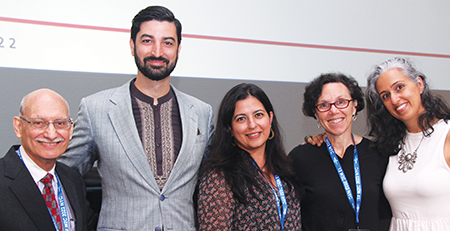
From l: Keki Dadachanji, James Darius Ball, Narges Kakalia, Dr Anne Khademian, Homa Dashtaki
"Did everything to fit in”
Having migrated from Iran to the US at the age of eight, Homa Dashtaki, founder of The White Moustache Yogurt Company with her father, recalled how she "did everything to fit in” although she felt an "inherent sense of betraying my heritage, my motherland…” Weighed down by "a very heavy and acute sense of mourning, the one place where I found comfort and safety was the Zoroastrian center” where the shared language, food and festivals celebrated created community bonding. "I understood what our ancestors did to hold on to their faith and beliefs… There is a heaviness felt by indigenous Iranian Zoroastrians; heaviness to be born a Zarathushti.”
She studied literature at the University of California, Los Angeles and law at Cornell University, eventually working at one of the top five law firms in the country. After the 2009 financial crash, she started her yogurt manufacturing company based on the recipes her family had used for generations. Referring to her business as "insane,” Homa mentioned that "my yogurt took three days to make. It was a therapeutic process. It allowed me to connect to my history, to my roots. It gave me a sense of validity. It made me feel whole; very strong in my identity. It was so liberating.”
What started as a bonding activity for the family turned into a successful food brand. Their Zoroastrian ethos guided every decision the company made and it has come to be reputed for sustainable food production and minimizing food waste while respecting the environment, people and animals over monetary profits.
"The earlier ache of loneliness” was replaced with a confidence to form a personal relationship that resulted in marriage. Acknowledging the support of her husband who was present at the Congress, Homa added, "My heart has found a home. I am free to be silly, sexual, fun, Zarathushti…”
Preparing for the Congress "helped me. I have grown from this panel,” she offered hope to "other hamsaris (coreligionists) like me who feel alienated and don’t want to communicate (thinking) it is easier to be alone... Why did I come here? Because I love and need this community. Each one of us is a Zoroastrian and yet each one of us is so different,” she remarked. Homa referred to the work of artist Kayhan Irani who taught her that "open wounds can touch others’ wounds and that is how we heal.” A standing ovation met her frank speech.
"Spoke truthfully to me”
An offspring of an interfaith marriage, James Darius Ball considered himself "half Parsi, 100% Zoroastrian.” While he finds it amusing to see how others perceive him, he does not take his identity for granted. Raised in West Caldwell, New Jersey, "kindness and service to others were the spiritual values” ingrained in him by his American Christian father and Zoroastrian mother. Sunday mornings were spent by the family at the Baptist Church, engaging with the local parishioners in different activities. "My parents introduced me to meditation and yoga as a connection with the divine, to lead a spiritual life.”
After earning his Bachelor’s degree in industrial design from the Pratt Institute, he gained experience working at Habitat for Humanity that launched his career in green housing. Currently vice president of business development for MaGrann Associates, an MEP (mechanical, electrical and plumbing) engineering and sustainability consulting firm, he undertakes high-end and affordable government housing projects. A leader in the building industry who serves as a home inspector, trainer, and consultant, he is co-chair of the Net-Zero Energy Coalition, is on the advisory board of Washington DC’s Building Innovation Hub and on the Environmental Committee of Hyattsville, his hometown.
When he was in his late 20s the family had planned a trip to India. A severe storm at Heathrow disrupted their plans and eventually James alone proceeded to India. He recalled being welcomed warmly with an achhoo michhoo by the Shroff family. Dr Shernaz Cama invited him to attend the Return to Roots program where his Zoroastrian "identity started to grow. I made multiple trips to India. I read the Gathas. It was incredible. The unique idea of a good mind spoke to me… It spoke truthfully to me…
"At the age of 30 I had my navjote. That decision was rooted in my spiritual journey… The Zoroastrian practice of wearing the sudreh-kusti was so empowering, so different from the community service I attended every week.” He then attended the 10th WZC in Bombay in 2013 where he met and fell in love with Roshni Kabraji. "We came together on shared values of kindness, service to others. Now my life is very deeply connected with Zoroastrianism. Roshni brings the cultural connection and I bring the spiritual connection. There is an incredible continuity of ideals and beliefs…” Acknowledging the contribution of different members of his family he was grateful for "their influence on my life.”
"Be true to yourself”
Married to Marc, a man of Jewish descent, Narges Kakalia referred to her multifaith family as very different from the "traditional Parsi Zoroastrian family in Karachi where I grew up, following all the rituals and dogmas.” Her mother sent her to the Friday School for little Zarathushtis where the "wonderful teachers taught us what Zoroastrianism is without labeling it. We learnt that creating happiness is an obligation. That using the vohu mana is an obligation to grapple with things, to question and come to one’s own conclusions.” As a youngster, she would have hypothetical debates with her orthodox mother: "What if I were to get married to a half Parsi?... What if I have LGBTQ (lesbian, gay, bisexual, transgender, queer) proclivities?”
After studying at the Oberlin College in Ohio, Narges served as a commercial litigator in New York for nearly two decades before turning her sights on making the legal profession more equitable and inclusive. Currently she is the director of Diversity, Equity and Inclusion in the law firm Mintz where she previously practiced as an associate and partner.
Knowing that her mother was not happy with her choice of a non-Parsi partner, Narges delayed marriage. Over the many years she dated Marc, they would have "conversations that helped us to be better individuals” while her mother, "an immovable rock, never budged.” Convinced of her "right choice” Narges ultimately got married but her mother refused to meet her husband or children (Cyrus, now 17, and Zane, 13) until she breathed her last. "She was following her faith and beliefs, and I was following mine.” Her bond with her mother was "fractured; the joy in our relationship was gone. We are taught to create happiness but in families with fractured relationships there is no happiness. You need to be true to yourself while creating happiness for all,” she is convinced.
"There is no right or wrong way of being a Zoroastrian. We need to accept each other. My children who are Zoroastrians are different from me… I joined ZAGNY but it took me five years to start attending meetings out of fear of not finding a sense of belonging.” Once she did, she found "ZAGNY was a very welcoming, comforting, open community that made me feel at home, I belonged… For some of us who are considered renegades we want to experience the freedom of walking into a space, be critical of it and yet be accepted.”
"A big transition”
Though initially uncertain whether they would be able to establish a connect with the Zoroastrians in Washington, "We were instantly accepted by the wonderful community in 2003,” recalled Dr Anne Khademian who describes herself as "a Zoroastrian by choice… My main concern was would I be accepted? What can I do to help? It was a big leap, a big transition. As I got older and have come to better know other members [of the Zoroastrian Association of Metropolitan Washington Inc (ZAMWI)], I am daring to be myself… I don’t know whether I belong but I know what it is to be a part of this incredible community in the diaspora.”
Born in Illinois of Irish-German-French descent, she was a member of the close-knit Lutheran Church community that would reach out to the wider community. An athlete who raced every weekend to pay for her higher education at the Michigan State University, she met her husband-to-be who was a Muslim from Shiraz, Iran. Recognizing that they had "so much potential and could do things together,” she proposed marriage to him! "Thirty-seven years later, here we are,” she told the audience.
Drawn by the principles of "a good mind and a good life leading to happiness,” their journey into Zoroastrianism was guided by the Council of Iranian Mobeds and a Zoroastrian couple in Chicago who adopted them. "You are a Zarathushti in your heart. It’s a decision you make on your own,” she observed. Their "complicated path” required long conversations with the family, getting their sedreh-pooshi performed, planning for their daughters… Initially Anne served as an Avesta class teacher and coordinator for many years at ZAMWI before she was elected to the board. Last year she completed a four-year tenure as president of ZAMWI.
Convinced that the Zoroastrian community can have an impact on the world and there is yet so much to learn she is "eager for what comes next” while pursuing her job as executive director of the Universities at Shady Grove, an innovative center in the University System of Maryland supporting pathways for all students to accessible and affordable higher education and high demand career opportunities. Her research and published work focus on the practice of inclusive management, understanding organizational culture and change. A fellow and member of the board of directors of the National Academy of Public Administration, Anne was inducted into the Michigan State University Athletic Hall of Fame for cross country running in 2016.
Although Dadachanji had stressed at the start of the session that each panelist would be permitted eight minutes and a bell would be sounded at the seventh minute, ultimately he did not insist on adherence to time when he saw the passion with which they spoke and the reception they received from the audience. After the panelists accepted some questions from the floor, Dadachanji concluded, "Changes cannot come from the podium, but a Congress can act as a catalyst for changes to happen organically.”
Faith and felicity
"It is through spiritual awakening or renaissance that humankind will be able to address global challenges,” stated Ervad Tehemton Mirza, president of the North American Mobeds Council and head of its Institute of Zoroastrian Studies when moderating the session "Faith Matters.” Representatives of Zoroastrianism, Hinduism, Judaism, Christianity and Sikhism stressed on the relevance of faith in the contemporary world on the morning of the first day of the 12WZC, July 1. All religions are grounded on common truths although they appear to manifest differently, it was reiterated by the speakers.
From far l: Ervad Tehemton Mirza, Dastur Khurshed Dastoor, Rabbi Joseph Potasnik,
Fr Brian McWeeney, Swami Sarvapriyananda, Bhai Sahib Satpal Singh
"Find something in common”
"We practice blind faith every day without consciously thinking of it. All kinds of human endeavor are based on faith in fellowmen and faith in ourselves. We make plans for the coming days/ years. There is no guarantee that we will get up the next day but we have faith in the unknown. Faith allows us to procrastinate,” pointed out Dastur Khurshed Dastoor. He has completed 20 years as High Priest of the Iranshah Atash Behram in Udvada during which time he has participated in three World Zoroastrian Congresses and spoken on the Zoroastrian religion at community and interfaith gatherings.
"The origin of faith lies in religion or belief in a set of doctrines or way of life. There is the realization that God is greater, wiser, smarter than the human mind can conceive.” In modern world affairs, science attempts to find solutions. "If every question had a ready answer, if every loss could be restored, there would be no place for hope. Faith in religion helps us to reestablish the importance of life… Religion comes from the Latin word ligare that means to connect and bind. Organized religion that gives meaning to life, customs, ceremonies, worship of deities, reflects the need for communal bonding and instills ethics. Coming together as a community leads to altruistic behavior, the best of shared humanity.
"With different religions existing side by side we learn to respect other faiths, celebrating similarities and understanding differences without imposing our ideas on them. Being at peace with different ideas increases our appreciation of others’ customs. Peaceful coexistence, tolerance, charity are taught by all religions. No matter how different we may be, we need to understand and learn from one another, find something in common so that ultimately we learn to embrace the impossible,” stated Dastoor.
"Faith guides our feelings”
Fr Brian McWeeney who has been serving as a Roman Catholic priest and pastoring communities for 49 years was happy that the subject of the discussion was titled "Faith matters” and not "My faith matters,” "A faith matters” or "The faith matters.” He viewed "faith as that which guides our feelings, draws us into a relationship.” Is faith relevant today? he asked rhetorically before proceeding with an answer, "If we ever need faith it’s in the present moments when we see society dividing and self-dividing.”
Recalling his younger days when his political inclinations would frequently take him to the United Nations office, there would be no security personnel standing on guard. One just needed to purchase tickets to attend different meetings. Members and affairs were accorded "honor that we don’t see in foreign affairs today. In the current throw-away society that believes in using and discarding objects as also people, it is hard to find a television repairman!” People nowadays don’t talk to each other, they only network with those who agree with them. Their opinions and rights are the only ones that count. Recognize the sense of commonality, build relationships through communication. See each other, celebrate and embrace. We want to conquer nations instead of protecting others around us who are really us. "An Interfaith Security Council sounds like the most threatening assembly of ministers of all faiths!” jested the priest who had been a professor at the Institute of Religious Studies and Diaconate Formation Program of the Archdiocese of New York, a city he preferred to describe as a mosaic rather than a melting pot.
Sincerely adhere to the faith
Followers of Zoroastrianism and Hinduism are ancient friends who have common roots, declared Swami Sarvapriyananda, a minister and spiritual leader of the Vedanta Society of New York founded by Swami Vivekananda in 1894. He referred to the conversation on a voyage between Jamsetji Tata and Vivekananda that led to the establishment of the prestigious Indian Institute of Science in Bangalore. "You (Persians) gave us the name ‘Hindu’ because you did not pronounce it as Sindhu,” he told the gathering. Ancient Hindus coexisted with a variety of religious systems. The beginnings of Jainism, Buddhism are known to be in India.
The concept of "Vasudhaiva Kutumbakam (the world is my family)” is unifying. "For those whose minds are big, the world is one family,” maintained the TEDx speaker who has served in various capacities at different educational institutes of the Ramakrishna Mission in India. Respect for all paths is absolutely important. That is possible if we recognize that "the truth is one even though the wise speak differently.” We can have different approaches. If our goal is to reach the roof of the house, we can use a wooden or stone or bamboo stairway. God realization is the goal of human life. Faith is essential to transcend from the material to the spiritual. It is not crucial to hold interfaith conferences to pass resolutions. "More important than knowledge is the attitude of acceptance that it is fine if people are different.”
Those seeking spiritual salvation through varied routes he equated with men in search of water digging at different places. If they had persisted by digging deeper in one place, they would have found what they were looking for. Hence one needs to adhere to faith and transmit the culture that has come down over millennia with dedication, he advocated.
The collective courage
"I know what it feels to be left out,” said Rabbi Joseph Potasnik, executive vice president of The New York Board of Rabbis, the largest interdenominational rabbinic body in the world. As host of the television program "Faith to Faith,” he has been engaging in meaningful conversation with people of all faiths.
A former member of the New York Human Rights Commission, he is committed to protecting the security of Jews and combating the violence plaguing the US. Seeing the rise of crimes by hate mongers he cautioned, "The person who hates me today will hate you tomorrow. We cannot afford to be detached. One plus one may equal two, but one and one can remain one if we share the oneness of spirit.” In favor of forming a protective ring around vulnerable targets, he felt we should have the collective courage to fend off attackers by saying, "If you want them, you get through us.”
Advocating a life of altruism, he posed the question, "Who would be entitled to the last glass of water in a canteen?” before responding, "The owner of the canteen may have the right to the last glass but it is his responsibility to share it with the other diner.” He recommended selfless giving for ultimately we will remember what we gave but not what we kept.
"Nothing else mattered”
"Today is the 127th day of the Russian invasion of Ukraine. Why is this happening? Why do we fight?” asked Bhai Sahib Satpal Singh, former chair of the World Sikh Council — America Region and founder trustee of the Sikh Council for Interfaith Relations who participates in many multi faith alliances. "We forget what is important. We hold on to our ego and our materialistic pleasures. We are all children of one God and yet we are like two sons who fight over whose mother is better.” He advocated that we should instead be like the person who when attacked by lynchers and knowing that his end is near prays for himself and even his attackers "because all come from one God.”
Spiritual and worldly life are connected by faith. Diversity and interconnectedness are the two principles of creation irrespective of whether you believe in God or acts of God/nature like tsunami, hurricane, Covid, he believed. He cited the instance four years ago when incessant rains and floods led to 13 soccer players being trapped in a cave in Thailand for nearly 10 days until they could be rescued. That was a time when "nothing else mattered but faith.”
Singh is a professor at the State University of New York at Buffalo where his research focuses on neurodegenerative disorders. A strong opponent of violence against women, according to the facts and figures he quoted, every day four women in America are killed in domestic violence. Until 1929, a woman in Canada was not legally considered a "person.” The Sikh leader commended the faith and resilience of women despite the mistreatment they suffer.