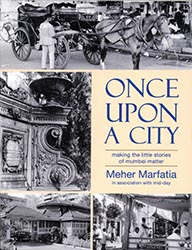
Once upon a city: Making the little stories of Mumbai matter by Meher Marfatia in association with mid-day. Published in 2020 by the author, 49/50 Books, 22, Peacock Palace, 69, Bhulabhai Desai Road, Bombay 400026. Pp: 266. Price: Rs 950.
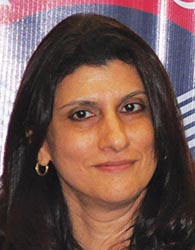
Whether you are a student of sociology or a Bombay lover, an admirer of old photographs or a lover of anecdotal stories, columnist and author Meher Marfatia’s (pictured) latest offering is the go-to book for you. A compilation of 50 essays from her previously published columns for mid-day, the book includes updated stories and photographs and even a map on how to get to the places that Marfatia so obviously loves, and gets you to fall in love too.
 Once upon... is not a "get-into-bus-number-so-and-so-and-go-discover-place-so-and-so” kind of self-discovery guidebook. Instead, Marfatia takes you by the hand and walks with you to discover little known gems. She deftly weaves the timeless with the today: histories of Bombay’s grand buildings mingle with the stories of their inhabitants; the middle-class housewife in Matunga has as much of a voice in the book as does, say, actress Scherezade Mody or the scion of a former city father.
She brings into the fore people who have been behind the scenes: for instance the office manager of Bobby Kooka, the whiz kid behind Air India’s one-time brilliant hoardings. Or take the case of Alfred D’Souza, the father of Orlem (Malad) resident Barses who she interviewed while researching the then village. The senior gentleman was felicitated in 1929 by house owners of Valnai (as Orlem was then known) for his role in the struggles against the Notified Area Committee that wanted their properties for development. "If Bombay has K. F. Nariman to defend the rights and liberties of the public, Valnai village can be proud of another Nariman,” read the citation. Marfatia lets the locals, whose brains she picks as part of her research, add color — and their voices — to her book. These are pithy statements about localities as local residents know or knew them. Sometimes they are remorseful about the passing of an era; oftentimes a "life-has-to-go-on” tone.
Not only about people, we learn of snippets from local history too: how present day Mulund gets its name via its earlier avatars of "Mahabali,” "Muchalind” and "Mul-Kund,” for instance. Or, how Breach Candy was named. The "Breach” was suggested by a gap in the rocks that the landmass formed. "Candy” could well be the Anglicized way to pronounce khind (pass), she states. The tone is never academic. It is almost like she is talking to an intimate circle of friends at a local history lovers’ association. No wallowing in nostalgia here. As she says in the Author’s Note, the essays are impressions of the people and precincts, rooted in the here and now. She is equally at home writing about palaces of erstwhile royalty on her home turf — Warden Road — as she is about the skyscrapers that now line the road.
You are with Marfatia as she watches a Parsi natak in the company of her pill-popping aunt who is wheezing and chortling at the same time, when she writes about the Bombay stage down the ages. You are invited to share the joy she felt as a child on discovering she was born on the same date, separated by many decades, as the arrival of Queen Mary and King George V in Bombay!
 Marfatia has actually tramped the various localities she has written about. She tells us that she owes her love of local history to man-about-town Saleem (Bittu) Ahmadullah when he led her on a heritage trail "interesting enough to trundle along tightly clutching an eight-month bellyful of her first baby!” A "years-ago promise” made to herself while delivering articles for publication to Parsiana’s office had led her to write about the "eight edifices flanking Prescott Road” and its people, she narrates.
There is a gentle nudge to the readers to explore on their own. She gives a hint of what she knows, not overmuch, just a whiff to egg her readers on to discover more on their own. Her narration of her visits to relatives in Khar includes a hint of a fabled "witty-wise” goat called Bakor Patel. One cannot but resist following through to know more about the wise animal. (Patel is a children’s literature character created by Hariprasad Vyas for funny animal stories published from Surat by a biweekly magazine.)
Photographs with detailed captions embellish Marfatia’s prose. The black and white cover photographs and those on the last few pages of the book are attributed to the collection of late "Bombayphile” and city historian Foy Nissen, now with the Jehangir Nicholson Art Foundation. Ferriel Palkhivala provided her editing skills and maps are attributed to Payal Joshi. Cyrus Guzder, Jamshed and Shirin Guzder Trust, M. D. M. Jeejeebhoy Trust, Pheroza and Jamshyd Godrej among others are acknowledged for their support.
Whether one reads the 50 pieces alphabetically as arranged in the book, or skims through the photographs and then savors each locality in order of one’s favorite, is the reader’s choice. Either way, one is in for a treat.
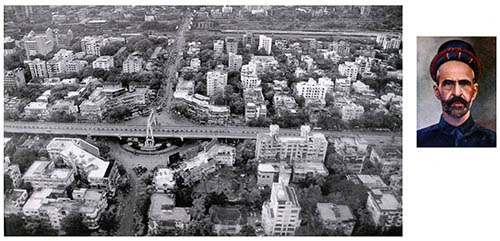
Above left: aerial view of Dadar’s Khodadad Circle Photo: Dr Jehangir Sorabjee/Above Bombay;
above right: Khodadad Irani Photo: Gustasp Irani
Dhun Lodge in Tardeo Photo: Simin Patel/ Bombaywalla Historical Works