The mid-winter Jashn-e Sadeh festival once celebrated mainly in Iran is now observed in several countries
Parinaz Gandhi
The chief mobed starts praying Atash Nyaish on reaching the pyre of wood. Clasping each other’s hands, mobeds and mobedyars in white along with the laity encircle the fireplace three times in a clockwise direction after sundown. "The fire has to be lit at the words Aesmo zasto, Baresmo zasto (from the Atash Nyaish),” states Mobed Mehraban Firouzgary who led the Jashn-e Sadeh celebrations in Tehran this year when Zoroastrians and Muslims gathered together around the bonfire. "Aesmo means burning wood, zasto, offered with extended hands, Baresmo, tied up bunch of twigs,” elaborates Firouzgary explaining how the bonfire is ignited by "a tuft of 21 dried twigs of wheat stalks forming the Baresmano” which signifies unity/hamazori and reverence to the plant kingdom.
Congregation at the Jashn-e Sadeh fire in Tehran
Prayers by community elders
Ladies carrying religious implements
Sadeh procession in Tehran
Photos: Soodeh Hajikaram
Whilst Sadeh may be a reminder that there are 50 days to go for Navroz, this mid-winter festival is observed on the 10th day of the 11th month (mah Bahman, roz Avan) according to the Fasli calendar. In Persian, saad means 100 and Sadeh is the celebration of the 100th day of winter, confirms Firouzgary, in response to Parsiana’s queries. The onset of winter is calculated from the first day of Avan as per the Fasli calendar (October 16). Thus to the 30 days of Avan, are added 30 days each of Adar and Dae, and 10 days of Bahman totalling 100 days or Sadeh on January 24, 2016.
This bonfire festivity is meant to bring back the light, fire and warmth of summer, and to defeat the forces of darkness, frost and cold. "Iranians of all faiths make a collective effort on this day to keep up with their ancient traditions and to celebrate the precious things God has granted humanity,” states Wikipedia.
In Kerman, Sadeh is traditionally observed as the 10th day of Bahman while in ancient Yazd Sadeh was celebrated 100 days before Navroz (mah Adar, roz Ashtad). The 100 in Sadeh is not to be calculated as 50 days and 50 nights remaining for Navroz, stresses Fariborz Rahnamoon of Vancouver.
For ancient Zoroastrians, the chief preparation for Sadeh was gathering of camel thorns, a common desert shrub in Iran, from neighboring mountains the previous day. When teenage boys in the company of some adult males undertook this journey for the first time, it was likened to a rite of passage to manhood. The boys would carry the camel thorns to their temples, and if it was their first time, they would return home to a celebration.
Once the fire was lit, it was kept burning all night. The next morning women would take a small portion of the blessed fire back to their homes and tend it there to spread the blessing of Sadeh to every household in the neighborhood. The remaining embers would be carried to the temple and placed in a container until the next year.
The fire also symbolized "the love for one’s homeland which burns fervently in every Iranian’s heart.” The festivities originally lasted for three days and besides wine the community would feast lavishly on roasted lamb, beef, chicken and other delicacies. Sadeh is also known as "the day of kindness since…food was distributed among the poor,” noted an explanation of this festival by Rashid Mehin on the website of the Zoroastrian Association of Quebec. According to his interpretation, "The flames of fire which always tend upwards, symbolize the human yearning for the higher life.”
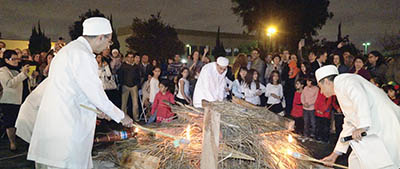
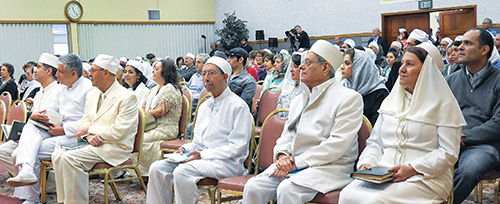
At the Sadeh celebrations in California
Photos: Ardeshir Baghkhanian
Children celebrating in Washington
Photo: Bahram Namiranian and Afshin Sepehri;
Youngsters performing indoors prior to the outdoor celebration in Ontario
Ladies at the Sadeh celebration in Australia
(From left): Jal Garda, Marzban Giara, Dara and Kersi Deboo
Congregation at Sadeh in Navsari
Like in years past, days before the event youngsters in Iran went around to collect wood and ready the venue for the celebration, writes journalist Ashkan Khosropour when answering Parsiana’s queries. With wood becoming scarce now, every household is encouraged to contribute in some form, whether a broken spade handle to logs and broken branches. In Tehran, Sadeh is celebrated in two places, Kooshk-e Varjavand and Markar complex. In Kerman, Bagcheh Bodagh-Abad is the popular venue. Other Iranian cities and villages of Yazd province also encourage youngsters to celebrate Sadeh, states Khosropour.
Also associated with Sadeh are some mythical stories on how fire was discovered. According to the Shahnameh, Hoshang, the Peshdadian king, threw a stone to kill a snake but it instead hit another flint and sparked a fire.
"We celebrated Jashn-e Sadeh this year as well,” states Atriya Salamati, president of the Zoroastrian Society of Washington State in an email response to Parsiana. A poem on Sadeh was recited, the history of the festival was recounted, group prayers were chanted by the youth. Outdoors, all present joined in the Tandorasti prayer around the Sadeh fire and livened it up with music, dance and a potluck supper.
The California Zoroastrian Center has been celebrating for around 20 years, notes a report by Ariyan Ash. Nearly 600 people of different ages participate in the festivities that last from 6 p.m. to midnight. Around the fire that reaches up to 10 feet, mobeds and children dressed in white, recite the Gathas. Children who attend the Sunday school give cultural presentations in the form of songs, dance, poetry and drama. Traditional Iranian food such as ash reshte and wine are enjoyed by the congregation.
Over 200 Zoroastrians attended Jashn-e Sadeh in Toronto with prayers led by Mobed Kerman Katrak, recital of the Gathas by the young adults and songs by the youth, writes Mitra Jam on behalf of the Zoroastrian Society of Ontario. Once the congregation moved outside to start the traditional fire, the evening was spent socializing and dancing until late evening.
In Australia, Sadeh was celebrated on February 6. As conveyed Dr Pheroza Daruwalla, "It was a very wet day and we were in danger of flooding but more than 60 people showed up. The evening commenced with feasting as everyone ‘brought a plate’ (of food) to share. The fire was constructed under the pergola (shaded arbor), prayers were offered by Khodamorad Kaviani and then an explanation of the significance of Sadeh was given by Dr Scharyar Amanat, trustee of the Australian Zoroastrian Association (AZA). People took the opportunity to feed the fire with girebans (front portion of the sudreh that signifies the repository of good deeds) and other religious items that needed ritual disposal. The main organizers of the evening were Mahanaz Shariyari and Paricher Jamshidi, both members of the AZA managing committee.”
In Bombay, the N. M. Petit Fasli Atash Kadeh was the venue for the Sadeh jashan on January 30. There is no bonfire but kathi and sandalwood in an afarganiu and incense sticks are used as substitutes for light and illumination, mentions Darayush Zainabadi, organizer of the Bombay based Sazeman-E-Jawanan-E-Zartoshty-E-Irani (The Iranian Zoroastrian Youths Organisation). This time they were joined by visitors from Iran who played the Iranian daf (drum) and rendered songs. Dryfruit packets and mava cakes were distributed at the end of the traditional jashan.
In Navsari, the Parsi Cultural Division of the Sorabji Burjorji Garda College Trust celebrated Sadeh on January 30 on the grounds of the Dossibai Kotwal Parsi Boys’ Orphanage. The function included a jashan by 13 priests in the Aivisruthrem gah led by Ervad Freddy Palia, speeches by College Trust chairman Dara Deboo, honorary secretary Kersi Deboo and writer Marzban Giara, and the lighting of a bonfire by hereditary trustee Jal Garda. Thereafter nearly 500 in the congregation recited a humbandagi, partook of snacks and enjoyed fellowship.
Rusi Sorabji of California has memories of Sadeh being celebrated in Agra in the 1930s: "We boys did our part in collecting wood, dried shrubs and twigs to light the bonfire that was expected to last for five to six hours if not the whole night to help the sun and the lengthening hours of the day to add more warmth on the planet. Don’t know how much light and warmth it added outdoors as we ran and danced around it while the elders wined, dined, recited poems or told stories. The embers from the blessed fire were taken inside the house. Sandalwood and frankincense were added to the glowing embers that were carried in a shining afarganiu from room to room, disinfecting the house with the fragrant smoke, and adding warmth and friendship amongst the 30 plus relatives, neighbors and friends gathered for the celebration. When the elders ran out of stories of old and narration of episodes from the Shahnameh, it was the turn of mother, aunts and uncles to serenade the gathering with their music.
"I think mom knew I liked Frederic Chopin’s music and that is what she played; his Etude in E Maj, Tristesse, also known as So Deep is the Night. Everyone kept themselves warm and energized with rounds of wine, arak, warm mohua, hot Ovaltine, or granny’s hot badam-ni-kanji. The music session by my uncles and aunts and the uncles and aunts from the Pestonji family usually came to an end with the first glow of dawn when mom unintentionally woke up the neighborhood with another Chopin classic, the Polonaise.”