The refusal to perform funerary ceremonies
for an interfaith married Parsi male has triggered
an outpouring of anguish and justification
Farrokh Jijina
Ervad Yazdi Aibara, panthaky of Cusrow Baug’s Nusserwanji Hirji Karani Agiary has stated he refused to perform after-death prayers for Bahadur Hansotia, an intermarried Baug resident as his late father Nadirshah had taught him to say "no” to performing any ceremony for intermarried men as well as women. Speaking to Parsiana on October 5, 2020 he, however, acknowledged that he had great respect ("ghanoo maan”) for the deceased. Hansotia had succumbed to coronavirus on September 27 and his family was keen to have prayers performed in the Karani fire temple.

"I do not force anyone to do anything. Why should anyone object when I do what my conscience says is right?” he queried. Aibara believes that a human soul can progress only if "aapré dharam pramaané chhaliyé (we act according to the religion).” The panthaky stated "Duniya né jé joiyé té karré (the world can do what it wants)… I do not want to change anyone… I know of many priests that perform these ceremonies…they are even conducted in atash behrams.”
Hansotia used to pray at the Karani Agiary. When Parsiana asked why Aibara did not bar him from entering, the panthaky claimed that Hansotia visited "very rarely... I am no one to stop anyone from coming to my Agiary… People should themselves understand if they have done something wrong… Who wants to argue again and again?” he said, somewhat resignedly. Aibara stated that he has been "bribed with blank cheques” to perform navjotes of children of mixed marriages, but has refused, even if the father is a Parsi. "Finally when I explain my reasons, they go back satisfied,” he stated.
As to the framed photo in the hall of the fire temple of Neville Wadia, born of an intermarried couple and whose wife was the daughter of a non-Parsi father and Parsi mother, Aibara stated the portrait was put up many years ago by "some Cusrow Baug League members.” The Wadia family is remembered for their largesse in endowing the sylvan Baug, termed the "Queen” of the colonies. At each salgirah function of Karani Agiary the trustees and Aibara request a two-minute silence in their memory.
Agiary trustees, tax expert Homi Ranina and Cusrow Baug resident Bomi Hansotia, have requested Yazdi, his brother Homyar, son Farhad and all their practicing priests to give a joint declaration addressed to "All fellow Zoroastrians” about their beliefs. Aibara read out extracts to Parsiana, the essence of which was all the priests associated with the fire temple as a practice "do not perform religious ceremonies for intermarried Zoroastrians, or those who are voluntarily cremated.” Bodies of those who die on account of Covid have to be cremated or buried as per the Bombay Municipal Corporation rules.
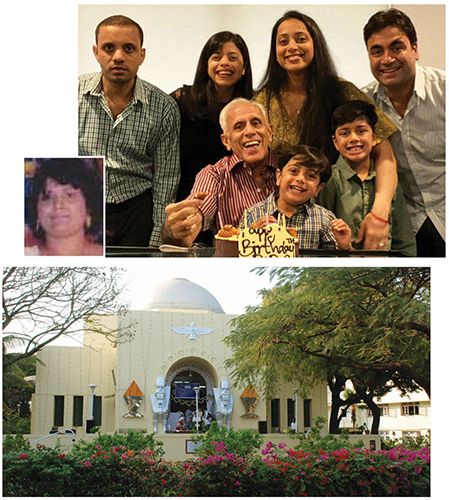
Top: Ervad Yazdi Aibara; clockwise from above r: Nusserwanji Hirji Karani Agiary;
Janet; Karl, Aafrin, Kamal, Prarthi Pandey, Aryan, Reyan, Bahadur Hansotia
Hansotia and Ranina both told Parsiana in separate interviews on October 12 that they provide "full freedom” to Aibara and priests to carry out religious practices as per their beliefs."They need to respect their conscience,” emphasized both. "We never interfere... The panthakies and mobeds are not our employees...They are free to do what they feel is right.” Both trustees stated that their role was more towards maintenance of the property and ensuring statutory tax and audit compliances.When Parsiana asked Ranina if his religious views were similar to those of Aibara, he stated "I do not think that is relevant.” A third trustee, Filly Karani, reportedly is not actively involved in the running of the fire temple.
As has become the practice, WhatsApp messages on the topic abounded soon after Aibara’s decision. One such anonymous message insinuated that a boiwala of Karani agiary is intermarried. When Parsiana requested Aibara to clarify, he stated that "none of the current boiwalas are intermarried.”
A WhatsApp message from Bahadur’s daughter Aafrin Hansotia stated: "Does the Zoroastrian faith condemn people to be treated this way? Does a well-respected and loved human like my father not deserve prayers and respects paid by people who he’s lived with/spent his whole life with? Do men who marry outside the religion cease being Parsi?”
"We only want answers to our questions,” Bahadur’s daughters, Aafrin and Kamal Hansotia Pandey told Parsiana on October 7. "Which scripture specifically states that if a man marries a non-Parsi he becomes a non-Parsi… and, if that is the rule, why are exceptions made for other intermarried people who may not be as famous? Why could our father’s after-death prayers not be conducted in the Agiary that he prayed at most of his adult life?” The sisters arrived in Bombay on October 4 after a 40-hour flight from Australia, where they live. Their father, who lived with their brother Karl, was admitted to The B. D. Petit Parsee General Hospital on September 11 to be treated for coronavirus. He took a turn for the worst and passed away two weeks later. A family friend made the funeral arrangements at the Worli Prayer Hall. Aafrin and Kamal told us their mother Janet had passed away 12 years ago.
"We respect our religion and the Agiary… We visit whenever we can when we are here,” said the women. "Could my father have deserved more empathy? We do not want to create any controversy… We only want our father to be remembered for the helpful soul he was.” Having grown up in Cusrow Baug, "it never crossed our minds to have the prayers done at any agiary other than Karani,” said both.
"There is no sense in creating a tempest in a teapot, when there are a number of agiaries in Bombay in which death ceremonies of (intermarried Zoroastrians) can be performed,” stated H. B. Wadia Atash Behram high priest Dastur (Dr) Firoze Kotwal, in conversation with Parsiana on October 6. He was responding to our queries on Aibara’s refusal to perform the funerary ceremonies. "It is the religious beliefs of the respective panthakies that count…It is they who decide whether to perform the obsequies for one who has married out…The panthaky’s choice has to be respected… No doubt the priest follows his conscience and no one has a right to encroach upon it, since the conscience is the oracle of Ahura Mazda.”
"Any Parsi male who has married out may visit a fire temple for his own personal belief,” as per the court decision, stated Kotwal. The 1908 Davar-Beaman judgment of the Bombay High Court states that Parsis are descendants of the original emigrants into India from Persia who profess the Zoroastrian religion; descendants of Zoroastrians in Persia who were not amongst the original emigrants; children of a Parsi father by an alien mother, if such children are admitted into the religion of their father and profess the Zoroastrian religion. "However, that decision has not been approved by the community…The court’s decision has nothing to do with death ceremonies in which a priest with a directly contrary religious belief is involved,” stated Kotwal.
Udvada High Priest Dastur Khurshed Dastoor shared Kotwal’s view that to perform prayers or not is the choice of an individual panthaky. However, he stated that the deceased "was a Zoroastrian… and as such, death prayers are a necessity… The same rules have to be applied for all Zoroastrians,” he informed us on October 6.
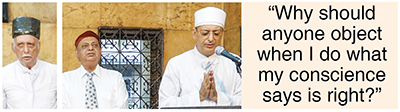
From l: Bomi Hansotia, Homi Ranina, Aibara at a previous salgirah function
"He (Aibara) did what his conscience told him,” said a full-time priest practicing for over three decades who did not wish his name to be disclosed. He would not pass judgment on the Karani panthaky’s decision. He, however, added that in the old days, priests believed "koi khara dil thi bhanaava maangta hoy tau na nai kéhvaay (if someone wants to get prayers performed out of conviction, they should not be refused).” In many south Bombay fire temples, prayers have been recited for intermarried Parsis, both male and female, he stated.
Dadar Athornan Institute (DAI) trustee and panthaky of Mewawala fire temple Ervad (Dr) Parvez Bajan was less empathetic to the deceased. "Aibara has done the right thing… One must respect individual decisions of priests,” he told Parsiana on October 6. "We Parsis have come to India to preserve our religion…Jé kharra sikhéla hoy té mobed nahi karré [mobeds who are perfectly accomplished will not (perform ceremonies for intermarried people)].”
Conceding that it was the "personal right” of priests to decide who they would recite prayers for, Ervad (Dr) Ramiyar Karanjia, principal of DAI stated to Parsiana on October 5 that he had not previously seen "concrete examples of cases where prayers were denied” for deceased intermarried Parsi men. "I see no reason why an intermarried man should not be considered a Parsi Zoroastrian,” he added.