Lawyer Pheroze Nowrojee was much sought after in cases involving probity in public life, civic values and bringing of succor to the downtrodden
Venkat Iyer
Not many lawyers have received such warm and effusive tributes at the end of their lives as those showered on Pheroze Nowrojee who died at the age of 85 on April 5, 2025. He succumbed to pneumonia while on a visit to the United States.
Nowrojee was a towering figure in legal and human rights circles in Kenya where he was born and raised. His grandfather had emigrated to East Africa in 1896 to work as an engine driver in the colonial Uganda Railway, and his father was a lawyer. A proud and deeply-rooted son of Kenya, Pheroze had his formal education on three continents, graduating with a Bachelor of Arts from Bombay University (1957), being called to the Bar from England (Lincoln’s Inn, 1965), and obtaining a master’s degree in law from Yale University (1974). He rose to become a designated senior advocate in Kenya, with rights of audience in the courts of Tanzania and Zanzibar as well, and enjoyed a wide and varied practice. He also appeared in the courts of Uganda and Seychelles.
Like many lawyers before him, Pheroze (known to many as "Phil”) had put in a stint as a university lecturer before embarking on a full-time career at the Bar. This involved teaching positions in the Universities of Nairobi and Dar-es-Salaam. He also later taught at the Kenya School of Law which concerns itself with the vocational training of advocates in that country. Shortly after returning from India with his first degree — but before qualifying as a lawyer — he had worked, for good measure, as a school teacher in Nairobi. All of this provided a good grounding for the career in which he was to make such a name for himself within a few years.
In addition to his qualities as a lawyer — which included an emphasis on meticulous preparation of cases, forceful advocacy, outstanding court craft, fairness to the court and to fellow advocates and, above all, strong fidelity to professional ethics — Pheroze possessed a passion for justice which manifested itself beyond the courtroom. Unsurprisingly, he was much sought after in cases involving probity in public life, the assertion of civic values, and the bringing of succor to the weak and the downtrodden. All this was matched by a fearlessness for which he gained a widespread reputation.
That fearlessness could be seen in his willingness to take on the high and the mighty, regardless of personal consequences. In the 1990s, for example, when the legal profession in Kenya came under attack from the government of President Daniel Arap Moi, he bravely and tenaciously defended the Law Society of Kenya (LSK) whose wings were sought to be clipped through a politically-motivated move that would have reduced its independence and its role as the protector of the rule of law. Battling against severe odds, Pheroze managed to stave off the threat, much to the relief of thousands of fellow lawyers and democracy activists. In recognition of this and other contributions to the profession, the LSK inducted him to its roll of honor in 2005.
For his courage, Pheroze had to occasionally face personal threats. One such incident happened in 1990 when he was charged with contempt of court — a criminal offence which would have led to his incarceration — after he took on the case of a widow whose husband, an Anglican bishop, had died in a controversial road accident. The government of the day had begun a criminal prosecution which, the widow alleged, was designed to deflect public attention and stall an inquest into the death which would have brought out inconvenient and embarrassing truths.
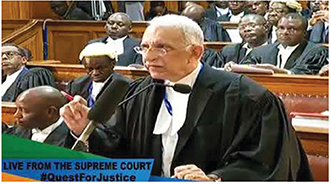
Top: Pheroze Nowrojee in court;
above: Nowrojee (r) with then
President of India Dr A. P. J. Abdul Kalam
Pheroze argued the widow’s case in the High Court and, when faced with an inordinate and unexplained delay in the delivery of judgment, wrote a letter to the registrar of the court asking for a reason for the delay. For his pains, the High Court slapped a notice of contempt on Pheroze alleging that his letter amounted to a "scurrilous and unjustified attack on the court.” Pheroze stood his ground and, after a criminal trial in which he received the support of dozens of fellow lawyers, with observers from organizations such as the International Bar Association and the International Commission of Jurists attending, he was acquitted of all the charges.
His advocacy of human rights was sometimes carried out on international platforms, too. A notable example was an impassioned speech he made at a conference of the Commonwealth Lawyers’ Association held in Hyderabad, India, in February 2011 where he asked for the release of a Kenyan activist, Al Amin Kimathi, who had been imprisoned in Uganda after being abducted while on a professional visit there. Such was the effect of Pheroze’s oratory that the Chief Justice of Uganda, who had been attending the conference, staged a dramatic walk-out, calling the speech an attack on his country.
Pheroze received numerous global honors for his work, including the Bernard Simons Prize for Human Rights from the International Bar Association in 2002, the Jurist of the Year award from the Kenyan section of the International Commission of Jurists in 1995, and the Pravasi Bharatiya Samman Award from the Government of India in 2007. He had an extensive network of friends and admirers around the world. He visited India frequently and had a special affection for Parsiana. He was unstinting in acknowledging the love and respect that he received from individuals and organizations, and he repaid such affection in abundant measure. To take but one example, his moral and material support for the Kenyan section of the International Commission of Jurists resulted in a permanent home for that organization in Nairobi; a section of the building proudly bears his name.
Pheroze was the natural choice as leading counsel in high profile constitutional law cases. In particular, he developed a reputation for tackling the difficult issues which arise in election petitions, viz cases where the validity of a general election would be challenged in the courts. An outstanding example was the 2017 litigation in which the results of the presidential election were annulled by the Supreme Court of Kenya after a challenge by the loser, Raila Odinga. Pheroze’s performance in that case — which was televised, and recordings of which are still available on YouTube — was highly impressive and one which brought him many plaudits. Pheroze himself likened the outcome of the case to the Brown vs Board of Education decision in the United States (1954), holding that it set a significant legal and moral benchmark for future electoral integrity. It would be fair to say that Pheroze has appeared in many, if not most, of the politically and socially significant cases in modern Kenyan history — a bit like Nani Palkhivala did in India (although with one important difference: whereas Palkhivala was a staunch votary of free enterprise and capitalism, Nowrojee was distinctly on the other, progressive, side of the ideological spectrum).
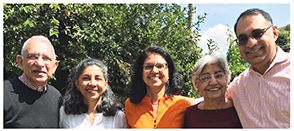
From l: Pheroze, Binaifer, Anahita Sia, Villoo and Elchi Nowrojee
Above: Pheroze with his sister Thrity Elliot;
r: with cousin Phiroze Dastur (r) at their navjote
His contribution to nation-building also included helping in the establishment of numerous institutions within the non-governmental space in Kenya, such as the Independent Medico-Legal Unit (which aimed to improve forensic medicine as a tool to eradicate torture and other human rights violations), mentoring members of the Kenya Medical Association Committee on Human Rights, and influencing the drafting of his country’s 2010 Constitution. Pheroze also involved himself in politics, occupying organizational offices in two political parties, the Forum for the Restoration of Democracy-Kenya (FORD-Kenya, where he was a National Executive Committee member between 1992-99) and the Social Democratic Party (SDP, where he served as national treasurer between 2002-12).
One of the tributes which followed Pheroze’s death noted that he was "a poet, a historian, a public intellectual, and a quiet revolutionary.” His publications bear testimony to all those attributes. They include: A Kenyan Journey (memoir); Station Master, Eburru and Other Stories, Dukawalla (short stories); Pio Gama Pinto: Patriot for Social Justice (biography); and A Vote for Kenya: The Elections and the Constitution, Conserving the Intangible and Practising an Honourable Profession (non-fiction). He has also left behind a corpus of articles in academic journals — most of them going back to his time as a university lecturer. It is said that he was astoundingly forthright in his book reviews: he reportedly panned a standard textbook on administrative law, which contained plagiarized material, with the following brutal advice: "Do not read it!”
Pheroze led a long, active and achievement-filled life. He is survived by his wife Villoo, daughters Binaifer and Anahita Sia, and son Elchi. When asked about what legacy he will leave behind in an interview he gave to a Kenyan magazine edited by his friend Gitobu Imanyara, as recently as in September 2024, he said: "I hope my legacy will reflect a steadfast adherence to professional ideals and persistent efforts to realize those ideals. The constancy of one’s principles, even when faced with tempting offers or challenges, and the relentless pursuit of justice, are key aspects of my legacy.”
Imanyara himself, in a touching tribute to Pheroze, called him the "conscience of our Republic.”