My current series of paintings — The Endangered Species — is about our community,” Katayun Saklat, one of the grand dames of Calcutta’s art scene, states. The series began in 2013 with watercolors and five canvases measuring five ft by three ft along with several sketches and drawings. "Senior citizens playing games, the perils of dementia and the experience of watching one’s nearest and dearest grow old inspired me to create a series of paintings about our precious community which is aging and fast disappearing. My work emphasizes the need for us to look after our aged parents and remember that each day with them is a blessing,” she stresses.
"My favorite media are watercolors, oils and sketching,” admits the Calcutta based octogenarian. Her artistic forte lies in the strength of her draftsmanship and the use of bright colors. Her first opportunity to give free rein to this was when she was commissioned to create stained glass windows and panels, and walls of glass which rose from floor to ceiling for the house of a client in Calcutta’s Alipore.
Over a span of 15 years, Saklat was commissioned to create 15 stained glass panels for her beloved agiary, The Late Dhunjeebhoy Byramjee Mehta’s Zoroastrian Anjuman Atash Adaran in Calcutta, including a large arch window of the Amesha Spentas for the fire temple’s centenary in 2012 (see "Centenary in Calcutta,” Parsiana, December 21, 2012).
Saklat sourced colored glass from Delhi and Bombay, worked with metallurgists to create tools and embarked on her exhilarating project to create windows and huge panels with imagery depicting a magic island, lakes, birds, animals, foliage, deer and flying parakeets, all done in stained glass. For this primary venture, she studied birds and fashioned a unique series of doors with green parrots, enjoying considerable creative freedom and liberty. "The project took six years to complete,” Saklat shares.
Earlier, in November 1997, Saklat held an exhibition of her stained glass work at Art Today in Connaught Place, New Delhi. With a specially created structure to illuminate the works, Saklat exhibited over 100 pieces of stained glass. Her theme for the exhibition was the seven major religions of the world: Zoroastrianism, Hinduism, Christianity, Islam, Buddhism, Judaism and Sikhism. Most of these works were sold during the exhibition.
"Stained glass panels are breakable; they can’t be stored and need to be installed immediately as they warp when stacked up,” Saklat explains some of the drawbacks of the medium. "Thus, in my studio, we only work on confirmed orders. We select the design, then the colored glass, cut it into small pieces, glaze it, put it into lead cames (strips used to join cut pieces of glass into picturesque designs), solder all the joints in the front and back, cement the gaps and then clean and polish our creations,” she elaborates.
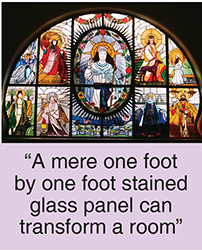
"The ‘fake’ stained glass industry functioning today paints the glass, uses outlines from a tube similar to one for toothpaste and, therefore, finds it cheaper and quicker to execute orders. No colored glass or lead is used,” she rues. Though there are a plethora of design books, the artist does not take the easy way out. She will not compromise, but painstakingly designs each piece herself.
"My painting continues alongside,” adds Saklat. "Painting is a jealous mistress. Once she gets a grip on you, she won’t let you get away,” she smiles. Her current works comprise both oils and watercolors and include series like Animals in Churches depicting animals in derelict houses of worship with angels looking down benignly upon them. Dolls and toys too are recurring motifs in her works.
"The function of glass is to change the atmosphere of a room or space. A mere one foot by one foot stained glass panel can transform a room. A painting can transform a wall. That’s the difference between the two art forms,” states the artist with an enthusiasm and zest that is perhaps at odds with her age. Then again, it is perhaps this spirit of creativity which keeps her so energetic and passionate about life and art.
Many people perhaps know Saklat best as a gallerist, although this is just one string on her remarkable bow. She started Gallery 52 at 52 Chowringhee, Calcutta (now the Olpadwala Memorial Hall) in 1970 followed by Gallery Katayun in Auckland Square on May 22, 1989 after a long hiatus. The Gallery, which is over 30 years old today, has nurtured several artists who are now household names. With paintings to suit every budget, her name is a byword for probity in the city and indeed the country’s art circles. She continues to exhibit at venues all over Calcutta including the Bengal Chamber of Commerce and Industry and the hotel Swissotel.
"I realized early that I would earn more as a gallery owner at a time in the 1980s when there were very few dealers and galleries. With a plethora of aspiring and talented artists around, I decided to become their conduit to potential buyers. It seemed the right decision to take at the time and I have no regrets whatsoever... The artist inside me often helps me to make the right selection from the thousands of paintings that I see,” explains Saklat. "It is purely aesthetics,” she adds with a twinkle in her eye.
Saklat was born to Homai and Rustom Tehmurasp Saklat on February 10, 1938 in Calcutta. While her older sisters Aban (Hormusji) and Frenny (Billimoria) were busy studying or playing, young Katayun spent her time scribbling and drawing. From drawing fashion designs on school textbooks, this evolved into an all abiding passion for the visual arts. An alumna of the Government Arts’ College, Calcutta, Saklat also spent time at the Sir J. J. School of Art in Bombay to learn commercial art and trained at the Indian School of Art and Draftsmanship in Calcutta in the early 1960s.
Saklat trained as a Montessori teacher and taught art for 30 years at the Oral School for Deaf Children in Calcutta, a remarkable institution founded by Dhun Adenwalla. "I was so proud to teach several students the nuances of fine art at the fifth best school for hearing impaired children in the world,” she states.
The turning point in her life came in the form of a three-year visit to the UK in 1973 to master the art of anatomical drawing. Through some remarkable circumstances she got a scholarship to learn the art of making stained glass under Patrick Reyntiens, a noted medieval stained glass artist in the UK. "Being under the tutelage of a great master gave me the opportunity to observe his creative mind and learn his art,” explains Saklat enthusiastically. "Stained glass is a tedious, laborious and time consuming activity. But learning from Reyntiens, who has done glass all over the world, was my greatest pride and joy.”
When she returned to Calcutta from London in 1975, Saklat found she could not source the the quality glass she required to practice the art or indeed the lead cames or any other tools she needed. "I had learnt an exciting new discipline for which neither equipment nor material was available in Calcutta in those days,” recalls the artist wistfully.
In the fullness of time, though, another door opened leading to new and exciting creative ventures. Saklat met Nari Ghandy, one of India’s leading architects who urged her to "be creative.” This meeting was the inspiration to embark upon a series of fabric collages made with scrap material sourced from tailors. "As I began using fabric instead of glass, I was forced to imagine fabric to be my chosen medium and the attachments made from felt material to be lead cames,” reveals Saklat.
Saklat’s two older sisters, Hormusji in London and Billimoria, a renowned hostess, author and social worker in Delhi, both support her every step along the way. Her late cousins Khurshed and Jehangir Dustoor were pillars of strength who aided her in all her ventures, a tradition carried on by their children. A practicing Zoroastrian and a participating member of the 420-strong Parsi community in Calcutta, Saklat enjoys the frequent get-togethers and events conducted by the Parsi institutions there.
Busy in her world of art, she thinks nothing of living alone and feels she is married to her art. "I regret I am not a good time manager, housekeeper and lack organizational skills. But I am blessed with a wonderful extended family and friends.”