An updated record of the commercial and
social history of the city has been published by
The K. R. Cama Oriental Institute
Farrokh Jijina
It has intrigue and adventure, a la poisoned cakes, adrift Sikh gentlemen picked up by a Norwegian freighter, boatmen sleeping along a river carted away to England, wealthy Parsis who took their cooks along with them on their second and third trips to England. While one Zoroastrian-Iranian father secreted away his two daughters to the "safety” of India in the charge of a German traveler, many Hindus ventured abroad as early as the end of the 18th century without fearing "loss of caste” [crossing the kala pani (literally, black water) was taboo]. Eminent physician, photographer and urban historian Dr Jehangir Sorabjee who released Mumbaino Bahaar [(MB), Splendor of Bombay or Springtime of Bombay] on March 14, 2024 at The K. R. Cama Oriental Institute (KRCOI) was narrating snippets from the Institute’s publication to a packed audience. Chhatrapati Shivaji Maharaj Vastu Sangrahalaya (CSMVS), the erstwhile Prince of Wales Museum’s director general and guest of honor Sabyasachi Mukherjee, president of KRCOI’s board of trustees Homa Petit and KRCOI trustee and honorary secretary Dr Nawaz Mody joined Sorabjee in launching the book.
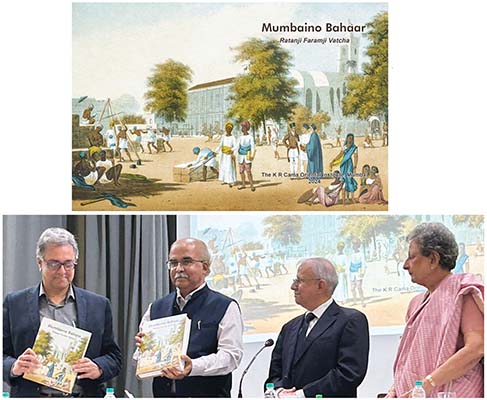
Above, from l: Dr Jehangir Sorabjee, Sabyasachi Mukherjee, Homa Petit, Dr Nawaz Mody launching the book
As states the title page, the tome originally published in Gujarati in 1874 is a "description of the history of this island (Bombay), its inhabitance by people of various communities, life sketches of many benevolent personages and other memorable incidents.” Sorabjee called the volume "a history of the mercantile life of Bombay, its merchant princes — Hindu, Portuguese and Parsi… A big chunk is about Parsis.” As states the Preface, the book’s "wealth of information… is unsurpassed by other similar works.”
Written by businessman Ratanji Faramji Vatcha (1815-1893) who traded with China, both on his own account and as an agent, the book was translated into English by Homi Patel (1945-2019). The English publication was edited by the trio of educationist Dr Zenobia Dumasia, veteran translator Aban Mukherji and vice principal of Sophia College Dr Rashna Poncha. They "restyled” the original work to suit today’s reader.
Sorabjee said he was fascinated by the depth of Vatcha’s research. "He reportedly asked people to come to him with documents supporting their anecdotes,” he said. Bombayphile Sorabjee provided a snapshot view of the history of Bombay as part of the Gujarat Sultanate, a Portuguese possession, the improvements after its acquisition by the English and the years of prosperity due to the cotton and share market booms. Vatcha lived through the years of prosperity the city experienced from 1820s to the 1900s, stated Sorabjee.
Included in the book is, among other things, a list of Parsis living in Bombay, the villages they migrated from, lists of their landholdings, descriptions of their "palatial homes” at Gowalia Tank, overseas visits and lists of their businesses, with the Banajis and the Dadys (Dadysett) popping up with predictable regularity. Vatcha writes that "when Johnathan Duncan left Bombay to go back to England after his stint as governor of Bombay, trader Cawasji Patel (after whom the street in Fort is named as well as C. P. Tank in Girgaon) gave him half-a-ton of Bombay Ducks as a farewell gift,” narrated Sorabjee, eliciting chuckles over the malodorous offering. Among the anecdotes Vatcha narrates are a visit of Governor Sir Henry Bartle Frere to the Panday Sanatorium at Colaba; strictures regarding uniformity of color of horses and buggies; a petition by philanthropist Jagannath Shankersett on behalf of the Bohris who were not permitted to ride horses.
Sorabjee noted that he had three issues with the book. Vatcha used four different calendars when referring to dates — Yazdegardi, Vikrama Samvat (which starts 57 BC), Shaka Shalivahana (78 AD) and Gregorian. "Perhaps the editors can take care of it in the next edition,” he suggested. The Parsi practice of naming one’s son after one’s father was confusing and had him re-reading some passages. "Also, there is nothing about himself (Vatcha)… perhaps he did not feel he should mention himself” in his book.
We have very little material from Indian authors of that period, "so we must appreciate the efforts,” stated Sorabjee. Coincidentally, he remarked, the books on Bombay he liked best were all by Vatchas — the current work; Sir Dinsha Wacha’s Shells from the Sands of Bombay, Being My Recollections and Reminiscences, 1860-1875 and P. P. Vachha’s Famous Judges, Lawyers and Cases of Bombay A Judicial History of Bombay During the British Period.
So detailed was Sorabjee’s introduction to the volume that one member of the audience was heard jokingly stating, "Now I don’t have to read the book!”
Clockwise from top l: Dr Rashna Poncha, Dr Zenobia Dumasia, Aban Mukherji;
Deepak Mehta Photo: Wikimedia Commons;
Elyzia Fatakia, Zarine Patel, Zenobia Fatakia, Freddie Patel
"Garden of words”
Introducing the book on behalf of her co-editors, Poncha stated that MB was the second book by Vatcha, the first being Panchang Pothi, a compilation of a calendar containing Hindu, Muslim, Christian, Parsi and Chinese dates for the years 1744-1871. Commending Vatcha’s "record of leading families” and "very, very detailed family trees,” she stated that Vatcha used poetry to add charm to his writing; he "tried to create a garden of words.” The Gujarati used at that time was archaic and poetic, which is why Patel’s translation helped greatly. Dumasia edited the text, Aban the verses to make them melodic and comprehensible while Poncha undertook the general editing and preparation of an index, she explained. She too stated that the editors found repetitive names across generations in Parsi families a stumbling block, as also the multiple spellings of Parsi names. "We have retained Vatcha’s notes as Author’s Notes and added our notes as Editors’ Notes.” While it is known that there was a second volume of the original MB, it has not been found, stated Poncha.
Veteran Gujarati writer and critic Deepak Mehta believes that "no one should write in the (Gujarati) language without referring to MB and the Parsee Prakash.” Calling the 19th century a period of renaissance, he stated that Parsis brought in new ideas to the country — the introduction of Gujarati fonts for printing, the first Gujarati novel, the first Gujarati printing press, the establishment of the newspaper Mumbai Samachar, the first periodical, the first women’s magazine, the introduction of the serialized novel, et al. His appeal to the editors: "Give us (translate) the first three volumes of Parsee Prakash” that are reportedly unavailable in print.
Communicating with Parsiana before the event, Aban told us that the original MB in Gujarati is available online and the hard copy is at the Cama Institute. "Actually it was Dumasia who was approached by Cama (Institute) to edit the translated book… She said she would do it only if I too was involved and that is how I walked into this project… We had studied history at Elphinstone College… We owe a big thank you to the Forbes Gujarati Sabha… They had digitized the book and made diskettes that could be bought… This helped Zenobia and me tremendously as we could work on the text from our homes.” In no way has the original work been abridged during their editing, she stated.
We queried her about the obstacles in making the tome comprehensible to today’s reader. "In 19th century Gujarati texts, the spellings of words were not standardized.” This standardization happened only in 1936 due to the urging of Mohandas Gandhi. "So the same word could be spelt in a number of different ways. Also, there were no provisions for printing blends (compound letters created by joining two alphabets) so a word like ‘Pragati’ would read ‘Paragati’… We soon got used to this spelling but when it came to cross checking English names we were often flummoxed… As 19th century Gujarati spelling is much more phonetic than English, we were often at our wits’ end to figure out the spellings of proper nouns, especially the names of ships.” Both Aban and Dumasia emphasized that "without (Patel’s) translation we don’t think we would have had the nerve to work on the book.”
Homi Patel’s family — wife Zarine, son Freddie and daughter Zenobia Fatakia were present at the event. Zarine told Parsiana later that the translation took "about three-four years.” A bank official, Homi found some words in Gujarati very difficult to translate. "Koi koi words per attki jata hata (He would get stuck over some words)” but got help from "here and there,” said Zarine. MB was the one major translation that Homi undertook. "There were a few other small articles” which he translated.
The front and back covers of the publication depict a scene of the erstwhile Bombay Green, today’s Horniman Circle, by Robert Grindlay. The view shows St Thomas Cathedral "with the counting house of Messrs Forbes and Company in the background.” The image was provided by the Museum from one of their publications.
Tribute to Muncherji
Welcoming the audience, Mody stated that the current volume had been in the making for 15 years and was a pet project of former KRCOI chairman, the late Muncherji Cama. His mother Banoo Cama had "generously supported” Homi’s translation. "The book is a tribute to all (Muncherji) did for the Institute,” she stated. Mody introduced Petit, who also presided over the meeting, referring to his work as a senior jurist specializing in civil and arbitration law and banking matters.
Mody told Parsiana before the event that "the idea of translating MB came to mind when I was carrying out research on the Parsis and other families who built Bombay… Since the work was written in old Gujarati it was always difficult to find the proper locations and details in the volume itself.” Hence the need to translate it into English so that researchers not familiar with old Gujarati could have access to this unique documentation, she stated. Mody is credited as the publisher. "Getting proper translators for the volume was the biggest challenge which was faced… A number of (people) were tried out… Given our high standards of academics at the Institute we were still not satisfied and were lucky to locate the team of Dumasia, Aban and Poncha who painstakingly edited the translation and polished it,” she added.
Introducing Sorabjee, Petit gave a rundown of the doctor’s multifarious achievements in medicine (honorary professor of medicine and head, department of medicine at Bombay Hospital), teaching and photography. "In recent years he has focused on history and heritage” and his forthcoming book will be on the history of Bombay, Petit revealed. Sorabjee’s photographic coffee table book Above Bombay is "widely acclaimed and has run into three editions.” Petit acknowledged that he learned the fundamentals of law from Sorabjee’s father, jurist and former attorney general, the late Soli Sorabjee. While commencing his address, Jehangir called the fulsome introduction "cringe-worthy.”
Mody offered the vote of thanks, but Petit had the last word in commending Mody’s "dynamism” in running the Institute.