On August 3, 1893, Mumai, six months old, was married to her paternal cousin, a boy of 10. This was one of the last child marriages amongst the Parsis of Navsari and, therefore, attended by Chimnabai, then 22 years old, the second wife of Sayajirao III Gaekwad, the Maharaja of Baroda, whose domain included Navsari. Greatly distressed by this child marriage, Chimnabai became a crusader for the rights of Indian women, until her death in 1958, at 87.
Mumai was asleep in Aimai’s lap and oblivious to the rice and rose petals being showered upon her and her husband, who kept on poking his finger in Mumai’s tummy as the two bearded mobeds performed the ashirwad ceremony (wedding benediction). The shindig that followed woke Mumai who began to cry loudly, and was given a vancake (a tiny wine cake) to suck. Mumai began her married life rather disastrously by swallowing the cake and nearly choked to death, until her alert grandmother thumped her hard on the back and she spat it out. Her young husband found the goings-on too funny and began to laugh uproariously, when he was slapped across the cheek by Mumai’s mother-in-law, who was 26. Rustom, Mumai’s elder brother, fondly kissed her on the forehead and Mumai smiled, for the first time, as a lawfully wedded bride.
Mumai’s father, Burjor, was not too pleased with the match as he had heard unconfirmed reports about Mumai’s husband and his three younger brothers suffering from some genetic abnormality. However, the patriarch, Jehangirji, had decreed the marriage and his word was gospel. In any event, marriage with cousins, near or distant, was the norm.
"Aimai, if we have another daughter, we shall not have this farce of a child marriage,” Burjor told his wife, who vigorously nodded her assent.
Being first cousins belonging to the same sarkar (family), no dowry was paid and both families bore the wedding expenses equally. The principal item was the 100 hens which were slaughtered to make the most delectable aanthéli murghi, sizzlingly spicy and cooked in home made ghee.
Mumai’s cousin husband was the eldest of six boys and one girl. The latter was chronically asthmatic and bad tempered. All lived in a large house in Seervai Vad.
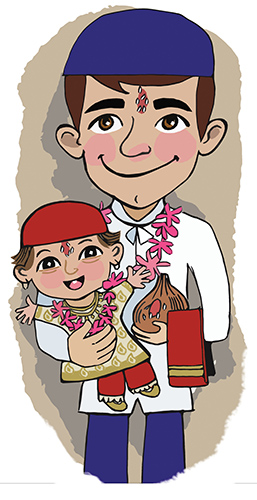
Illustration by Farzana Cooper
Mumai Seervai attained puberty rather late, almost at 14, by which time, her 24-year-old husband had secured a job as an assistant engineer in Baroda. Neither family appeared too anxious for the couple to commence conjugal life.
Unlike her soft-spoken mother, Mumai grew up to be a headstrong girl, with zero tolerance for fools. She harbored no complex at being a fatherless child and learnt quite early to assert herself, when the situation so demanded. Even the ruthless Jehangirji realized that Mumai was a firebrand, not to be trifled with.
In 1903, the Tata Girls’ School in Navsari planned its first excursion to Bombay for the sari wali girls (there were the sari wali girls who were old enough to wear saris and the younger topi wali girls). Even though Mumai was still a topi wali girl, the teachers thought so highly of her that they requested Aimai for permission to take Mumai on this excursion, at the cost of the school.
The girls were provided a feast to remember at the Tata bungalow at Boribunder, where the childless Navajbai Ratanji Tata personally supervised the function (she would, a few years later, adopt Naval Tata). The girls were shown the telephone and told that it was a device to communicate with the dead. The gaggle was also surprised to learn that people in Bombay ate a third meal, which they called breakfast.
Although Mumai stood consistently first in her class, at 12 she was told to discontinue school and instead work in her in-laws’ kitchen. Mumai broke into an allergy as soon as she saw her sister-in-law, who, though a duffer, was attending school regularly. Their skirmishes grew every passing day until Mumai’s husband, a gentle soul, took her to Baroda with him.
At 16, the short, squat, unusually dark skinned Mumai with a rotund face, was almost asexual. Although they stayed alone for nearly eight years in Baroda, the marriage was not consummated. Both appeared to be utterly disinterested in sex. Otherwise, they enjoyed a harmonious co-existence.
During that school excursion, Mumai had fallen in love with Bombay. Back in Navsari, she yearned for Bombay. Fifteen years later, during the First World War, her maternal cousins migrated to Bombay. One of them, Dally, who was particularly fond of Mumai, invited her to Bombay during the monsoon season. Dally resided with his brother’s family in a spacious, rented accommodation somewhere in the Fort.
After returning to Navsari, Mumai realized that she was pregnant. She contemplated abortion by eating raw papayas. She finally decided to have a child. She delivered a son who was named Rusi. Her cousin husband never questioned her till his dying day, about the father of her child.
The child bride never had a trace of passion in her. Nor was she ever indiscreet. She had surprised her family, her husband, Seervai Vad and Navsari with her sudden pregnancy. Perhaps, she herself had been surprised during those rainy nights. A conspiracy of silence would play out over the coming decades with some rather strange consequences.
Berjis Desai, author of Oh! Those Parsis and The Bawaji, occasionally practices law.