The highlight of Swedish convert to Zoroastrianism Alexander Bard’s visit to India in November 2019 was entering and worshipping at Asha Vahishta — The Zoroastrian Centre in Poona.
He termed the two-year-old Centre "a universal temple in a universal country,” unlike other Zoroastrian temples that deny entry to those not born in the faith or located in totalitarian regimes where accessibility may be restricted. Though a convert to Zoroastrianism over 27 years ago in Stockholm, this is the first time Bard has entered a fire temple in India. When the 58-year-old, bearded European is asked his profession, he replies, "philosopher,” while his online profile describes him also as a songwriter, radio producer, television personality, religious and political activist.
"I wish Parsis would have more self-confidence and be more open to others,” he told Parsiana this November 19 during his visit to Bombay. He had never attempted to enter a fire temple in India, knowing he was unwelcome. "I want the Parsi community to accept me as another type of Zoroastrian who cherishes their culture without belonging to the community,” he had told the late Parsiana managing editor, Arnavaz Mama ("Haurvatat is a flow,” Parsiana, April 2008”). By deliberately not choosing Parsi Zoroastrian ceremonies from India Swedish converts avoided the controversies that dogged Joseph Peterson’s navjote, he had noted then.
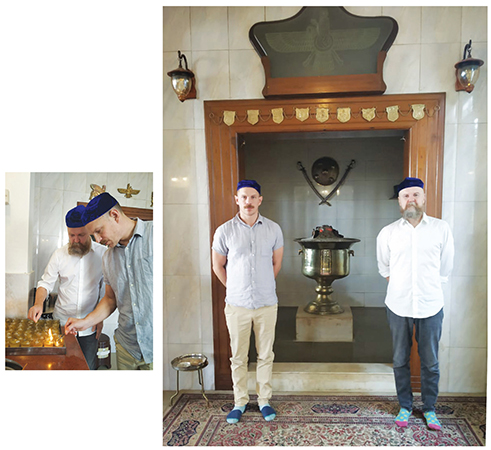
Alexander Bard (bearded) and friend Peter Tauson at Asha Vahishta — The Zoroastrian Centre in Poona
His advice to the Parsis is to "accept those who are sincere, have studied the religion and respect the Parsi community.” He advocates replacing "walls with membranes that one can walk in and out of. Let the children decide which side they want to be on. Stop putting the children (of Parsi mothers married to non-Parsis) outside because of technicalities. Be mindful.”
One factor that drew him to Zoroastrianism was the fire, "Always burning, always changing. That is what life is.” We are "receiving a number of converts” in Sweden, Bard says. Many are atheists who "believe in Zoroastrianism.” As to why atheists would take to any religion, he replies they insist they are drawn to Zoroastrianism. A discussion in his latest book, Digital Libido co-authored with Swedish writer Jan Söderqvist, also deals with "Why religion has nothing to do with God.”
He estimates there are around 3,000 Zoroastrians in Sweden. These include Iranian Zoroastrians in exile, westerners married to Zoroastrians who may have converted and western converts to Zoroastrianism.The Zoroastrian fire temple in Stockholm is "temporarily closed,” says Bard. They are "thinking of starting a new one.” When Parsiana asked Mobed Kurosh Aryana of Bozorg Bazgasht Organization for a clarification, he replied the house of worship was run by Kurds and that "in a few cases when members of our (Zoroastrian) community in Europe asked permission to visit the place, they received a (negative) response.” In "Numbers swell in Sweden,” (Zoroastrians Abroad, Parsiana, April 21, 2012), when Parsiana wrote about the temple, the parties were very forthcoming.
Bard states the refugees/immigrants from Iran who earlier came to Sweden were "highly educated” and skilled. They fled the dictatorial regimes of the Shah and then Ayatollah Khomeini. According to him the Iranian Zoroastrians are found more in France and Belgium, the Kurdish Zoroastrians in Germany, while the Parsis are predominantly in England.
"No religion, no philosophy, no ideology, has ever been as misunderstood or as misrepresented as Zoroastrianism. And this is a double loss, both for the Zoroastrian community itself and even more so for humanity at large, since Zoroastrianism until this day remains the only truly universal religion. We will hopefully be able to make up for this double loss in the coming century, as Zoroastrianism also happens to be perfectly adaptable to the new digital and global cultural environment we are entering. So while the Parsi community in India is struggling with isolationism and the acceptance of converts and intermarriages, the Iranian branch of the religion has been busy spreading its wings internationally. The internet has been and continues to be of great help in this process,” maintains Bard.
Bard was in India to deliver a talk on "Symbiotic Intelligence and Sensocracy” at the INK conference in Jaisalmer in November. The 20-year-old INK organization terms itself a "platform for exchange of cutting edge ideas and inspiring stories.” A sensocracy is one where "machines sense all human drives and desires and adjust the world accordingly.” Bard compares voting for political parties once every so many years as versus voting every minute in a digital era where technology knows what we want.” Digitization changes everything, "It is the biggest revolution in human history...technology is so universally prevalent.” The present models of business, politics, "will be replaced by new systems that are adaptable to technology.”