The medical fraternity in Bombay lost one of its prominent and highly decorated members when Dr Pesi Behramsha Bharucha, a pioneering surgeon and ex-medical director of Breach Candy Hospital, passed away on November 28, 2018 at the age of 98.
Bharucha lived a life filled with achievements, both professional and personal, which had been earned through meeting challenges with fortitude, dedication, hard work, integrity and a spirit of service.
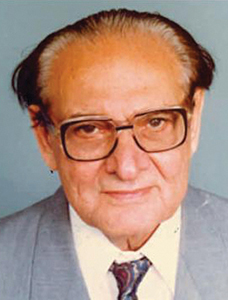
In the early 1950s, after completing his MD, Bharucha set off for Britain and studied surgery. He earned the fellowship – and the post-nominal FRCS (Fellowship of the Royal College of Surgeons) from all four Surgical Royal Colleges in the UK: England, Edinburgh, Glasgow, Ireland. This was an enviable achievement considering that before the unification of the syllabi of each of those colleges and the introduction of a common intercollegiate examination in 2004 (which now leads to a single qualification), a candidate had to take four separate examinations.
Upon his return to India in 1955, Bharucha joined the Tata Main Hospital in Jamshedpur where his medical knowledge and surgical skills were put to the service of a large community. His interventions in accident cases, as well as occasionally in saving lives, soon received widespread recognition. To cite a few examples of the cases he successfully handled during those initial years: An eight-year old boy, attempting to cut wood, chopped off his thumb instead. Bharucha re-attached the thumb without the aid of modern-day operating microscopes. When a patient had severed the tendons in her hand, he grafted tendons from her foot, allowing the patient to retain the use of her hand. Once a worker with burns over 85% of his body was brought in. Without a specialized burns unit (which the Hospital did not have) this condition was considered beyond treatment and potentially fatal. That did not deter Bharucha who undertook the skin grafts, checked on the patient several times a day and, in the process, taught the staff the relevant protocol and techniques despite the lack of advanced facilities. The worker survived and the successful treatment drew national attention.
In a 1962 testimonial, Sir Jehangir (Joe) Ghandy, a senior executive at Tata Iron and Steel Company and Tata Engineering and Locomotive Company, and board member of Tata Industries, wrote to Bharucha after his operation at the Hospital: "Thank you for the excellent manner in which you performed my operation and for the care and attention during my stay. I would not have received better treatment anywhere else in the world. I pronounce you a first class surgeon!”
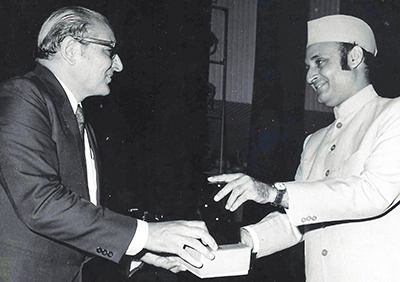
Dr Pesi Bharucha; center (l) receiving award from Dr Karan Singh
(From l) Homi Bodhanwalla, Sumant Moolgaokar, J. R. D. Tata, unidentified executive,
Bharucha showing model of Tata Main Hospital, S. A. Sabavala and Nani Palkhivala
What is remarkable is that the surgeries were not restricted to a particular specialty. Bharucha applied his knowledge and skills to treat a broad spectrum of ailments and injuries. This talent and pioneering work were noticed by the Hospital superintendent Lt Col A. F. Lasrado who came to rely on him to diagnose and treat difficult cases, so much so that he issued an edict that Bharucha (or ‘Pezzi,’ as he called him) must be consulted on all complicated cases. When Lasrado retired, Bharucha was asked to take his place.
At the time he took charge of the Tata Main Hospital, the institution was a "cottage” hospital. To meet the needs of the growing industrial township, Bharucha developed it into a multispecialty center with enhanced medical capability and modern facilities. In 1978-79 he brought in the first orthopedic surgeon, after having done all such complex surgery himself earlier. He sent a fresh obstetrician-gynecologist to the UK for training to become a specialist; prior to that Bharucha had done all the cesarean sections. He also established a radiology and oncology unit.
His medical work was not confined to the Hospital’s wards and operating theaters. In the early 1970s, working alongside Dr Lawrence Brilliant of the World Health Organisation (WHO), he played a significant role in the eradication of small pox. Hitherto, the efforts undertaken in this area were simply to reduce the incidence of small pox marginally, but that meant that the disease would simply resurge. Bharucha understood the shortcomings of this strategy and joined the efforts to eliminate small pox altogether. To this end he travelled to remote areas of Bihar, West Bengal and Orissa. This sort of work was the domain of public health officials, not surgeons, but Bharucha always thought and worked ‘outside-the-box,’ long before that term entered the lexicon. For his work he was felicitated by WHO, and in a ceremony celebrating the eradication of small pox, Dr Karan Singh, the then minister of health, awarded him the prestigious Dhanwantri Award.
After his successful career in Jamshedpur, Bharucha came to Bombay where his wife Gool had a law practice at the Bombay High Court. He became medical director of the Breach Candy Hospital and continued his administrative, medical and surgical work.
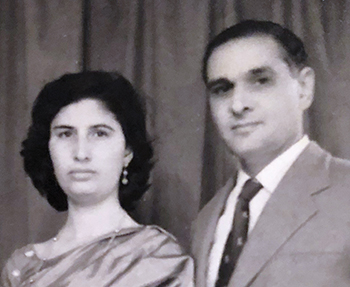
Gool and Dr Pesi Bharucha
At the family level, Pesi and Gool nurtured two children who took good care of him when he became frail in later years: daughter, Dr Azmy Birdi, a medical practitioner in England, and son Zarir who is well-known in the legal field in Bombay.
It is no wonder that Bharucha was held in high regard, even revered, by everyone he worked with, from skilled surgeons and matrons to sweepers and gardeners.
With additional inputs from Rustom Jamadar.