Family support, an enjoyment of nature and inspirational reading help a nonagenarian cope with loneliness and health problems
Burjor Karanjia
I can no longer deceive myself that I’m not the age I am, confronted by a handsome son, taller than me, aged 55, and two charming daughters, 64 and 57. So now I go to the other extreme, announcing my age, 91, to everyone I meet, eagerly waiting for their response "You don’t look it” — a consolation prize for my ego, what little is left of it. But about this, more later.
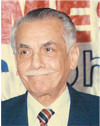
For the last 20 years of my long career, I worked for Godrej. I was not called upon by them to retire, although I had offered to. So, till I was 87, I used to attend my office at Godrej Bhavan. I would leave my home in Bandra at 7:30 with my driver every morning, avoiding the heavy traffic, to arrive at Godrej Bhavan in the Fort area at 8, along with the sweepers. I edited the Godrej house magazine Change, also founded by me, and authored books chronicling the lives of Godrej stalwarts. I thoroughly enjoyed the work. But my wife Abad’s death in 2005, after a prolonged and painful illness, bravely borne, changed everything.
(Top) Burjor Karanjia: creating a new consciousness; (above) A trusted family member supervising children at play
In those days the frequent reports in the press of senior citizens living alone being robbed and killed in their homes were a damper on my continuing to stay by myself in Bandra. Poona seemed the only viable alternative. My son Yuzud who has my power of attorney and his wife Binaifer went on a tame goose chase to look for a suitable flat and make it ready for habitation. The flat they hit upon is no doubt bigger and brighter than the Bandra one and much better decorated. But the fact of my being uprooted from Bombay and the further fact of my loneliness following my wife’s death after 64 years of togetherness was depressing. The flat too was isolated — no grocers, no restaurants, not even a coffee shop in the neighborhood. No friends, too — except for one who had been my technical adviser when I was chairman of the Film Finance Corporation, Sukumar Shidore, and his charming wife Madhu. But they stayed too far away for us to meet regularly.
In the first few weeks in Poona, I was desolate, forlorn. I even considered suicide. I purchased and studied Derek Humphrey’s Final Exit: The Practica-lities of Self-Deliverance and Assisted Suicide for the Dying. At the same time I was a firm believer in Sri Aurobindo’s Hidden Forces of Life. These forces had come to my aid in several times of crisis in my career and guided me to the right path. Once again these forces came to my aid in the form of a book, The Power of Now, and its sequel A New Earth: Awakening to Your Life’s Purpose. These books by the German spiritualist Eckhart Tolle transformed me, they made my declining years exciting and a challenge — not retiring, but as if reborn, reliving.
Here I’d like to revert to the issue of togetherness which played an important part in my life. Abad, a co-student at Wilson College, was as well educated as I was. We would spend hours discussing the raging issues of the day. We were married for 64 years, which must be some sort of a record. Oh, we had our rows, several of them. But because of these we learned the virtues of understanding and tolerance and in the love of our children Rutton, Delshad and Yuzud.
Ever since I can remember I led a strictly disciplined life which continues to this day — wake up at six, bathe, recite the kusti prayers as a devout Zoroastrian, keep myself well informed by reading both The Times of India and The Indian Express to which I often contributed. A highlight of my day is the early morning call to or from Delshad, which I call my "lifeline” because it was that in my early lonely days in Poona. Another highlight is a glass of beer with a papad, at 11:30 a.m. This goes back to my working days in Godrej. Walking from the office to the Ripon Club every afternoon on working days, I would slide into one of the two bars facing the Bombay University to enjoy a beer before going up for lunch, followed by a 15-minute snooze in the armchairs thoughtfully provided by the Club. Back in the office after the lunch break, I would leave for home by four. Then it was my wife’s turn to decide how to spend the rest of the evening.
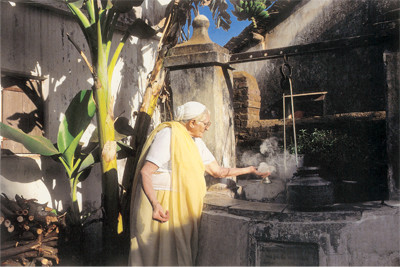
Rituals play an important role for the elderly lady in Udvada
My diet has never been a problem. I eat everything, so long as it is not too spicy. I have no cook, so a local caterer, Khushroo Irani, sends me my food. Over the past few years I have been losing my appetite. People say that as you grow older, your stomach becomes smaller. But Khushroo sends me food enough for three people. When I told him this, he dismissed my comments, saying: "A meal is a meal. I charge for a full meal and must justify what I charge.” He is a principled man and I respect him for that. In any case, I have a domestic assistant who enjoys the leftovers. My attitude to domestics is to this day governed by my mother’s words: "See how much they do for us and the pittance we pay them. Treat them as human beings and never ever dare to trample on their dignity which is their only possession.”
Time I returned to Eckhart Tolle and The Power of Now. In both the Old and New Testament there is reference to the collapse of the existing world order and the arising of "a new Heaven and a new Earth.” As Tolle points out, heaven is not a location but refers to the inner realm of consciousness. The emergence of a transformed sense of human consciousness is reflected in the physical realm as a new earth. The commonly used "I” embodies the primordial error, a misperception of who one is, a false, even dangerous, sense of identity. This is the ego. Albert Einstein, quoted by Tolle, called it "the optical illusion of consciousness.” But Einstein remained humble, egoless. In fact, he even spoke of "a grotesque contradiction between what people consider my talents and achievements and the reality of who I am and what I am capable of.”
There was another factor that transformed what I had considered dull and routine, into an enchantment. Early one morning, on my way to the toilet, I had a fall and cracked a bone in my right thigh that called for an operation and a stay in Jehangir Hospital for over three weeks. My operation was a success. It had to be with a surgeon of the caliber of young Dr Rahul Damle who turned out to be a man whose friendship I cherish. My hospitalization was a break from the routine which was killing me — almost like a holiday! Yuzud and his wife Binaifer came to see me every day. Both my daughters, who live overseas, travelled to Poona to be with me during my hospitalization and convalescence. Rutton, a physiotherapist by profession, taught me several exercises to speed up my recovery. Each of the few friends I have made in Poona also visited whenever they had the time.
At times like these, one truly appreciates the devotion and attentiveness of family and friends. My wife had been by my side through all my previous illnesses, and now it was my children who pulled me through. There was never a dull moment for me. Hospital chairman Jehangir Jehangir and his lovely wife Jasmine also visited me several times. They made me comfortable in every possible way. On the two occasions I fainted due to sudden falls in my blood pressure, I realized how efficient the doctors, nurses and other staff were in emergencies. Jehangir Hospital was unique in that everyone went about his or her work with a smile. The striking thing about Jehangir himself is that he never allowed his baronetcy to come in the way of his treatment of his many employees. He plays cricket with them and joins in all their sporting activities. What I can never forget is the graciousness in offering me the services of his ward boys even after I left the Hospital.
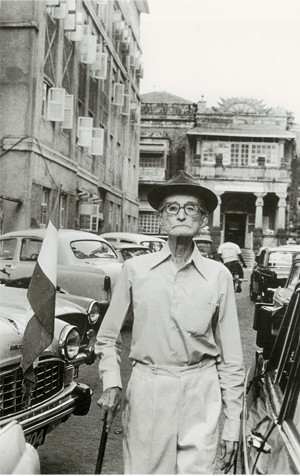
A senior citizen cherishes his independence
The long hospitalization was followed by weeks of physiotherapy and a painful and slow recovery. But I made up my mind, I willed to be able to walk again. I concentrated on creating within myself a new consciousness as explained by Tolle in his book. My mind was powerful; it wasn’t going to be easy, until and unless my will became even more powerful.
For days after coming home, I felt the struggle within me. Ultimately I decided to go down to the garden in my wheelchair. I could not but admire the lush grasses in different shades of green and mauve arranged in zigzag fashion, the numberless flowers in their beds, the vast green lawn ringed with palm trees and encircled by a well-tiled pathway, the flower laden bougainvilleas, dropping flowers which the wind carried across the lawn, white flecks across the steadfast green. I made up my mind that one day I would walk the entire circle. I looked up at the sky, crowded with clouds of all shapes and sizes, their edges tinged with gold from the setting sun, a galaxy that took my breath away. I took it as a happy augury. As I grow older I begin to realize how to find happiness in the little things of life.
Above all else, I owe my happiness in my old age to the loving care and devotion of my daughter Delshad. I’ve come to consider her as God’s gift to me for some good I must have done in a previous life. In the poet Rumi’s words, "she kindled a candle in my heart and filled the void in my soul.” My heart attack in 1967 and my recent fall were the two best lessons in my life, showing me the dangers of sedentary living and playing my own doctor. My thinking has been transformed in subtle ways. I have discovered the joys of good health and of living in harmony with nature. I have learnt to be tolerant and understanding and never to sit in judgment. I have begun to listen, really listen to what other people are saying. I have learnt to control the random thinking in my head and the brazen depredations of my ego. I have learnt the humility of recognizing my limitations and, doing so, discovered the inner strength and fearlessness one needs to emerge from old habits and set patterns, and recognize difficulties for what they are — just obstacles. And obstacles by their very nature have a way of vanishing when confronted.
Tolle describes the ego by a simple example. On a visit to a restaurant there is no ego in telling the waiter that your soup is cold and needs to be heated up. You stick to the facts which are always neutral. "How dare you serve me cold soup. Know who I am?” That’s complaining. There is a "me” here that loves to feel personally offended by the cold soup and is going to make the most of it, a "me” that enjoys making someone wrong by feeling "wronged” itself. Grievances constitute a significant part of many people’s ego; collective grievance can survive for centuries in the psyche of a nation and fuel a never-ending cycle of violence. Take World War II, a clash of national egos that left a death toll of several million.
Ladies engaged in creative work at the Sir Ratan Tata Institute in Bombay
There has been a shift in my reading from the great novels of Charles Morgan and Lawrence Durrell to scientific and spiritual books. I am reading two now — The Intention Experiment by Lynne McTaggart and Apprenticed to a Himalayan Master: A Yogi’s Autobiography by Sri M. A mind-blowing thought inspires the first — what if thought had the physical power to focus our lives, heal our bodies ... and even transform the planet? The book reveals how invention has a real effect on the world and shows how to "power up” your own thoughts and impressions to change your life and those around you, and gives you the opportunity to participate in the world’s biggest mind-over-matter experiment in history. The second book, a yogi’s autobiography, is the rags to riches story of a young man from Kerala who, by sheer dedication, sincerity and single-mindedness evolved into Sri M, a living yogi. One of the most unusual and intriguing aspects of this story is that Sri M was born Mumtaz Ali Khan. Both the books were gifted to me by a dear, dear friend "To dear Uncle, with love always, Pushpa.”
Music, too, Western classical music in particular, has always been a source of great inspiration to me. Now more than ever before I get a feeling of exaltation at the high reaches and profound ecstasies of great music — Rimsky-Korsakov’s Scheherazade, Macsagni’s Cavalleria rusticana, Handel’s Ombra mai fu — and each time I listen to these they tear at my heartstrings. I find I write better, because of the sustained effort required, particularly when writing a book, listening to music. Even the frequent writer’s blocks tend to melt away. You might almost say I write on borrowed inspiration.
I would like to end on an inspirational note, with a quote from Tolle. "Whenever there is inspiration which translates as ‘in space’ and enthusiasm which means ‘in God,’ there is a creative empowerment which goes far beyond what a mere person is capable of.” As one to whom writing is a form of prayer, I long more than anything else for this creative empowerment. Yes, even at my age!