A tribute to Dr Maneck Bhagat, medical man,
mentor and musician, on his 100th birth anniversary
Dr Patricia Steckler Bhagat
It was 7:30 a.m. sharp in Pediatrics Ward 2, at the King Edward Memorial (KEM) Hospital, Bombay. In came Dr Maneck Bhagat (pictured), dressed informally in his plain shirt and pants. First stop: the ward toilets. Were they scrubbed clean? If not, there was hell to pay. The orderlies had to appear pronto and scour those bathrooms spotless. Then, one by one, the nurses brought in the
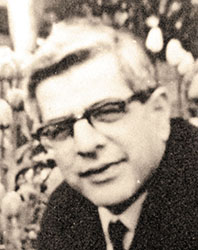
newly admitted children for Bhagat to examine with his pediatric residents and medical students gathered around. "The nurses had to be meticulous with the kids’ cleanliness. The nails had to be scrubbed clean,” said one of Bhagat’s former residents, as life-threatening gastrointestinal infections were rampant among the vastly overcrowded slum communities from which the patients in his KEM ward came.
Bhagat was the third pediatrician in Bombay. The art of the thorough, meticulous clinical exam taught by him prepared his residents, from the 1940s through the 1970s, to confidently diagnose and treat ill children throughout their professional lives. As heads of inner city pediatric units and as researchers in pediatrics now in the United States, many of his former residents have built professional lives that are a living legacy to his excellence, and worthy of celebration in the 100th year of his birth.
At the ward, Bhagat’s residents would arrive hours before he did in order to examine and fully work up each new admission. Sometimes 40-50 children were admitted overnight. "The ward was an open unit with two rows of 30 or 40 beds and cribs on either side of a central aisle. Parents had to sleep on the floor. Often the number of patients would exceed the bed number but we had no choice but to accommodate them,” shared Dr Sarla Inamdar, one of Bhagat’s residents who now heads the pediatric department of Metropolitan Hospital in New York City and was named one of the city’s top pediatricians in New York Family magazine in 2012. And then would come the delight for Bhagat’s residents: his bedside clinics and ward rounds. Once his pre-rounds standards were met, Bhagat relaxed. His warmth and affection for his pediatric residents and patients, and his lively, engaging teaching and lecturing at each child’s bedside, filled the ward.
Each morning’s rounds began with Bhagat asking his residents to tell him the child’s story, rather than lab results, including a "thorough history of the child’s growth and development, a very careful exam of all systems with an analysis of the findings, and a sound differential diagnosis,” explained Inamdar. He "took great pains in demonstrating all the clinical signs,” said Dr Mahrukh Joshi, one of his assistant attendants, who went on to create an intensive care unit in Bombay which treated premature low weight babies from all over India. "Besides,” she added, "there was little choice: the KEM was an overcrowded urban hospital and had few funds for labs and equipment.”
Early in her training, Inamdar saved a baby’s life thanks to Bhagat’s teaching. A very ill six-month-old baby was admitted, vomiting repeatedly. The senior resident from a different pediatric ward insisted that the baby had meningitis and required a full and time-consuming lab work-up. Inamdar intervened, "Wait, a minute!” she exclaimed, "this patient has a blockage in the stomach and needs immediate surgery!” She had closely observed the baby’s belly where she could see the waves of peristalsis moving from the left to the right but not proceeding any further. "That’s a classic sign of pyloric stenosis,” she explained. She prevailed, emergency surgery was performed, and the baby survived.
Born in 1917, Bhagat grew up in a middle class family. He went to Seth G. S. Medical College in Bombay and later earned the highest British honors in both medicine and music: Fellow of the Royal College of Physicians, London, and Fellow of Trinity College, London, in Music Theory and Piano Performance. His training and the London advanced exams were completed in India by the 1940s, as described by Dr Jissa Moos in Bhagat’s official Royal College obituary. However, in 1969 Bhagat went to London for his induction as a Fellow of the Royal College of Physicians. Soon after he died, the Maneck Bhagat Gold Medal for the MD pediatrics examination of Bombay University, and the Maneck Bhagat Honorary Oration were established by his students in his honor. Thirty-five years after his death, these honors are still being bestowed.

From left: Khorshed, Maneck and Patricia Bhagat
"Three things mattered most in life to my dad,” says his daughter, Shirin Watcha: "Music, medicine and family.” Though a Western classical music career in India was not practical financially, music became an enduring, lifelong passion and another sphere of excellence for him. Bhagat was also my father-in-law: I am married to his son, Phiroz.
Each of his former students, colleagues, and family members interviewed for this profile highlighted Bhagat’s integrity. "He was a fearless fighter for the truth and did not hesitate to pick up the cudgels for any resident or any cause where he saw wrong,” recalled Joshi. He would not engage in giving or taking fee ‘kick-backs’ from other doctors for patients referred to him, or sit on the board of any pharmaceutical company even though many invited him to do so. He never suggested that his hospital patients come to his private office, as did many of his other colleagues, in order to collect a fee. "However, if poor patients with no hospital to go to came to his private office, he would treat them free of charge,” stated his daughter.
Prior to the 1940s, mothers’ obstetricians took care of children. The need for doctors trained in treating ill babies and children opened the door to pediatrics as a new specialty, and Bhagat eagerly stepped in. His teachers were the first two pediatricians in Bombay. However, he furthered his knowledge by reading every pediatric medical book and journal article that he could lay his hands on. When a rare new medical book came to Bombay, he would borrow it from a local bookstore, take copious notes and incorporate the latest findings into his lectures. He published numerous research papers throughout his career, including important ones on the understanding and treatment of the convulsions that babies with high fevers were susceptible to. He also set up the first neo-natal unit in his hospital ward.
He made his own meticulous lecture slides, and created an "excellent movie on how to conduct an examination of a newborn baby,” noted Joshi, at a time when video equipment was rudimentary and had no sound recording apparatus. He did his own narration and painstakingly spliced it in to accompany the film. Pediatric medical students and residents viewed it as part of their training. He loved being the honorary pediatrician at The B. D. Petit Parsee General Hospital. His son remembers him saying, "I learn from KEM and give back to Parsee General.” He was also long remembered by many in the Parsi community from his attending to so many of them in his private practice.
Many of Bhagat’s former students came to the US and have held important positions including: Dr A. V. Jayam, chairman of Department of Neurology at Howard University, Washington, DC; Dr Sheela Laungani, chief of neonatology at Kings County Hospital in Brooklyn, New York; Dr Tonse Raju, chief of pregnancy and perinatology branch at the National Institute of Child Health and Human Development; the late Dr Shobhana Vora, researcher in hematology at the Scripps Institute in La Jolla, California; Dr Rama Bhatt, senior neonatologist at the Cook County Hospital in Chicago; and Dr Jyotsna Deshmukh, who was in private practice in the Bronx, New York.
Bhagat’s story is only partially told without knowing about his wife Khorshed, and his passion for music. From a very early age he was giving piano lessons, and it was that which brought him and Khorshed together when she successfully auditioned to be his student. She would travel three hours by the Deccan Queen train from Poona to Bombay for her lessons every fortnight and would stay the night with a family approved of by her parents. A young single woman traveling unaccompanied was frowned upon in those days. But Khorshed was determined to learn classical music and piano performance from the man widely regarded as the best teacher.
Khorshed was the gentle, kind and soft-spoken counterpart to the gruff and irascible doctor. But, like him, she too was principled and strong. During their marriage, when she found Bhagat to be harshly opinionated, too curt or unkind with residents, colleagues or hospital administrators, she firmly set him straight. During World War II, a European pianist due to perform Grieg’s Piano Concerto in Bombay became ill and was unable to travel for the scheduled concert. With only two weeks until concert time Bhagat was asked to step in as soloist and he agreed. His demanding hospital schedule left him with little time to practice at his piano. Fortunately, he could "play and hear” the music in his head. He studied and memorized the score while travelling to and from the hospital by tramcar. At the concert, he performed impeccably.
In 1982 when we were expecting our first child, Kay, and Bhagat’s first grandchild, he and Khorshed came to New Jersey to share in this happy event. When my obstetrician learned who my father-in-law was, he invited him into the hospital nursery to be the first doctor to examine Kay. I remember seeing him through the glass window of the nursery, gowned up in yellow hospital garb, tenderly holding his grandchild in his arms.
Once we were home again I asked him to accompany me to Kay’s first baby visit with our new pediatrician, Dr Arvind Shah. When we walked into the examining room, Shah exclaimed, "I can’t believe it! You are that Dr Bhagat!” Not only had he known Bhagat’s reputation in India but had also sat before him for his final pediatric certification exam. Happily, Shah’s thorough examination of his new grandbaby met with my father-in-law’s approval. During that visit he was my at-home pediatric expert. So much of what he taught me stays clear in my mind today: like the banana/yogurt shake he’d devised as the ideal remedy for babies’ upset stomachs. He played delightedly with Kay. How thrilled he would be now to know that Kay has just given birth to her first child, a girl, Fiona Roshan!
When Bhagat came to the US to be with us he had a heart condition, and the risk of having a heart attack away from Bombay worried him. He was not afraid of dying, but he was concerned that his body would not be brought back to the Tower of Silence, the hilltop garden retreat in Bombay where Zoroastrians take their beloved family members after they die. He died in our home, five weeks after Kay’s birth, at the age of 65. We lost him too soon.
On the day of his death all his New York area former students performed a miracle. They felt deep affection for their former mentor and teacher, and so each of them left their respective hospitals and divided up tasks: certificates from the Indian Embassy; airline arrangements to get Bhagat’s body onto the plane to Bombay; papers required by the US government to transfer his body. By that evening all was accomplished, and my father-in-law made it to his Tower of Silence as had always been his wish.