A 100 years ago, a Parsi couple, Nanabhai Davar and his wife,
traversed the majestic and unforgiving area of Ladakh
Text: Aban Mukherji Photos: Doreen D’sa
With steely determination the Davar couple trekked through difficult Himalayan terrain, completing their arduous three-month journey to Ladakh via Kashmir. It was reportedly the first ever such trip undertaken by a woman. Parsiana carries a three-part series by Aban Mukherji’s retelling of the trek recorded by the duo
I never expected Nanabhai Sorabji Davar’s Vichitra Ladakhmaa Tran Maasni Manjal or Three Months’ Sojourn in Wondrous Ladakh to be riveting enough to keep me glued to my seat till I finished reading the book; a book I had found tucked away in the corner of a library cupboard.
Written in Gujarati in a surprisingly straightforward and captivating style, the book was published in 1936 by the Gurjar Prabhat Printing Press, Calcutta. The book was a compilation of the many articles sent by the author and his wife, a fellow traveler, to the Jam-e-Jamshed in 1932, after they completed their nine-month sojourn (May 1931-February 1932) to Ladakh via Kashmir.
Davar’s descriptions of the places they visit, the many spectacular and dangerous passes they cross, and the narrow mountain roads they traverse, leave one spellbound as one is drawn into a terrifyingly majestic and unforgiving Himalayan landscape. This book, I felt had to be brought to the notice of a wider readership.
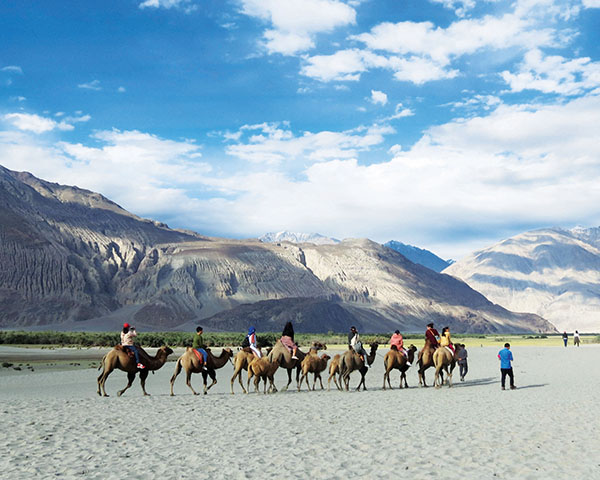
Bactrian camels in Hunder, in Ladakh’s Nubra Valley
Contemporary photo to reflect the terrain
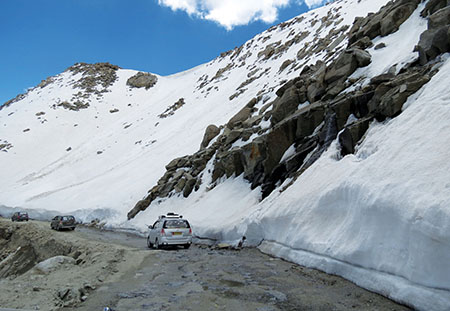
Crossing at Khardong La Pass
Contemporary photo to reflect the terrain
The Davars dedicated their book to Sir Jivanji Jamshedji Modi, the renowned scholar of Zoroastrianism and the Parsis. "There is only one Zoroastrian who has travelled in the same direction and even further than us, and has written about his travels, and that is the late revered Shams-ul-Ulama Dr Sir Jivanji Jamshedji Modi,” writes Nanabhai in his preface , referring to Modi’s book My Travels Outside Bombay: Iran, Azerbaijan, Baku.
The Davars had visited Kashmir in 1928. Their curiosity aroused after reading about Ladakh in Dr Arthur Neve’s guide book, The Tourist Guide to Kashmir, Ladakh and Skardo (1923), they decided it would be their next destination. For the next two years they read up all they could lay their hands on, about Ladakh. Another book they seem to have referred to often was Major M. L. A. Gompertz’s Magic Ladakh: An Intimate Picture of a Land of Topsy-Turvy Customs & Great Natural Beauty (London, Seeley Service and Company Ltd, 1923). As the Davars wrote in Gujarati I have spelled the place names as Gompertz has done.
"It is cold here, for the sun disappears early behind the surrounding hills, and you will want all your warmest clothes, and be very glad of warm food and an early bed, though you may find considerable solace in the marvelous view as you look back to the long line of hills on the farther side of the Indus,” wrote Gompertz. "You sit in the grey shadows, watching them catch the last evening light on their snow-capped summits — a great chain of flaming red and gold peaks, under a rapidly darkening sky, whose translucent cobalt is changing to indigo even as you watch it, while the peaks pass from rose to madder, madder to green, to blue, and then to cold white.”
I was most impressed by Davar’s wife’s indomitable spirit and daring. She was game for any adventure, the more arduous and dangerous the better. Unfortunately, her husband never refers to her by name. It is always "maari dhaniyani (my wife)!”
Despite being warned by the tehsildar of Leh that it would be near impossible to reach the famous Shyok Dam (Khumdan Glacier), and out of the question for a woman to do so, she put her foot down, retorting, "Have we come thousands of miles just to turn back now?” Her husband was helpless in the face of such steely determination. And though right from the start their journey was beset with problems, go to the Khumdan Glacier they did.
On their return to Leh, the lady was looked upon with great awe and wonder by the locals as "the woman who has returned from Khumdan alive!” The tehsildar was sure that no woman had ever attempted such a feat. She was, perhaps, the first Indian woman to successfully complete such a perilous journey, and most certainly the first Parsi woman to do so. "Only God knows if this is true,” states Nanabhai, "but I can vouch for the fact that we did go to Shyok Dam!”
Shyok Dam/Khumdan Glacier is on the way to Yarkand, and one has to cross one of the most dangerous passes — the Saser Pass — to reach it. This is a "high mountain pass on the ancient summer caravan route from Leh to Yarkand in the Tarim Basin. It leads from the head of the Nubra Valley into the Upper Shyok Valley on the way to the even higher, but easier Karakoram Pass.” Before Saser there is the forbidding Khardong La (pass) to cross and no one expected the expedition to succeed.
Around the time the Davars were contemplating this trek, an English officer had returned disappointed at not having been able to cross the Saser Pass. But Davar’s wife was not one to give up. So the tehsildar advised the couple to go at least till Panamik, the last big village of Nubra Valley, to get a glimpse of the spectacular landscape.
The Davars found their porters most reluctant to accompany them. They made a number of excuses: there were two extremely difficult passes to cross; if anything happened to them their families would suffer, etc. But the lady remained adamant. She was quite willing to place bangles round their wrists and send them packing. Seeing that she would brook no opposition, they reluctantly prepared to accompany the couple.
And so, after a 10-day rest in Leh, their journey towards Khardong La began on a bitterly cold day on July 19, 1931. The weather was icy cold when they reached Leh Polu which boasted nothing but a dilapidated hut for travelers to shelter in. The following morning, after a sleepless night, they began the ascent of Khardong Pass. There were huge rocks with crevices made slippery by the melted ice, causing the ponies and mules to stumble and slip. Moreover, the ponies had an unnerving habit of walking on the outside of the ledge of the narrow mountain paths "in order to avoid scraping their loads against the inner wall of the cliff and so being pushed into space.” On one occasion the lady fell off her pony but got up without batting an eyelid. Though battered and bruised, she laughed it off saying, "Those who want to learn riding have to be prepared for a fall or two.” After that, they had to climb up the slope on foot. This is a very difficult pass and remains open only from June to November. On the way they passed a snowfield and found themselves knee deep in snow! The corpses of pack animals lay strewn across their path.
Later, the road improved and they reached Khardong Village only to discover that both the khansama (cook) and sweeper who had been sent ahead had not arrived. They were told that the two had been unable to cross the pass. Davar’s wife was unfazed. "I’ll be cook and I’ll be sweeper,” she declared, and began arranging three stones to build a fire on which to boil water. But the next day the two hired hands sheepishly made their appearance when they realized that their ruse to abort the expedition had failed.
On the following day the climb downhill began. It was picturesque country with a stream flowing by, its pale blue water crystal clear, reminding them of the Sindh River in Kashmir. Wild roses grew in profusion. They were soon walking along the left bank of the Shyok River. As the river was too deep to ford they were forced to take a long detour.
Their trek ended at Khalsar, a very picturesque village on the other side of the Shyok River. This village had a gauge reader to check the level of the water. When the water began to rise, a postman would be dispatched to Leh by boat to inform the tehsildar who would then send a message to Srinagar.
As a suspension bridge had been washed away, another long detour had to be taken across a sandy plateau. When the Davars reached the other side, they could see the wide Nubra River surrounded by fertile plains. The source of the Nubra is the Siachen Glacier, 47 miles in length.
Nubra Valley is flanked on both sides by tall snow-capped mountains, their peaks visible through blue mists. It is a fertile valley, rich in apricot and apple trees, fir and poplar trees. The panoramic view of the Nubra Valley that the Davars had first seen before their descent — Shyok River flowing below and the Nubra River, like a thin, slithering snake, making its way towards it — was utterly breathtaking.
The luggage was loaded on rafts by boatmen who wore loose robes which they would bundle up to their chins exposing their stark naked bodies as they carried the goods onto the rafts. The ponies were divested of their saddles and the Davars were told to ride bareback through the waters. This was very difficult and they had to cling to the manes of their sturdy beasts. Davar’s wife, unable to manage this, was hoisted onto the shoulders of a boatman. Soon they reached the other shore and turned their backs on the Shyok River to enter the Nubra Valley.
The Davars passed picturesque little villages like Tirit, rich in fruit trees, crops and dog-roses — the "summer dress of Nubra Valley” — and traversed sandy open spaces to reach Tegur, a camping site for travelers. The roads were wet and slippery and they often had to wade through marshy land.
They reached Panamik, the largest village of Nubra Valley, an area famous for its sulphur springs. The water of these springs was so hot that when a filthy handkerchief was passed through it came out clean and milky white. Two huts were provided in which men and women could bathe separately.
To be continued