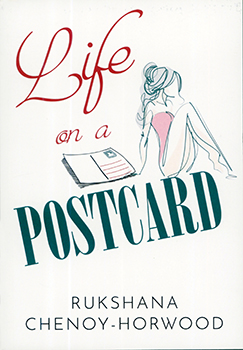
Life on a Postcard by Rukshana Chenoy-Horwood. Published in 2022 by Olympia Publishers, Tallis House, 2 Tallis Street, London, EC4Y 0AB. Pp: 335. Price: Rs £ 9.99 and $ 12.99.
Medical emergencies abound in the life of Rukshana Chenoy-Horwood (pictured) in her novel Life on a Postcard. As a stewardess, she has delivered a baby at 35,000 ft, and injected an 18-year-old in the heart. Now, in Postcard 30, the first in the novel, in the midst of "clear air turbulence,” the plane hits a pocket of air which resulted in a sudden fall of 50 ft. While she is running from pillar to post, checking if the passengers had their seat belts on and if there were any casualties, a lady passenger suffers a heart attack. Horwood is excellent in creating an atmosphere of nail-biting excitement and apprehension while her protagonist/alter ego, Charlotte Baxter, and her colleague try desperately to search for a suitable spot to place the defibrillator as the lady was very well-endowed. Narrating all this tension, Horwood does not lose her sense of humor; after 40 minutes of resuscitation, the woman revived and as a measure of thanks vomited all over them (see "Mid-air maneuver,” Parsiana, March 7-20, 2023).
 Horwood decides to tell her story through "snap shots, anecdotes and incidents.” It is, she confesses, the story of her life, "well, almost my life…a lot of it is made up.” These postcards are numbered from 1-98, but especially in the beginning, she avoids chronological narration. This is an excellent strategy as one starts with Postcard 30 which throws the reader headlong into the story rather than Postcard 1 which describes a relatively boring episode where her mother gives birth to her despite having fibroids, which "had miraculously… moved out of the way (so) that a child would be born after all.”
The postcards are not piled on without any thought to the narration. Horwood presents the critical ones first. Hence, we learn in Postcards 8-10, which soon follow Postcard 1, of the important event when her father announces out of the blue one Sunday that "it would be wonderful to travel,” and mentions in the same breath that the family would be shortly moving to Hyderabad from their comfortable existence in the UK. The arrival in Hyderabad is next described in these postcards where Horwood relates Charlotte’s initial reactions as she looks at India through rose-tinted glasses: she is charmed with the colors she sees everywhere — the hustle and the bustle of a big metropolitan city. But reality sets in very soon and she realizes the privileged life they lead in their comfortable home in Hyderabad run with the assistance of a chauffeur, cook and nanny, but which is surrounded by blatant child labor, intense poverty and open drains, to name a few. But despite all the negatives, "I loved it so much that I vowed to go back and live there one day.”
Horwood introduces us to a host of interesting minor characters, several of whom Charlotte would maintain a lifelong relationship with. One was Mr Raju, a neighbor, whose informal behavior of visiting without prior notice was anathema to her. He is always there to provide good advice especially when Charlotte is facing difficult alternatives. When she is a flight attendant, she makes friends with the gutsy, calm and collected Freya who has a stormy relationship with her boyfriend Adrian. The ups and downs of their relationship are described in a very amusing and forthright manner. Then there is also Graham, who she calls Gayem, "the greatest drama queen that ever minced the earth.” He shrieks when a snake emerges from a passenger’s hand luggage; when Charlotte falls and bleeds rather profusely, he is more worried about the floor he has just polished rather than the fact that she was wounded. Though Graham is a great figure of fun, Horwood does seem to stereotype him to a very great extent. However, Horwood presents an unusual closeness between these three friends and, when Freya has to undergo chemotherapy, all three of them — Charlotte, Adrian as well as Graham — shave off their hair and become bald in solidarity with Freya.
 Zareer Mody, the son of an army general, becomes the love interest of Charlotte’s life. It is, pardon the cliché, literally love at first sight and she is thrilled that her affection is reciprocated. He is a Zoroastrian and has all the necessary qualities for being Mr Perfect. He is "wise beyond his years,” interested in philosophy, literature and music and "felt everything with such passion.” Zareer soon graduates with excellent grades and plans to go to USA for further studies. Charlotte’s father’s term in India comes to an end and it is time for the family to leave the country. The couple hope to meet up in the vacations but fate has other plans. There is an unfortunate incident and if Horwood is capable of presenting scenes of great mirth, enjoyment and hilarity, she is also capable of describing heartbreak and sorrow in equal measure. And though the general tone of the novel is upbeat, there are moments of great suffering and tragedy which the author handles in a skillful manner without descending into melodrama.
Charlotte decides to become a stewardess and, to appease her parents who are sick with anxiety, she plans to write a postcard from every destination despite the fact that considering the vagaries of international post, the postcards often arrive after she does. She realizes that the job is not as glamorous as she thought; a stewardess is no "Trolley Dolly” and she goes through rigorous training not just to serve a drink to or restrain an unruly passenger but also to deliver a baby mid-air, comfort irritable children and pacify discontented passengers — "all at the same time.” On one of her flights, a pregnant passenger’s waters broke and she had to assist in the delivery. Charlotte was more tense than the woman who was giving birth to her third baby!
Horwood continues to load incident after incident of exciting and unusual occurrences. On a flight to New York, a passenger suddenly has problems with breathing and his condition deteriorates by the minute. The call for a doctor resulted in a doctor of letters who could at best translate Tolstoy’s War and Peace into Latin! The young passenger soon loses consciousness and every effort to revive him seems to fail till Charlotte takes a decision which could have cost her her job. She gives the patient an adrenaline injection in the heart. The patient recovers but Charlotte has to undergo a disciplinary process: she did not lose her job but was certain that "even if I had lost my job, it would have been worth it.” During a flight to Dallas a passenger chokes on a piece of chicken and Charlotte has to hit him violently on his back till he spits out the offending piece. After a Herculean effort he recovers and Horwood wryly comments that Charlotte does not "give him the option of ‘chicken or beef’ for the rest of the flight!”
In the midst of her hectic career and interesting escapades, she meets Guilliaume, the love of her life, on a flight, under even stranger circumstances and he proposes to her in an equally bizarre and unconventional manner. The courtship, marriage, the difficulty with pregnancy and the birth of her child are all described with great gusto and immediacy.
Reading the novel, one wonders which part of it is factual and what comprises the 50% which is made up. Horwood confessed in the interview with Lord Karan Bilimoria at the book launch at Nehru Centre in London that she did deliver a baby in flight but it was not her first flight as she had claimed. But the reader must remember that Horwood makes no claims of writing an autobiography — it is a novel after all, and a very enjoyable one at that. At the same book launch in London, she mentioned that her ambitions for the book would be fulfilled if people picked up the novel, read it, laughed for a couple of hours and forgot all about their problems. Reading the book, one certainly feels she has achieved her ambition. F. G.