On Wings of Fire the movie made
31 years ago has been restored
Farrokh Jijina
"Our idea is to sell or give the DVDs (of the restored film) away to young people getting married and also to kids having navjotes. We are keeping the price low so all people can afford it and learn about our history and religion,” says Cyrus Bharucha, director of On Wings of Fire which he co-produced with brothers Meherji and Jamshed Madan, under the banner of Persepolis Production Inc and Oriental Heritage Trust. Thirty-one years after the theatrical release of the film, which received some critical acclaim as well as brickbats from traditional Zoroastrians, and 15 years after the DVD was first released, the producers are ready to release a restored version of the film. Modalities of distribution for the DVD, priced at Rs 399, are being worked out.
The film is a history of the Zoroastrian people and depicts the search for his roots by renowned music maestro Zubin Mehta with the help of a priest played by Khojeste Mistree. "The deal was that he (Mistree) could not change a single word in the script,” Meherji informs Parsiana over lunch on April 5, 2017. Bharucha, who started his career with the BBC (British Broadcasting Corporation) in London, worked in the USA for 30 years and has over 80 television shows to his credit.
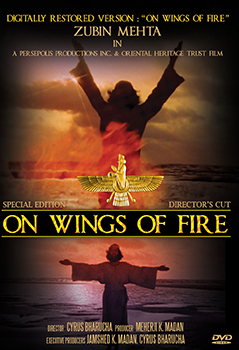
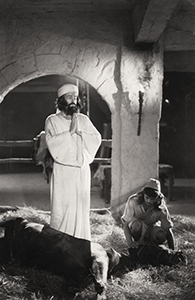
Cover of restored DVD; Nigel Terry as Zarathushtra
Cyrus Bharucha, Meherji Madan, Jamshed Madan
Clockwise from top: At the filming; Bharucha (middle) with
Dadi Balsara (left) and Sohrab Godrej (right)
The director recalls that when the film was first released in 1986, he was accused of insulting the religion by a group known as the Committee of Vigilant Parsis "who first invited me to sit inside a circle and threw questions at me about the religion and objected to the fact that I had a non-Parsi playing Zarathushtra ... Aapro too good actor Homi Daruwalla should play the role, not some foreign person.” Meherji informs us that "they wanted us to show Zarathushtra with a halo around him all the time!” The prophet was played by British stage actor Nigel Terry. Jurist Nani Palkhivala, who defended the producers in court, "stood up for just eight minutes and destroyed their ... arguments by talking about the Constitution and the power of free expression and speech in the country.” Bharucha chuckles that "when the case was over, the judge asked me for tickets to the premier.”
The director, who lives in Poona, and in San Diego for part of the year, states that last year Meherji suggested they restore the film which was in a poor state. "Frankly, I had doubts about any one helping us financially on an old flick,” he writes in an email to Parsiana. Funds were collected from donors and community-minded individuals. Meherji mentions that Farokh Kavarana, chairman of several Tata companies, "ushered (me) in January 2016 to Tata Sons, and inspired the Tata Trusts to assist us and launch this precious project of restoration.” Kavarana also personally contributed Rs 22 lakhs towards the project. Bharucha adds that art aficionado Pheroza Godrej, industrialist Cyrus Guzder and corporate executive Homi Khusrokhan also chipped in with funds. Meherji shares that they were able to move ahead after 17 large film cans, some damaged by water flooding, were brought over from Jamshed’s office in Connecticut during a trip to India.
Bemoaning that the "immense wealth of film material in our country has not been stored in proper conditions over the years,” Sheeba Sehgal, the restoration expert involved in the project explains that celluloid film is very fragile if not stored in correct temperature and humidity conditions. Proper storage of these cellulose acetate/nitrate films is essential and is termed ‘film preservation.’ For films that are deteriorating as the years go by, they require a process of ‘restoration,’ which, then, can last for more than 100 years if stored properly, she shares.
Sehgal explains in an email that restoration involved five steps: scanning of the negatives from film to digital output and removal of superficial dust; cleaning the inherent dust, oil and handling marks; color correction to remove changes due to the environment and re-coloring "according to our esthetic liking, yet closer to the feel of what the film should be;” clean-up of the sound where the music, dialog and effects are mixed together in one track, including replacement of some old music tracks with better recordings of the same pieces, recreating some sound effects, and re-dubbing where necessary; printing of the film back onto Kodak stock ("I am reiterating the fact that celluloid is the best medium for preservation of film”); finally, printing of DVDs from the master version.
"It is a whole new film now ... completely with respect to the wishes of its original producers,” she notes.