Surgeon turned fashion designer Arnaz Soonawalla has opened
her first retail outlet in the heritage district of Kala Ghoda with
friend-cum-business partner Gopi Vaid
Farrokh Jijina
"Creativity occurs impetuously,” according to ENT (ear, nose and throat) surgeon-cum-fashion designer Arnaz Soonawalla, of the women’s wear label of "Gopi Vaid by Arnaz and Gopi.” The duo of Soonawalla and Gopi Vaid have, on October 15, 2016, opened their own first retail outlet in the heritage precinct of Kala Ghoda, after retailing from their atelier in Municipal Industrial Estate at Lower Parel in Bombay since 2003. Talking to Parsiana in the airy 500 sq ft retail showroom a week after the opening, Soonawalla says the school friends first retailed exclusively at Mélange the store-cum-clothing brand of Lifestyle International Private Limited. Their clothing now retails at 20 high end design studios and retail outlets, including Mélange, Ensemble, Aza, Fuel, Vama and Amethyst, in all major cities.
Arnaz Soonawalla (right) with Gopi Vaid
Chandni collection using gota work in a
Persian pomegranate motif
Ajrak Collection with Kutchi vegetable dyeing techniques
and Mughal flowerpot motif
The outfits are manufactured by a team of nearly 100 craftsmen who are mostly male. Staff includes machine embroiderers, hand embroiderers and a stitching unit that turns out 500 garments a month. "We have the designs, they add their exquisite handiwork,” adds Vaid, joining the conversation. The fabrics are mainly cottons and cotton silk, and they "shy away from chiffons and georgettes.” Material is hand dyed and hand block-printed at their workshop. If a fabric requires digital printing, that service is outsourced. A write-up accompanying the invitation to the opening of the store states that "the label continues to be identified with ‘dori and mirror work,’ explaining that in this craft the fabric is embroidered with a thin cord or dori using a hand embroidery machine, with mirrors fixed later.” Other techniques include embroidery with beads, sequins, zardozi and appliqué work. Bridal wear is also part of their creations. A range of western wear (shirts, linen dresses and "resort wear”) is exported. Sixty percent of their sales come in from exports, says Soonawalla, revealing that in the USA they partner with a ready to wear label called ‘bella tu’ (Beautiful you) started by designer Jeanne Daniel. Even these have elements of Indian design, echo both designers, who turned 50 last year. "We will always have a touch of India in our lines” (of clothing), smiles Soonawalla.
Already manufacturing and selling a range of scarves and potlis (ethnic evening bags), "who knows, we may do more of that soon,” says Soonawalla. "Or perhaps introduce the resort wear line into our store,” adds Vaid. Prices range from between Rs 30,000 to Rs 150,000 for a wedding lehnga (ankle-length skirt, favored at formal or ceremonial occasions). Everyday wear retails from between Rs 7,000 to Rs 10,000. The duo does not intend to stock heavier pieces in the store "because we won’t always be present there to customize them. For that, the clients will have to come to Lower Parel,” says Soonawalla. They have no desire to launch a range of menswear, laugh the duo.
"Both of us are creative personalities,” says Soonawalla, revealing that they schooled together at Queen Mary’s and then went their separate ways, she to study medicine, "after debating between architecture and science.” Vaid went on to pursue a law degree and to work with her mother Mita Parekh, a textile professional "who was the first to introduce hand-block printed fabrics with an English palette (pastel shades) to Bombay.” Vaid had artisans working in the compound of their home, recalls Soonawalla. Many artisans, and in some cases their offspring, who worked with Vaid’s mother, are now part of their label, she adds. The pair got together after their children grew up, and decided to give their creativity a kick start in 2003. When they reconnected, Soonwalla states that she "told Vaid that she was ready to go ahead, but ‘the label is all yours, I cannot say how long I will be able to work on it.’” That was 13 years ago, she smiles gently. "She has grown up being surrounded by things of beauty,” says Soonawalla of her business partner. "Arnaz has always been the shy one,” states Vaid, adding that with the launching of the store, "I insisted I add her name to the label,” to make it more visible. "I have been the limelight hogger,” states Vaid of herself!
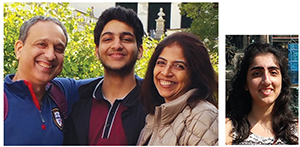
From left, Firoze, Zal, Arnaz and Rhea Soonawalla
Their products have mostly sold themselves till now, according to Soonawalla. "Neither of us is very good at PR (public relations),” she smiles. Film personality Juhi Chawla, who was the chief guest at the store opening, was among the first to wear their creations in the early 2000s. "We also spotted Kareena Kapoor wearing one of our creations in a newspaper,” states the medico-designer.
For the marriage season, Vaid forecasts that lehngas and crop-tops will be hot items for bridal wear, or perhaps lehngas with sheer jackets. "A lot of sexy, that’s what is going to be in, this coming wedding season,” states Soonawalla, adding that fitted gowns, with an Indian silhouette too will be popular. "We want to bring the kurti back,” states Soonawalla, harking back to the short, hip-length tunic in a global silhouette that was popular in the 1990s. They note that "hand block-printing, hand tie-dye and vegetable prints will make a mark in the current season,” and forecast slim tunics, jacketed ensembles in linen satin as head turners. Their three-year forecast indicates simpler lines, more gentle in expression. "Nothing over the top,” states the sedate Soonawalla. But, for now, the mantra is "God bless the big fat Indian wedding,” according to the bubbly Vaid, who recounts the celebrity destination weddings they have designed for.
Arnaz’s husband Firoze, a urologist, is "extremely supportive,” she states. Mother Piloo Hakim, also a doctor with an ENT specialization "is not too happy about my devoting large amounts of time to fashion,” smiles Arnaz, who holds a weekly clinic at Masina Hospital. Father Pervez, an orthopedic surgeon, now provides private consultations to a few clients. Daughter Rhea is studying economics at Warwick University while son Zal is an undergraduate at St Xavier’s. Vaid’s husband accuses her of running an "open tijori (treasure chest),” and wants her to be more businesslike, she laughs. The duo are looking for a business manager and accounting staff to look after their costing. Inventory is a pain area for them. Vaid estimates that their concern carries about Rs 30 lakhs of inventory.
"Our faith (Zoroastrianism) is based on very simple, positive values… a very simple religion… that’s what I love about it,” says Soonawalla. It is a lovely way to direct one’s life, according to her. Believing that it is a shame how "closed we are about how we look at our religion,” the designer says she is "blessed to have been born a Parsi.” She believes that it is "the most popular community…everyone has at least one Parsi friend who they cherish.”