Evolving with Subramanian Swamy: a roller coaster ride by Roxna Swamy. Self-published in 2017 by the author, A-77, Nizamuddin East, New Delhi 110013. Pp: xii + 264. Price: Rs 699.
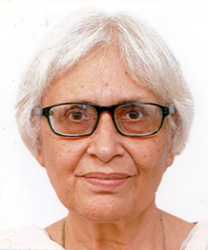 For sheer spousal loyalty, Roxna Swamy (pictured) deserves full marks on the strength of this book. She writes about her husband, the pugnacious and highly opinionated gadfly of Indian politics, Subramanian Swamy, with a devotion and approbation that is extraordinary even by the standards of sympathetic works of this genre. Many husbands would give their eyeteeth for such fealty.
Given that books of this kind are far from common, the reader may be excused for wondering what impelled the author to put pen to paper. She supplies a ready answer: "The idea of this book arose just last July when someone in the BBC (British Broadcasting Corporation) asked me for an interview about my life during the Emergency. I refused because after one or two experiences I am wary of the media; but BBC (sic) persisted, so finally recollecting that during the Emergency there was one meeting with Atal Bihari Vajpayee, later Prime Minister of India, that I had never publicized (outside my family, I had told only Lal Krishna Advaniji of this meeting), I consented to be interviewed on the condition that the man would faithfully carry this recollection. He promised; and of course, he broke that promise. The broken promise confirmed my rather poor opinion of the time serving nature of the Indian media/intelligentsia; and I realized that if this Vajpayee recollection was ever to go on record, it would have to be me who made the effort. The result is this book.”
(Elsewhere, in a filmed interview aired to coincide with the publication of the book, Roxna mentioned that she wrote the book because "I was angry that the BBC tried to black out my memories.” It is also worth noting that the book is written for Subramanian’s admirers —an admission she makes explicitly in a preface to the volume.)
The 23 chapters of the book cover the author’s life with Subramanian up to and including 1991 which, as a blurb on the dust jacket explains, accounts for roughly half the time they have spent together since their marriage in 1966. For the most part, the narration is organized chronologically, and it stays within the period under discussion (except for occasional references to developments of more recent vintage, e.g. a rather drawn-out listing of legal cases in which Subramanian has been involved, usually as a petitioner).
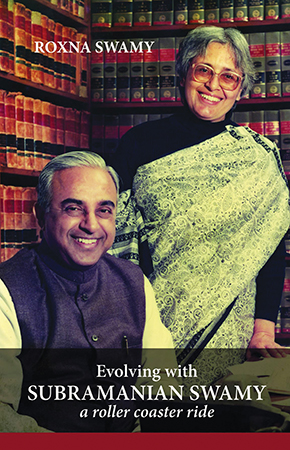 Not even those ill-disposed to the Swamys (and Subramanian has, during his long stint in politics, gathered a sizeable and motley crowd of critics and admirers alike) can deny that the couple have led an eventful life together. By far the most edgy – and, from the point of view of readers, most interesting – phase of that life concerned the period between 1975 and 1977 during which the then Prime Minister Indira Gandhi put India under the shadow of a dubious state of emergency and suppressed civil liberties on an unprecedented scale. Subramanian’s exploits during this period – including, of course, his dramatic appearance in, and exit from, parliament while still being an "absconder” from the emergency regime — is too well known to need reiteration. What is less well known is the terrifying ordeal, and the savage vindictiveness, that Gandhi’s government visited upon his family while he was at large. The book describes that ordeal with lucidity, feeling and illumination.
The predominant image that comes through the narration is that the Swamys are, by and large, a normal middle-class family, albeit with a level of education and affluence which are clearly above the national average for urban India. The author is at pains to distance the couple from being seen as part of the Establishment (hence her pointed and repeated denunciations of the "Delhi elite,” "Lutyens’ Delhi,” etc), but that claim is unlikely to command universal acceptance. There are, however, some touching vignettes of life in the Swamy household which show the family in a very unglamorous light. A striking revelation concerns Subramanian as a youngster: he was, says the author, "dismissed (by his father and his siblings) as the easygoing loafer, a vagabond because of his uncaring-of-consequences attitude to life … and was not expected to amount to much.” What a far cry from the highly ambitious, hugely talented, fiercely competitive achiever that he is now seen as by friends and foes alike!
Roxna is at pains to stress the importance of values in life, and she presses in aid the lessons that her own father, a Parsi stalwart of the Indian Civil Service (who, curiously, remains unnamed throughout the book), constantly dinned into her as a child. "I am,” she notes, "no believer in Parsi ritual; but I was born and brought up as a Zoroastrian; I was initiated as one in our navjote ceremony; and I have a profound pride and belief in the ethics of Zoroastrianism…”
She discusses with candor the opposition that her proposed union with Subramanian drew in her family: "My liberal father-in-law (to be) was quite approving; not so my orthodox Parsi grandfather. It was not that he knew of any harm of ‘Madrasis’; and he certainly respected their brains, honesty, dedicated scholarship and unconcern over worldly success; but Grandpa genuinely believed that Parsis were a race apart.”
The same grandfather, she reveals, accepted as true, many years later, a "statistical” argument advanced by her husband that "the original Parsi shipload to India, reputed to consist of 96 men and four women could not possibly have produced the present Parsi community … and there must have been intermarriage with local Indians.” The Swamy children – two daughters, both professionals now and both happily married – chose Hinduism over Zoroastrianism. Many readers will, incidentally, be disappointed by the author’s reticence in describing the time that she spent romancing Subramanian [barring a rather abrupt statement that "(In 1964) I came to Harvard and met Swamy. I married him two years later…”].
The undisputed villain of the book — and Roxna’s bête noire by a mile — is Vajpayee. No words are strong enough to condemn him: "small, mean, envious and malicious” are among the measured terms of criticism she uses, in addition to insinuating that Vajpayee shares certain traits with "insecure” and "second rate politicians,” including a "dog-eat-dog wolf-pack mentality.” More seriously – and this may be one of the reasons why some publishers who had been approached for this book turned it down – she accuses Vajpayee, albeit obliquely, of corruption, referring to "the literally hundreds of crores that Vajpayee, his foster daughter’s family and his friends and creatures (sic) are reputed to have made while in power.” Not surprisingly, she has "nothing but contempt for the manner in which Vajpayee reacted to Subramanian” – an experience which has, she says, left Subramanian "imbued with a nobler but more detached philosophy as enshrined in the Bhagwat Gita: you have only the obligation to act to do your duty, no right to or expectation of the fruits of such action.”
Another person who also comes in for less-than-favorable treatment in the book is the recently-departed governor of the Reserve Bank of India, Raghuram Rajan, against whom Subramanian conducted a ferocious campaign which made headlines in the national media for months. Roxna is particularly disapproving of the US-returned academic’s liking to be referred to as "Governor” Rajan ("an American title not commonly used in India”), thus implying a vanity on his part which clearly is not to the author’s taste. That criticism is, however, likely to be countered by those who consider her own husband’s frequent references to his Harvard background as no less an exhibition of immodesty.
While the author’s admiration for Subramanian is palpable, there are passages in the book which may have the effect of taking some shine off any attempt to project a whiter-than-white image for the latter. She refers, for example, to two occasions when the couple accepted out-of-turn allotments of cars [one a Maruti at a time when the waiting list for such cars ran, as the author herself notes, "into the lakhs,” and the other, a Premier, after an "obliging friend” had lobbied with the owners of its manufacturers that "they must give (…an…) out of turn allotment of a Premier to Swamy in time for his birthday.”] Not exactly the kind of conduct which would sit well with Subramanian’s admirable and well-advertised crusade for probity in public life.
No less unflatteringly, she concedes that "Swamy can quietly maintain a grudge for decades” and use it to get back at someone who has slighted him at some stage in his ascent up the greasy pole of politics. The example she cites concerns a career diplomat, Gopalaswami Parthasarathy, who had, in the aftermath of Swamy’s dismissal from a teaching post at the Indian Institute of Technology, reportedly suggested that he should change his name and get the job of a travelling salesman in Bombay. Subramanian, we are told, prevailed upon Rajiv Gandhi, when the latter became prime minister many years later, to deny Parthasarathy a government position.
Even those who are, on the whole, sympathetic to Subramanian are unlikely to see him as a man without contradictions. This book would have done well to acknowledge those contradictions better and, by doing so, to present a more rounded picture of a man who is both truly gifted and generally well-meaning. Roxna might argue, as noted earlier, that the book is intended for his admirers and that they may not wish to be reminded of his blemishes. That would, alas, be doing a disservice to her readers and, in the long run, to the beloved husband whom she so clearly dotes on.
The book itself suffers from many imperfections. For a start, the lack of a back index is a serious shortcoming (authors and their publishers in India are, sadly, increasingly becoming oblivious to the importance of good indexing). There are jarring Americanisms (e.g. "gotten,” "blue ribbon,” "program,” "mosey along,” and "outside of,” which sit badly alongside the otherwise even British usage) and an abundance of misspellings (e.g. "flabberghasted” for flabbergasted; "cynch” for cinch; "flibberty gibbet” for flibbertigibbet; "inquisatorial” for inquisitorial).
Not enough attention is given to getting names and phrases right e.g. "Bachan” for Bachchan; "Simon Kusnets” for Simon Kuznets; "Sarsang Chalak” and "Sar Sang Chalak” for Sarsangchalak; "King Virendra” for King Birendra (of Nepal); "Thai Airline” for Thai Airways; "Bendels 1927 book” for (Julien) Benda’s 1927 book (LaTrahison des clercs); "alternate history” for alternative history; "twitters” for tweets; "phenomena” for phenomenon. Poor grammar rears its head up from time to time (e.g. "a U.S. citizenship,” "communication what it was”) as do odd usages (e.g. "cream of the passport fracas,” "Heathen Chinese”).
The proof-reading is atrocious, with a profusion of unnecessary commas (especially before the start of every phrase or sentence in parentheses); lack of commas where they are needed; idiosyncratic use of em and en dashes; inattention to spacing; uneven indenting of paragraphs; use of lower case where upper case is called for; unnecessary upper case usage, screaming capitalized words in the middle of sentences where italicization may be more appropriate for emphasis; poor sentence construction ("Swamy does not know who and why his benefactress was”); improper use of apostrophes. The list is painfully long.
Arguably, the greatest disservice that has been done to the book is by whoever assisted the author in editing the manuscript. Even those who may not agree with everything that Roxna has said in the book will probably agree that she deserved a better editor.