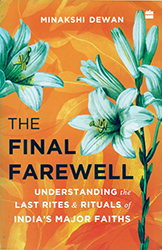
Dr Minakshi Dewan (pictured), in her book The Final Farewell: Understanding the Last Rites & Rituals of India’s Major Faiths, delves into how different religions deal with a loss of life, pre-death rituals, styles of mourning and even the monetary cost of death.
Dewan was impelled to write this book after her father Vijay Dewan died in 2019. She mentions having "experienced these rites first-hand as chief mourner, watching everything closely.” When the Covid-19 pandemic struck, people were forced to adapt to different ways of handling death and rituals. "Péhlé insaan kandhé par aata tha (At one time the family members carried a bier on their shoulders,)” recalled a crematorium supervisor of Nigam Bodh Ghat in Delhi. But during Covid corpses "came wrapped in white plastic sacks” instead of the traditional white cloth.
Though she is a Punjabi Hindu, the author was fascinated by the way circumstances changed the otherwise rigid procedures involved in death for all. She wanted to provide insights into not just the Hindu customs, but also those of Muslims, Christians, Buddhists, Zoroastrians and others.
To delve into the meanings and interpretations behind end-of-life rituals Dewan spoke to researchers, death care workers and priests including Ervad Framroze Mirza who performs the obsequial ceremonies for those who opt for cremation. Zoroastrian priests are disparaged for performing the four-day ceremonies for those opting for alternate modes of disposal rather than dakhmenashini.
Dewan noted that funeral work is seen as ganda (unclean) and therefore thrust upon people belonging to a lower social strata. Caste and gender divisions go hand in hand with death rituals, she points out. She narrates the plight of Gunjan who was distraught because her newborn female child who passed away was not given "a respectful farewell” on account of her gender.
Dewan focuses on lesser known, eco-friendly alternatives to cremation and burial. The Zoroastrian method of dakhmenashini or sky burial, where the corpse is fed to the vultures, was considered one of the most environmentally friendly method of disposal.

The critical drop in the number of vultures has made this an unviable alternative. Some Parsis opt for cremation as an alternative.
Dewan makes mention of the Kinnar (transgender or hijra) community who were considered blessed and sacred during the times of the Ramayana and Mahabharata but who under British rule were ostracized and listed under the Criminal Tribes Act of 1871. She traces the history of the hijra community and their funeral practices which are unknown to the outside world and about which they are very secretive. She quotes from Zia Jaffrey’s book The Invisibles: A Tale of the eunuchs of India: "There are no Hindu and Muslim hijras… They’re all buried!” They are often denied access to cremation and burial grounds and so resort to hiding their identity. "While carrying the corpse of a dead hijra to the graveyard” they are dressed so as to disguise their sex. "We do this to hide the fact that the deceased is a hijra.” Discrimination leads to most transgender people burying their dead in secluded areas. Often priests refuse to perform post-death rituals for them.
The Final Farewell is a well-documented account of Indian last rites and rituals. It nudges its readers to delve further into the fascinating world of religious customs and beliefs. Published by HarperCollins in 2023, this xv + 294-page book, priced at Rs 499, is dedicated to Dewan’s parents Nirmal and Vijay, husband Sourabh Lohtia and daughter Kaavya.
LAILA BACHA