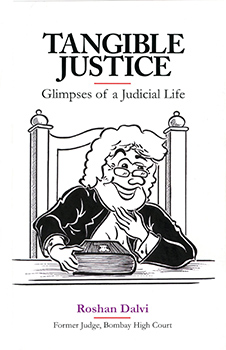
Tangible Justice: Glimpses of a Judicial Life by Roshan Dalvi. Published in 2019 by Granthali, 101, 1/B, The Nest, Pimpaleshwar Society, Manorama Nagarkar Marg, opp Star City Cinema, Mahim (West), Bombay 400016; email: granthaliruchee@gmail.com. Pp: x + 310. Price: Rs 400.
Such has been the decline in standards in the Indian judiciary in recent years that it is becoming well nigh impossible to find judges who combine first class minds with high levels of integrity. Consequently, when someone emerges with at least one of  those attributes — ideally, the latter — there is much delight, relief and exultation. Was it ever thus so? Many would say no, because, at least until the 1980s, India had the enviable record, especially when it came to the chartered High Courts of Bombay, Madras and Calcutta, of producing judges of great caliber and rectitude. That tradition, alas, suffered a rapid eclipse following a series of disastrous policy decisions taken by successive governments ostensibly in the name of ‘egalitarianism’ and other noble-sounding but misguided objectives.
Roshan Dalvi (pictured), a product of the Bombay Bar, served as a judge for 27 years, first in the Bombay City Civil and Sessions Court, and then in the Bombay High Court (assuming the mantle, along the way, of Principal Judge of the city’s Family Court for a brief period in-between). She stepped down from the judiciary, on superannuation, in November 2015. In this volume she offers her reflections on a wide — and somewhat disparate — range of subjects connected with her career on the Bench.
The book is composed of 36 chapters, but that statement needs to be qualified because many of the ‘chapters’ are no more than a few paragraphs long (the longest chapter runs into 32 pages and the shortest is a page-and-a-half long, all in fairly large type within the confines of a demy-sized paperback). What will probably strike readers most of all about the book is a certain earnestness on the part of the author and a homespun, but unmistakable, passion for justice. Dalvi, many would say, is one of those people who clearly has her "heart in the right place.” A senior member of the Bar who has contributed a Foreword to the volume notes that Dalvi sought "not merely to do justice in accordance with the law, but to mold her judgments to achieve a result which was acceptable to her own conscience.”
 Commendable though such an approach might be in principle, it has the potential to lead to tricky situations in practice, as the author herself illustrates citing a number of her decisions which were promptly reversed by an appellate court. When that happens, Dalvi is, unsurprisingly, not best pleased. Referring to one example where a higher court forced Dalvi to record oral evidence in a suit against her wishes, she upbraids the court for its "abstruse reasoning” and notes tartly that the judge in question was "neither a trial lawyer earlier, nor a trial judge then,” implying that he was clearly wrong in making the order that he did.
There is also a strong feminist streak evident in the manner in which Dalvi sought to do justice in cases involving matrimonial disputes. Applications for maintenance by husbands, in particular, seemed destined to failure in her court. Her approach in such cases is encapsulated in her assertion that "the husband wanting (his) pound of flesh with the blood and sweat of the wife had to be contained.” Where a ‘distraught’ wife sought maintenance from her husband, Dalvi seems convinced that the husband’s response would bring forth his "dishonesty.” In an intriguing — and, many would say, worrying — passage, she says: "I used to pretend to accept the case of the husband that he was dismissed or demoted from service, even thrown out of his family business with the refrain that all such disgraced husbands only grace my Court.”
Linguistic and grammatical blemishes abound in the book. Some of Dalvi’s formulations are hard to decipher (e.g. ‘ulterior fashion’). American spellings (e.g. ‘license,’ ‘clamor,’ ‘fetus’) and usage (‘every which way’) pepper the text indiscriminately. Many readers will also find her use of colloquialisms (such as ‘’ere’, ‘oft’ and ‘ole’), in situations where more formal language is expected, jarring. These are compounded by spelling mistakes (e.g. ‘Habeus Corpus’ for ‘Habeas Corpus,’ ‘tempered with’ for ‘tampered with’) and misuse of the definite article (e.g. ‘abuse of the process’ for ‘abuse of process’). A delicious irony of it all is that, at one point in her exegesis, Dalvi rebukes a fellow judge for his "incorrect use of the English language!” Pots and kettles come instantly to mind.
In substantive terms, too, there is much that the discerning reader will cavil at reading this book. Perhaps the most charitable thing that can be said about it is that it represents a missed opportunity. Dalvi could, with a little more effort — and perhaps some assistance from a professional pen-pusher — have offered her readers deeper insights into what the job of judging entails in a diverse, complex and corruption-ridden society that is struggling to live up to the ideals of democracy, freedom and the rule of law.
VENKAT IYER
Iyer is a UK-based barrister and legal academic.