Celebrating the Second Zoroastrian Children’s Day with an
assemblage of 2,000 youngsters, the Zoroastrian Children’s Foundation
plans to include children from abroad
The long line of buses with Zoroastrian Children’s Day banners might have intrigued many a morning walker at Marine Drive on a crisp, sunny yet smoggy winter day in Bombay. The vast Parsee Gymkhana grounds had been covered with a shamiana; the bright toran at the entrance and the portrait of Lord Zarathushtra proclaimed the Parsi presence.
Inside the shamiana, the blues, browns and beige of the school uniforms of almost 2,000 Zoroastrian children from Std III to Std X, seated row upon row, mingled with the reds and purples of kor saris of teachers and volunteers watching over them and of the few invitees present. For once the adults were in a minority! For a community counting in thousands in India, Zoroastrian Children’s Day (ZoChild Day) on December 5, 2004 was probably the largest single concentration of Zoroastrian children from all parts of the country at a single venue.
Martialling the program was Bombay’s well-known ‘karate king,’ Kyoshi Vispy Kapadia, a seventh degree black belt, whose Zoroastrian Children’s Foundation (ZCF) had organized the first Zoroastrian Children’s Day on November 23, 2003, bringing together around 900 children from all over Bombay at the Allbless Baug (see "Bonding the fabric,” Parsiana, March 2004). The number at the Parsee Gymkhana was more than double that — and included 400 youngsters from Surat, Navsari, Baroda, Ahmedabad, Nagpur, Hyderabad, Lucknow, Dahanu... The entire event — food, entertainment, transport, as well as lodging for outstation children — cost parents nothing. Digging deep into his own pockets, as well as tapping the philanthropic instincts of Zoroastrian businessmen/donors who sponsored breakfast, lunch or treats like ice cream, the ZCF also presented each child with a bag containing utilitarian gifts. The ZCF is a registered charitable trust, with donations exempt under Section 80G of the Income Tax Act, 1961.On the board of trustees, besides Kapadia, are his wife Shiraz, Perin Bagli, principal of Activity High School, Perviz Dotivala, social worker and Zenobia Daroga, chairperson of ZOSTA (Zoroastrian Student-Teacher Association).
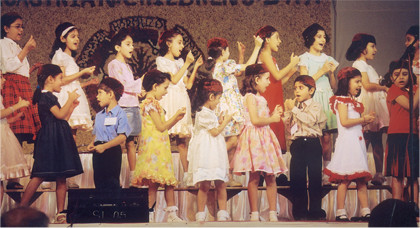
Enthusiastic songsters
Organized on the theme "Proud to be a ZoChild,” the festivities for the children from outside Bombay were spread over not one, but two full days. The day’s outing on December 4 included a movie at the Imax Dome Theatre, a harbor cruise and dinner and a visit to the Banaji Atash Behram at Charni Road, sandalwood offerings included! While the boys were lodged at the Athornan Madressa in Andheri, courtesy Ratan Lalkaka and other trustees, the girls were accommodated at the Cama Convalescent Home at Bandra, due to the good offices of Sam Choksey and other trustees.
For the Bombay students attending the function on December 5, an armada of hired buses had transported the youngsters from 6.30 in the morning from pick-up points as far-flung as Vikhroli, Jogeshwari, Andheri and Bandra to Napean Sea Road and Byculla, with the return trip after dusk meticulously clocked in as well!
"My greatest fear was handling such a huge volume of children. Their parents had reposed full faith in me. My prayer was that everything should go off smoothly, without any mishap,” declares Kapadia. The ages of the children and their backgrounds varied substantially. "Children of Std III are pretty small, their wavelength is different from those of Std IX or X. We had to provide the right mix, yet be very cautious,” he asserts. Financially and logistically, Kapadia says he feared not: "I had the full support of donors. My team of trustees, ZOSTA members, etc have worked selflessly and dedicatedly.”
At the packed Parsee Gymkhana grounds, Kapadia (see "Kapadia’s karate kingdom,” Parsiana, May 2001) was the pilot and pivot, clad in a traditional white dugli, Parsi pugree heightening his burly, six-foot frame. In his welcome address, he expressed his delight in hosting "this historic and memorable Second Zoroastrian Children’s Day... A national level program of this size and scope requires months of planning and huge resources in terms of time, effort and money. However, we see our effort as an investment in the educational and cultural empowerment of our children. After all, in your future lies the future of our dear community... Have fun, make lots of new friends, enjoy the food and hospitality, reflect on the wisdom that our learned elders will impart today and prove to the world that when it comes to demonstrating excellence, we Zoroastrians are never found wanting.”
The ZoChild Day function itself was lengthy but smooth-flowing and mirrored fairly accurately the ethos of the Parsi community in India — the blending of East and West, the easy adaptability of the traditional and the modern. The demure costumes of old Persia, the Parsi songs, skits and garba were interspersed with the frills and flounces of the ballroom dancers, the shimmer and shake of Bollywood numbers, the focussed concentration of the human pyramid... Taking part in the various items, among others, were the Zoroastrian children of the Activity, Avabai Petit, Alexandra, Girton, J. B. Vachha, Dadar Parsi Youths Assembly, Bombay Scottish and St Joseph’s schools, as well as youngsters from Rustom Baug, Nowroz Baug and Dadar Parsi Colony.
The day began with an early morning jashan by the young mobeds of the Dadar and Andheri Athornan Madressas. As the sun moved higher, Kapadia hoisted the Zoroastrian Children’s Day flag and the national tricolor, as commandos of the Maharashtra police (whom Kapadia’s academy trains in karate) saluted, police band in attendance. The oath-taking was led by Kapadia, with children and invitees full-throatedly promising to uphold the tenets of Humata, Hukhta and Huvarashta and "spread the light of the holy fire in the universe.”
In their chirpy song about the ‘bawaji,’ composed by poet Adi Mirza (Driver), the little cherubs of the Mancherji Edalji Joshi Memorial Trust Dharmagnyan class warbled: Pyaar thi sawné galé lagavé, énu naam té bawaji (a bawaji is one who embraces everyone with affection). The ZoChild anthem was composed by music teacher Gulnar Tafti, assisted by Monaz Wadia. "I wanted the verses to be a mixture of English and Gujarati, with music on the lines of a march, something rhythmic and catchy,” explains Tafti. "A Zoroastrian children’s anthem, I felt, should be a combination of the teachings of the religion as well as the characteristic fun and enjoyment of being a Parsi. Music and words seemed to fall into place quite quickly!” An earlier version of a Zoroastrian anthem, composed by musician Merwanji (Mehli) Cassinath which had faded away with time, was played by his daughter Banoo Cama, now infirm and confined to a wheelchair.
Believing that "no function of this magnitude can be held without felicitating those who work (for public good) without return or reward,” the ZCF honored with costly shawls and mementos a host of individuals — the two High Priests of Udvada, Dastur Khurshed Dastoor and Dastur Peshotan Mirza, the Bombay Parsi Punchayet (BPP) trustees, donors like Dr Rati Godrej (who sponsored the day’s lunch), eminent professionals like urologist Dr Phiroze Soonawalla, chief Income-Tax commissioner of Bombay Manijeh Kherawalla (the first Parsi lady to hold this post, who has since been promoted to the Central Board of Direct Taxes in Delhi), the first Parsi woman Air Force pilot Delshad Master and a long line of other achievers.
Seeking to provide a spiritual anchor to Zoroastrian children scattered in small numbers in an increasingly cosmopolitan ethos, Dastoor spoke of the importance of the navjote and the sudreh-kusti. The word sudreh means sud (good) and reh (path), he said, and the kusti connects you with Ahura Mazda and divine beings. It is not a case of doddoo bandhi didhoo (tying a rope) in quick time, he remonstrated. The kusti prayers are the very foundation of our religion, he emphasized.
Mirza traced the history of the migration from Iran to India and the ethno-religious meaning of the word Parsi. "Religion is duty, a divine law of life as revealed and taught by the Prophet... Religion is not a matter of convenience... It is our religious duty to marry within the community at the right age and have adequate number of children. We have adequate means; willingness is needed,” said the High Priest while admitting the task was difficult. In his "Three stories and a prayer,” Ervad Ramiyar Karanjia, principal of the Dadar Athornan Madressa, narrated incidents from Iranian history and scripture. "Let the Ashem Vohu become a part of you. Say one Ashem as you put your foot on the ground each morning and the last thing before retiring at night. Say an Ashem when you are under stress or difficulty or when you need peace of mind,” he exhorted.
Ervad Asphandiar Dadachanji of Vatchaghandhy Agiary spoke about the right way of performing the kusti prayers, while his son Ervad Hormazd demonstrated the correct manner of untying and tying the kusti.
Zoroastrian Studies founder Khojeste Mistree delineated briefly on what the Zoroastrian religion teaches: "Zoroastrianism is a religion which promotes supremacy of happiness within and without (around us)... If we marry within the fold and have two children or more, we’re home and dry,” he declared.
Noshir Dadrawala, editor of Philanthropy, advised the children to collect smiles: "Zoroastrianism is the religion of optimism. Anyone who has studied the science of aerodynamics knows that the bumble bee is not designed to fly. His body weight is too heavy, wing span too small. But the poor little bumble bee doesn’t know this and continues to fly! So don’t listen to what the pessimists say. You need to fly, you need to soar.”
With the priests providing much "food for thought,” in the words of compere and Dubai resident Hoshedar Khambatta, more on the same theme came in the form of the play Meherangeez. Watched in pindrop silence, the emotionally-charged play recreated the story of the fisherman Medioma, his wife Godafrid and their little daughter Meherangeez and the misfortunes that befall her after the death of her mother and her eventual adoption by the good Ardeshir and his wife Naheed. Written and directed by Dadar’s Mithoo Jesia and performed by the children of the Mancherji Edalji Joshi Memorial Trust Dharmagnyan class, Dadar, this was the first time, it was announced, that the play was being performed outside of an auditorium, without the benefit of a curtain or special sound and light effects.
In complete contrast of style was the "surprise of the day,” actor Boman Irani whose arrival galvanized the children into mobbing him for autographs, Irani’s role in the Bollywood film Munnabhai MBBS having made him an instantly recognizable face!
Kapadia’s eagle eye and dedication as a teacher came to the fore during a well-drilled demonstration by children of his karate class. Watching his karatekas, boys and girls, go through lunges, swivels, feints and tackles, bare-handed or with samurai sword, sai (Okinawan traditional weapon) and bo (long staff), Kapadia commentated: "Reaction well controlled... watch the diaphragmatic breathing... the body rhythm and timing is sheer poetry.”
The human pyramids by Cyrus Siganporia and his team from Nowroz Baug, ranging in age from five to 47, had the audience heart-in-mouth as a little fella at the peak of the pyramid touched the top of the stage shamiana, sans safety attachments!
"An army of 1,000 is easy to find. How difficult it is to find a good general,” said ex-principal Silloo Commissariat in her vote of thanks. Commending Kapadia as a born leader who fulfilled a dream (of bringing 2,000 "naughty, lovely” Zoroastrian children under one roof) few would dare to achieve, Commissariat spoke of the months of hard work, the "hundreds of meetings” ending at midnight. "We have been driven up the wall, up the mountain and down the valley,” she smiled. Commissariat made special mention of Shiraz — "the quiet, patient, good woman who has stood by his side.” She commended Bagli who was "from day one the right-hand man of Vispy” and the sturdy backbone of the program; as well as Dotivala whose "long experience on committees has greatly helped” the synchronization and supervision of the vast network of activities and individuals who threaded together the event. Daroga’s "great effort throughout the year in every aspect” received special appreciation. Commissariat also conveyed special thanks to principal Diana Marfatia for her "utmost time and effort” and other ZOSTA principals and the "70 lovely teachers who have been on their feet from seven in the morning,” the 40 volunteers from Nowroz Baug, Rustom Baug and Dadar Parsi Colony as well as Roshan Master, Khorshed Kapadia, Jehangir Dhatigara, Kersi Mistry and dozens more for their roles in looking after the children.
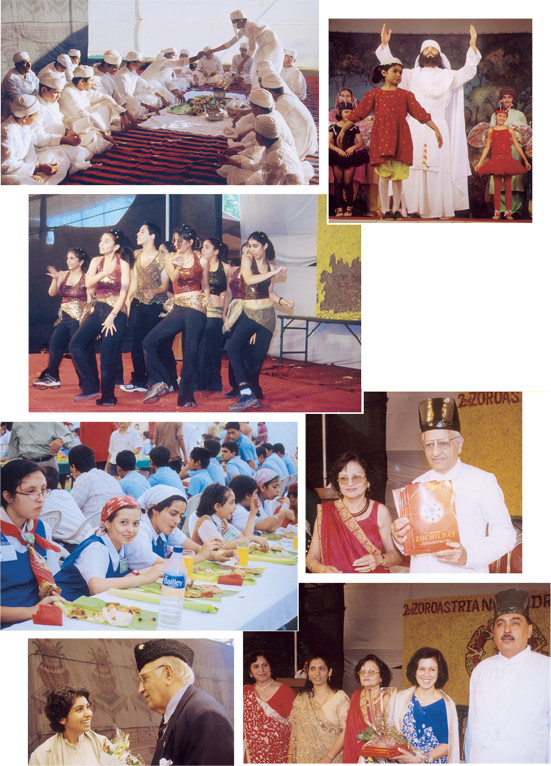
(Top row): Thanksgiving by young mobeds, scene from Meherangeez; (alongside) the rhythms of Bollywood; (third row) fresh faced and demure, Shroff (right) releasing souvenir with Dotivala alongside; (fourth row) Delshad Master with Gen Adi Sethna; Bagli, Shiraz Kapadia, Dotivala, Godrej and Vispy Kapadia
Photos: Armin Turel
As the sun dipped beyond the Marine Drive horizon, the bugles sounded, the flags were lowered. Kapadia promised a bigger, better Third Zoroastrian Children’s Day. "The dates will be announced soon. We are networking to try and bring in children from abroad. Though I cannot afford the airfare as of now, I can look after the boarding and lodging,” he told Parsiana.
"Yes, I would like to see more children,” says Sanaya Daruwalla who is in Std VII. Adds Natasha Bana: "Instead of many speechs by adults, we students should be given the opportunity to speak. The get-together was double enjoyment — learning as well as fun.” "I particularly liked the part about the sudreh and kusti,” says Std VII student Shreyas Pardiwala, adding he will be more than happy to attend future editions of ZoChild Day. Remarks Anita Pagdiwalla of Std IX: "The day provided a much needed relaxation after our exams! It was a well maintained program. But the children should have been banned from using their mobiles. Kids were chatting on their cell phones while the speeches were on!” For Arnaz Mistry of Surat, the 80 children from Surat "came as ambassadors of goodwill and togetherness. We promise to grow up and make you feel proud.”
Sums up Kapadia: "We hear so much about the Zoroastrian birthrate being so low, the number of deaths so many in comparison. But what has anybody really done for the children? The thought is deeply etched in my mind that this (Zoroastrian Children's Day) is here to stay. It should become a recognized day like, for example, Sanjan Day. Ideally, the Punchayet (BPP) should support it. It should become part of the community calendar.”