If one pays sufficiently, one can get
any facility in jail
Kobad Ghandy
These abbreviated and slightly edited excerpts of an interview with Kobad Ghandy from The Feared: Conversations With Eleven Political Prisoners by Neeta Kolhatkar have been reprinted with permission from the author. The first instalment was carried in the June 21-July 6 issue of Parsiana.
I have memories of a jail in London. They gave me a two-month term. All I remember was that I was given a room in a dark kind of chamber. I was given hard labor and had to carry potato sacks. You can’t compare this with Indian jails. In fact, you can’t compare the jails in South India and for that matter even in Jharkhand to the ones in Delhi. Tihar is the worst. In fact, when I moved to Hyderabad and Vishakapatnam, it almost felt like being in a hostel. The food was good of course because Andhra is respectful of Naxalites. Even in other places, they were nice, except for Delhi.
I’ve seen almost everyone break down. From the beginning, I made it a point to have a regimen of yoga and exercises in the morning and maybe sometimes a little bit in the evening. In Tihar, we were locked up practically the entire day. We were isolated, but I had Afzal Guru with me. He was extremely helpful and cooperative because it was my first jail experience. I spent most of my time studying and writing. I was not allowed, but I got an outlet to publish my work. I made it a point not to break down and keep my sanity intact. I ensured I was physically and mentally active all the time. I had a lot of health problems, but I still managed. I had to fight to get certain things and, towards the end, I was getting a bit frustrated. In Jharkhand, my case was going on and on, and I was not getting bail. That time I was a bit upset, but I made my mind strong. Delhi was bad. We got the court dates only after four months. So that really put me off. I would then divert my mind to studying and writing. I got an opportunity to study a lot in Tihar. Even though the Tihar jail officials didn’t allow me access to the library, there was a good person there who got me books.
Being a Naxalite prisoner, the jail officials didn’t allow me to read books. Dreaded dons were allowed to read books, but I was not. It is as per the whims of the superintendents. Mine was at first quite decent, but when he came back the second time, he was really nasty. Maybe at someone’s instigation or what, I don’t know, but that’s when he transferred me and got me nearly beaten up. The dons were fine, decent people and respectful towards me. As I have stated in my book, they are more decent than our politicians. They had no problem with me. They have other issues; they would carry or plant blade bars to attack us. They didn’t do anything to me or Afzal. As far as Gujarat was concerned, there were strict rules in the jail there. If I had stayed there longer, it would have got quite problematic for me.
Tihar jail is designed to break one psychologically. I noticed the same in Gujarat jail, and also Jharkhand (to a lesser extent). In Andhra Pradesh we were given political prisoner status so it was different. But even without that, in the south, jails are said to be more humane. The Hindi belt and Gujarat were the worst. I was lucky to be able to keep myself occupied with my writings in Mainstream; these articles were smuggled out. Also, my strict regimen of yoga and exercises helped maintain my sanity, to some extent. Being in the high risk ward, though cut off from other prisoners, I was able to get a table and chair in the cell due to a court order, which helped me focus on my writing. In fact, a table was unheard of in the entire history of Tihar. Imprisonment, I have found in West Bengal, sufficiently breaks a person and most when they come out prefer to take a non-confrontationist approach, by allying with the Communist Party of India (Marxist).
Gujarat authorities and even Tihar do not allow writing materials inside. Even reading books is only allowed in the jail library. I was fortunate to have managed to get both books and writing materials, and was even able to smuggle out my articles to be published in magazines and newspapers. We are not given political prisoner status and are treated as ordinary criminals. In Tihar, I met the 2G Scam offenders who were put in the VIP ward. If one pays sufficiently, one can get any facility in jail. It is exceedingly corrupt — from the ordinary guard to the top officials. Every benefit comes at a price.
Everything served in jail is watery, the food and chai. From the very first day, when the gates would open, the jail staff would come with chai, and Afzal would call me to his cell. He had a white thermos. I had asked for it (after he was hanged), but the authorities refused to give it to me. I said give me that at least, if not his writings, but no. So, in that watery chai, he would add tea bags and milk powder. He would then make an excellent cup of tea. He hated Pakistan and the Inter-Services Intelligence, but felt strongly about a free Kashmir and believed in it. Afzal was well read and sympathetic to communist ideas, unlike all the other Islamists who were with us in the high risk ward. The others were all lumpen types.
Their only purpose in talking to you was to convert you to Islam. Afzal was humane. He told me he was treated very badly in the first few years after his arrest. However, he would talk about it with no sense of grudge or bitterness. He talked about the people who were dealing with him and felt betrayed by them. He was trying hard to get his case moved to Kashmir, which was his right. His wife was a teacher and couldn’t come all the way to see him because it was expensive. He wanted to be closer to his family, which was his right. That is a right for every prisoner in jail, which he could have got had the lawyers tried. Probably the plan was to hang him, which they could not have done had his case been transferred to Kashmir.
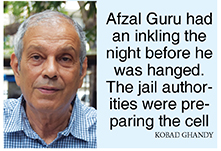
Afzal was angry with them because he saw what they were doing to him. He had an inkling the night before he was hanged. The jail authorities were preparing the cell. We saw things being prepared. We were all scared for him, but nobody wanted to say it. I felt I should have kept his diary at least. But how to ask him? It would have impacted him psychologically. We hoped for the best, but (pauses)…
Author Neeta Kolhatkar
It is a feudal ideology. Now, identity politics is dangerous. I’m opposed to identity politics. Even when we worked among the Dalits, we never blamed a particular caste. We said that the enemy is the ideology. The ideology which dominates the upper castes is everywhere in society. It is even prevalent among the poorest castes. India has very strong people traditions. We have replicated Marxism directly from Russia or China, but we haven’t Indianized it, which is to build on this non-Brahmanical tradition and peoples’ democratic traditions. To Indianize Marxism is to take it to the people and also to fight the Brahmanical ideology within us. When I see comrades, they are so patriarchal. They won’t beat their wives, but they will expect their spouses (women) to do all the housework. There is politics in it. The husbands will be doing the party work and the wives will accept domestic roles, even in a place like Bombay. It is extremely deep-rooted.

Even after criticism from the Left party, the boycotts they called for, all of which was reported in the newspapers, I was later expelled from the party. My lawyers in Hyderabad asked me not to get depressed. I told them nothing of that sort as I am not attached to such things. My attachment is to the future and to the youngsters. If we have done anything wrong, then hopefully the young will do better than us. I did feel, during her last stages, that I should have devoted more time to my wife Anuradha. In fact, I had made a decision in my mind but it was too late; by then she died. She had various ailments and also very bad arthritis. In those days there was no knee replacement or it was not so common. Otherwise, we had spent a lot of time together.
Interestingly, only in the Gujarat jail did they know what a Parsi is. (Laughs). They would ask me, a Parsi and a Naxal? You are in jail? There I was given very good treatment. You see, in jails we had to fill "caste” in our forms at the time of entry. They’d ask what caste I belonged to and I’d say I don’t believe in caste. Yet they would insist. I was forced to write and I ended up writing "Parsi.” None of them understood it. They were only concerned with filling that section and they would not bother beyond that. Even in Andhra, people don’t know who a Parsi is. Only the police in Surat knew, because that’s where the Parsis first landed in Gujarat. Though it is Modi’s heartland I still get respect when I go for my court dates there.
Concluded