The 101-year-old Iran League once played a vibrant role in promoting the
well-being of Iranian Zoroastrians as well as increasing cultural ties
Farrokh Jijina
"Rendering yeoman services to the country and the community, surviving for (over) 100 years…is an achievement in itself especially when infantile mortality is the case with many organizations,” stated Vispi Dastur in his president’s message in the newsletter of the Iran League (IL) distributed at the organization’s annual day cum prize distribution event at Allbless Baug on April 15, 2023.
The IL has been endeavoring that "our past glory, our history, our religion, our heritage, our traditions, our Parsipanu are not forgotten,” stressed Dastur. Established in 1922 with Sir Hormusjee Cowasji Dinshaw Adenwala as the founder president, the main object of the League, according to Dastur, "is to create in the hearts of our younger generation a love and reverence for the ancient land of Iran.”
Some of the objectives of the organization, as enunciated in Gujarati in the rules and regulations formulated in 1922 and amended in 1943, specified: to continue the relationship between Iran and India; to continue the feelings, camaraderie and enthusiasm (laagni, dilsozi ané oolat) towards that ancient country; to ensure Iranian Zoroastrians continue to thrive in Iran; to ensure an upliftment in the social, religious and other conditions of Iranian Zoroastrians.
"In 1922, a group of wealthy Parsis in Bombay founded an organization that they dubbed the Iran League,” noted historian Dr Dinyar Patel, assistant professor of history at the S. P. Jain Institute of Management and Research in his erudite paper, "Caught between two nationalisms: The Iran League of Bombay and the political anxieties of an Indian minority,” published in Modern Asian Studies (2021) by Cambridge University Press. "Originally designed to assist their fellow Zoroastrians in Iran who had suffered from centuries of oppression, the League quickly expanded its objectives to include the promotion of broader Indo-Iranian cultural and economic relations. It became a major player in the flow of ideas, literature, business and tourist traffic between the two countries, he added.”
The IL is believed to have evolved from philanthropic support extended by wealthy Bombay Parsis to fund pioneer Maneckjee Limji Hataria’s efforts to reverse the discrimination faced by Iranian Zoroastrians in the late 19th century. With Hataria acting as agent of the Society for the Amelioration of the Conditions of the Zoroastrians in Persia, Bombay Parsis sent aid, established schools for Zoroastrians, and lobbied Iranian authorities to reverse discriminatory practices.
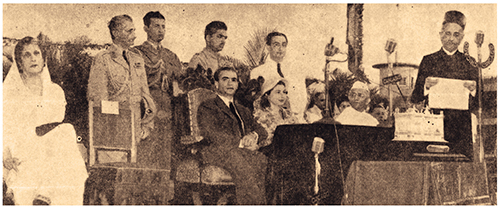
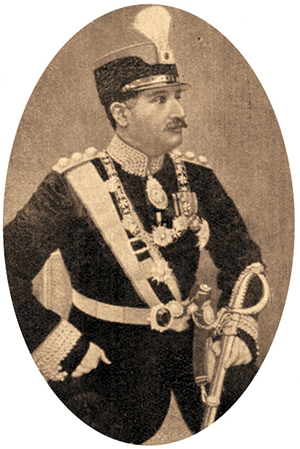
Top: Oil painting of the Shah of Persia by M. F. Pithawala;
above: felicitation at the Brabourne Stadium on March 7, 1956 (seated, from l) Lady Hirabai Cowasjee Jehangir,
Mohammed Reza Shah, Queen Sorayya, Morarji Desai, and Sir Shapurji Billimoria (at the mike)
Under Adenwala’s leadership, IL prioritized educational affairs. The League worked with Ardeshirji Reporter, a Parsi agent in Tehran who continued many of Hataria’s activities, to channel Parsi philanthropy, opening schools that favored the Iranian Zoroastrian community but were kept open to students of all backgrounds and creeds. Reporter convinced Ratanbanu Bamji, the sister of industrialist Jamsetji Tata, to donate Rs 1,00,000 (USD 1,209) for the creation of a girls’ high school in Tehran. Two years later, the Firuz Bahram Middle School (later High School), funded by another Parsi, Bahram Bhicaji, in memory of his son, Firuz, who had died during World War I, was inaugurated.
A patron of IL, Peshotanji Marker, great-granduncle of IL trustee Sam Choksey, reportedly travelled to Iran three times between the 1920s and 1940s. Under his initiative, schools and an orphanage were opened in Yazd; a fund was set up for outstanding students of the orphanage in Tehran University; also a fund for research in Zoroastrianism, notes the IL annual report. A clock tower in Yazd bears his name.
The IL raised funds for a two-tonne statue of Persian poet Ferdowsi which it donated to Iran. The statue was first installed in a Tehran square that the government renamed for the poet and, later, moved to the campus of the new University of Tehran, inaugurated by the Shah as Iran’s first university. A final Ferdowsi-inspired link between Parsis and Iran was forged when community members prevailed upon the Bombay Municipal Corporation to rename a road after the poet in the city’s Dadar Parsi Colony.
"Due to such philanthropic efforts, literacy among Iranian Zoroastrian men became almost universal. The female literacy rate also climbed through the establishment of an increasing number of girls’ schools,” stated Patel. Many of these girls’ schools were funded and administered by the Iranian Zoroastrian Anjuman (IZA), an organization led by IL’s vice-president Dinshah Irani, notes historian Dr Mary Boyce in Manekji Limji Hataria in Iran.
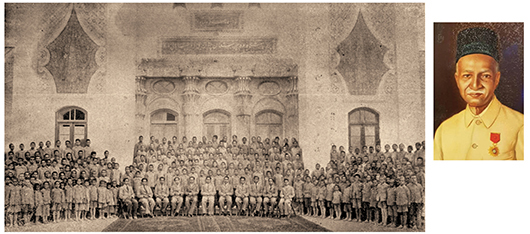
Above: Students at the P. D. Marker School, Yazd founded by Peshotanji Marker (right)
Above: Sir Cowasjee Jehangir (l) greeting Mohammed Reza Shah at the Taj Mahal Hotel in 1956
Top (r): Sir Hormusjee Cowasji Dinshaw Adenwala; memorabilia from
Iran League’s office and advertisements from their newsletter
"Major player”
Scholarly exchange, complemented by the IL’s publishing efforts, contributed towards a wider exchange of Parsi and Iranian tourists, businessmen and professionals in the 1920s and 1930s. "This was an important development: through tourism (and, eventually, commercial ties), Parsis engaged with the modern nation of Iran rather than a mythologized ancient homeland,” observed Patel. "One Parsi firm, Jeena and Company, took out regular full page advertisements in The Iran League Quarterly for its conducted tour to Persia (‘For Gentlemen Only’).
"The League quickly expanded its objectives to include the promotion of broader Indo-Iranian cultural and economic relations… It became a major player in the flow of ideas, literature, business and tourist traffic between the two countries,” stated Patel.
According to him, the "Parsi fervor for Iran stemmed from Iranian nationalism promoted by Reza Shah (1878-1944), which celebrated the country’s Zoroastrian past.” IL’s leaders felt that the Parsis of India could play a special role in the "regeneration” of Iran under the Shah’s rule. "They cast Iran as an idealized alternative to contemporary India where the Indian National Congress had supposedly taken an ominously ‘anti-Parsi’ turn.” In 1937 there was palpable anger when K. F. Nariman lost to B. G. Kher for the post of Bombay chief minister, writes Patel. (Kher was more popular outside Bombay city and won the largest number of votes — editors) "Worry about India’s future even prompted some Parsis to argue that their community should ‘return’ to their ancestral homeland of Iran... What is remarkable is the speed with which the IL transformed from being a vehicle for Parsi influence in Iran into a non-critical mouthpiece of a foreign government,” notes Patel.
The League also "began to flirt with revivalist, racist and even fascist ideas and personalities… Parsi anxieties resulted in the production of many nationalist ideas and tactics in vogue around the world at the time — a fascination with Aryanism and racial purity, the cultivation of pseudo-science and pseudo-history, and an observation about the originality and authenticity of a particular people or culture.”
In its initial years the Quarterly "then known as the Iran League Bulletin, was edited by another prominent Parsi scholar, Gustaspshah Kaikhusroo (G. K.) Nariman (1873-1933). Through his scholarship, he intended to promote mutual understanding between Parsis and Iranians by combating particular prejudices,” notes Patel.
In his book, Persia and Parsis G. K. Nariman "advanced very unconventional arguments for a Parsi: that the Arab invasion of Iran was marked by relative tolerance and respect for Zoroastrianism, and that the Sasanian Zoroastrians themselves, not the sword-wielding Arabs, were to blame for the downfall of the religion in Iran.”
The editor’s views did not find favor with many readers and he resigned. "The League steadily became a forum for pseudo-history,” stated Patel. "The Quarterly also carried articles that "transmitted Nazi perspectives on Zoroastrianism through Quarterly articles with titles like the best form of Aryanism in Zoroastrianism…
"Two months after the Union Jack was forever lowered on the subcontinent, Sir Cowasjee Jehangir, who succeeded Adenwala as the League’s president, rubbished any idea that the Parsis were considering a ‘return’ to Iran. ‘We are quite satisfied and happy in mother India,’ he reassured a Bombay audience…
"While in Tehran, the new monarch, Mohammed Reza Shah (1919-1980), asked Marker why Parsis were choosing not to relocate to Iran. Marker was blunt about the fact that Iranian Zoroastrians still suffered from discrimination and that Iran was hardly a liberal democratic polity: ‘In India we enjoy political rights without any distinction of caste or creed,’ he informed the Shah. ‘The same conditions are not prevailing here.’”
The League was at the forefront in felicitating, along with the Bombay Parsi Punchayet, the Persian Zoroastrian Amelioration Fund and the IZA, Mohammed Reza Shah on his 1956 visit to Bombay. Warm sentiments were expressed by the ruler: "I regret not to see you in our own country, but there is no difference if you live here or in your own country.” An archived copy of the royal’s speech was shared with Parsiana by IL trustee Saroosh Dinshaw, great-grandson of the founder president. Currently, contact with Iran is "close to nil,” said Dinshaw, barring an occasional interest from the Iranian consulate to visit their IL office on Dr Dadabhai Naoroji Road. Besides Dastur, Dinshaw and Choksey, Dr Sorab Jhaveri and Freny Jehangir (née Dinshaw) complete the quintet of IL trustees.
In the office that the League shares with the Bombay Jashan Committee and the Athornan Mandal, wooden cabinets with old editions of the Quarterly, remnants of the libraries of past members, and large, Persian language editions of the Shahnameh are gathering dust. A statue of Ferdowsi, eyes cast heavenward, sits in a glass box. Lectures by scholars and free Persian conversation classes were once regularly conducted here by IL. "Like many Parsi institutions in Bombay, it is a shadow of its former self,” sums up Patel.
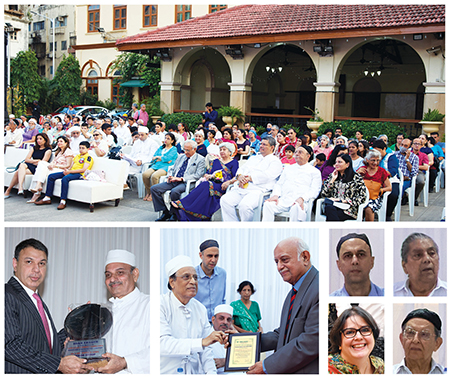
1st row: audience at the Iran League annual function;
2nd row, from l: Dr Cyres Mehta, Ervad Darayesh Katrak, Ervad Vispi Dastur,
Cmde Jal Postwalla; clockwise: Saroosh Dinshaw, Sam Choksey, Dr Sorab Jhaveri and Freny Jehangir
Felicitations
When The Maneckji Limji Hataria Trophy was bestowed on navy veteran Cmde Jal Postwalla (retd) at the IL’s annual prize distribution function in April this year, the League was continuing the tradition of recognizing an illustrious member of the armed forces or police. During his tenure the veteran had served as assistant director of weapons and equipment, deputy director of warship projects, and was general manager of retrofits of both Vishakapatnam and Bombay naval dockyards, responsible for over 70 ships and submarines.
Eye surgeon Dr Cyres Mehta was the chief guest and Ervad Darayesh Katrak guest of honor at the event attended by 400 community members. "Education is the passport to the future… tomorrow belongs to those who prepare for it today,” stressed Mehta. Katrak, secretary of the Dadysett Charity Trust, nudged the youth "to not question the act of praying and to devote a balanced amount of time to career, family and spiritual wellbeing.”
This year over 500 entries were received from persons aged three to 85 years for the various competitions conducted by the League, according to the newsletter. Prowess was judged in Shahnameh recitation, essay writing, elocution, religious quiz, drawing, rangoli, Gujarati reading, singing of Parsi songs/monajats and Western vocal and instrumental music. Winners took home 329 cash prizes and 30 trophies collectively.
The celebrations had commenced with a jashan performed by Ervads Farzad and Hormazd Ravji followed by a humbandagi led by students of the Dadar Athornan Institute. The function ended with a dinner catered by Jimmy Gadiwalla.
"By default, these (competitions) have become the current objectives of the League,” stated Dinshaw. Since they have "a very small corpus,” the League needs to get sister charities to contribute toward the shortfall on the expenses of the annual day. "It is very important to keep things alive,” he added, for "children look forward to the competition and the prizes… The family looks forward to making an evening of the annual day and the sponsored dinner.”