"For the last three weeks prior to closing, we had queues building up approximately one-and-a-half hours before opening time,” revealed Yadgar Marker to describe the sentiments of the patrons on learning that the popular India Club would not function from its premises at Strand Continental Hotel in London after September 17, 2023. Those who had made a beeline in the final days were "mostly regulars who had been to India Club for many years and wanted to have their last meal. We also had newer clientele who were curious about the food and ambience of the building,” added Marker, director of Goldsand Hotels Limited which is the company registered name trading as Strand Continental Hotel/India Club.
Having bought the lease of the premises in 1997, Marker had been running the Club for the last 26 years, initially with the assistance of his wife Freny. For the last 15 years it was his daughter Phiroza who has been managing with support from son Rustom.
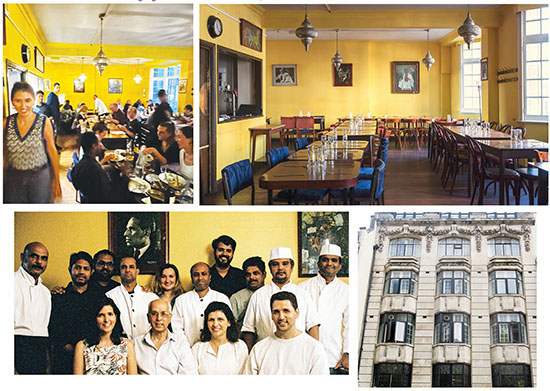
1st row: diners enjoy their meal at the India Club that retained its old-world ambience;
above: staff members with the Marker family (seated, from l) Phiroza, Yadgar, Freny and
Rustom Marker; (r) Strand Continental Hotel
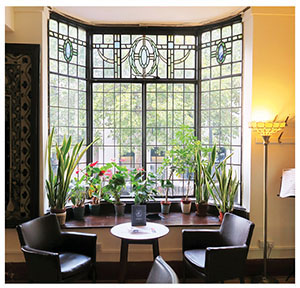
A nook at the India Club
"The charmingly eccentric India Club has remained much the same since its opening (in 1951)... Hidden up a flight of stairs, India Club is part of London’s history,” states their website. Since the formation of the Club by V. K. Krishna Menon, the first high commissioner of independent India to the UK and members of the India League, "we had not changed the ambience of the place,” be it the formica table tops or the straight backed chairs or portraits on the walls of prominent Indian and British personalities who visited over the years. "The building is steeped in history with Jawaharlal Nehru and Lady Edwina Mountbatten being its founding members. We are very sad,” Yadgar expressed his disappointment at having lost their fight to Marston Properties that plans to redevelop the building, forcing the Markers to look for alternative premises.
In the aftermath of Independence, the Club was popular with the Indian Workers’ Association, the Indian Journalists’ Association and Indian Socialist Group of Britain for their meetings as a cheap and cheerful venue. It was also a base for the new activities of the India League which following the freedom struggle included a free legal advice bureau and a research and study unit. The Asian community valued the welcoming space with a bar on the first floor and restaurant on the second floor where patrons could enjoy Indian food, speak their native language, seek advice and connect culturally. "The India Club helped all of us feel a little less alone in our new home,” historian Kusoom Vadgama was quoted in a write-up on www.bbc.co.uk.
Retaining its original purpose until the end, various Indo-British groups including the Calcutta Rowing Club, Goan Association and the Curry Club used these premises. "The Young Zoroastrians committee at the Zoroastrian Trust Funds of Europe have regularly organized events at the India Club bar and restaurant. We had several Parsis dining with us in the last week,” conveyed Yadgar.
At the time of closure, the dishes most in demand were bhuna (braised) lamb, South Indian chicken curry, brinjal, chana masala besides others. "We had to reduce the menu as the chefs could not take the strain of the increased demand,” stated Yadgar in response to queries from Parsiana. "Even after curry houses started opening across Britain, serving their versions of Indian food, the India Club’s restaurant was known for more authentic desi food,” wrote Vikram Doctor in his column Food Fables in The Economic Times of September 17, 2023.
The Yadgars had been endeavoring to preserve the heritage precincts for the last six years (see "India Club petition,” Parsiana, October 21, 2017). They had launched a Save India Club campaign that was supported by 26,000 signatories among whom were James Castle, the great-great-grandson of Dr Annie Besant and Rowan Brudenell, the great-great-grandson of Lord Mountbatten. But ultimately the Strand building was not deemed a heritage structure as the Club had started functioning from these premises in 1964 and not since its inception in 1951.
In 2019, the National Trust held an exhibition on the Club at the Strand premises "in recognition of the Club’s far-reaching cultural importance. The oral histories gathered from this exhibition are permanently housed at the British Library,” it is reported on the India Club website.