Inputs from representatives for formation of a
structured global body of Zoroastrians are due by February 28
Text: Parinaz M. Gandhi Photos: Jasmine D. Driver
Nineteen out of 20 representatives from India, USA, UK and Dubai in attendance at the Global Working Group (GWG) meeting at the Palamkote Hall on December 21, 2018 agreed in principle that the world body needed a formalized structure. The lone representative to express his dissent was Yazdi Desai, president of the Federation of the Parsi Zoroastrian Anjumans of India (FPZAI), who claimed that he was acting on the basis of "the last authorization I had in 2012.”
A donation of over one crore rupees from a Hong Kong based non-Parsi corporate has been procured by GWG non-executive chairman Neville Shroff for the amelioration of mobeds. This fund will be used to aid 109 mobeds aged over 60 years and having an annual income of six lakhs rupees or less. Every quarter beginning January 2019, Rs 19,500 will be given to each recipient, announced Sam Balsara, chairman of Madison World, who along with Dastur Khurshed Dastoor of Udvada and Dinshaw Tamboly, chairman of WZO (World Zoroastrian Organisation) Trust Funds, was entrusted with the task of preparing a project report for mobeds and maintenance of agiaries. Thirty widows of mobeds having an annual income of Rs 3,00,000 or less will be given Rs 13,500 every quarter. Whilst currently the donor has committed to funds for only one year, GWG is hopeful that the donor could be persuaded to make a similar donation each year if convinced of the organization’s transparency and worthiness.
"We are not guiding the community properly,” regretted Dastoor, referring to the Bombay Parsi Punchayet (BPP) owned Godavara Agiary in Fort where hardly any devotees come to pray but the Punchayet will spend Rs 30 to 40 lakhs on its repair. He recommended that the Punchayet shift the sacred fire to another agiary which could house it separately, sell the property and use the funds to help mobeds. The Langrana Agiary and Manekji Sett Agiary in Fort too lie deserted barring the time when the mobed performs the boi prayers. He was wary of the community heeding "some jokers on social media who have become religious scholars all of a sudden… Try and use the property. After 15 or 20 years nothing will remain with the community,” he feared.
Thanks to Shapoorji Pallonji, the Iranshah in Udvada is being renovated and restored as a heritage structure at a cost of five crore rupees, announced Dastoor. He invited participation at the Iranshah Udvada Utsav in 2019 and referred to upgrading the Zoroastrian Information Centre with the help of the Government of Gujarat and the house of Godrej.
The structure of the Federation of Australian Zoroastrian Associations is being reworked to include New Zealand that is keen to join, noted a written statement from Firoz Pestonji. Chair of the 11th World Zoroastrian Congress (WZC) in Perth from June 1 to 4, 2018, he reported that the Congress generated a surplus of AUD 30,000 (Rs 14,78,923).
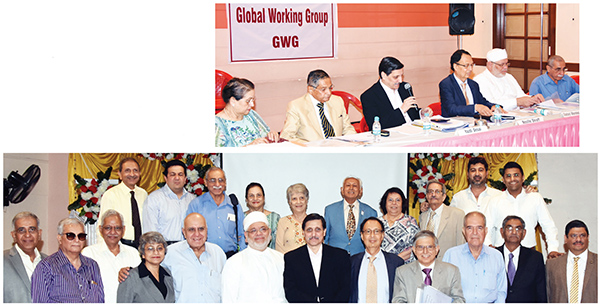
(Top from l): Meher Bhesania, Burjor Antia, Yazdi Desai, Neville Shroff, Dastur Khurshed Dastoor,
Rohinton Rivetna; (above): global representatives at the Bombay meet
The venue and dates for the 12th WZC to be held in New York in 2022 will be decided in the next six months, announced Homi Gandhi, president of the Federation of Zoroastrian Associations of North America (FEZANA). For the 7th World Zoroastrian Youth Congress (WZYC) from July 1 to 6, 2019 in California, 100 registrations have been received. They hope to close at a registration count of 600, revealed FEZANA vice president Arzan Wadia. He referred to the efforts of other associations to boost participation in the Congress: Zoroastrian Trust Funds of Europe (ZTFE) has booked 20 seats for its youth. Tinaz Karbhari, chair of the 6th WZYC informed the current organizers that they would use the surplus of the last Youth Congress to sponsor 33 youth from New Zealand.
Whilst there has been a tremendous response from Iran, "we don’t know how to get them visas,” stated Wadia. Appreciating Dastoor’s efforts to obtain visas for seven youngsters from Karachi who had come to India to attend the Return to Roots (RTR) program that familiarizes global youth with community institutions, traditions and religious practices, Wadia regretted that in the US they don’t have a National Minorities Commission or a Zoroastrian representative like Dastoor to assist in obtaining visas. At the start of the GWG the RTR delegates briefly introduced themselves before proceeding on the next scheduled halt in their itinary.
To guide students seeking professional advice and opportunities for overseas studies, a website, zoroastrianfacultynetwork.org created by Yazdi Tantra and an email address
zoroastrianfacultynetwork@gmail.com has been initiated. A second webinar was conducted on June 24 to provide information on finance options for students pursuing higher education, reported FPZAI honorary secretary Farrokh Rustomji who is a core team member of Zoroastrian Faculty Network (ZFN). Links were established with foreign consulates in Bombay to guide students on how to shortlist universities for study in the US, and how to apply for graduate and masters courses. At another program on November 20, students learnt of the universities and courses offered at French universities. Budgeted expenses of Rs 1.66 lakhs for these ZFN activities until March 2019 were funded by the R. D. Sethna Scholarship Fund.
The World Zarathushti Chamber of Commerce tie up with the WZO Trust Funds to promote entrepreneurship among community youth has resulted in three youngsters being extended loans of Rs 25 lakhs each to be repaid within five years.
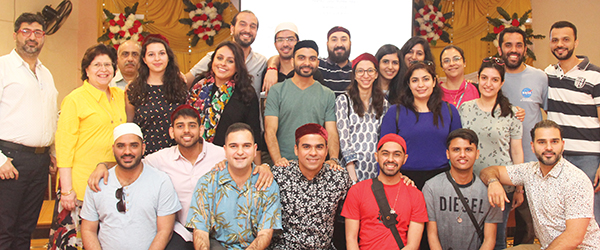
Organizers and participants of Return to Roots program in 2018
On the verge
"GWG is a connectivity platform…working towards socioeconomic uplift for maximum effect. We must put aside our personal differences and make it work for the future well-being of the community,” stressed Shroff in his opening remarks, adding, "I have been advocating a formalized body. We are on the verge of formalizing, hopefully we will get a consensus. I am indebted to Rohinton Rivetna and Meher Bhesania. We asked (solicitor) Burjor Antia to draft it in a legal matter. This document is essential if we need to register the organization and have a bank account. Common sense tells us that the office of the global body should be here (in Bombay).”
"Today is a historical day… when we can leave footprints on this earth,” stated Antia who was specially invited to the GWG meeting to make a presentation on a formalized structure that could replace the current informal Group that has been in existence since the Ninth WZC in Dubai in 2009. As against the normal nine-month time for delivery of a human baby, this structure will take shape nine years later, stated an optimistic Antia.
Since Antia’s proposal for a Global Council of Zoroastrian Trust (GCZT) had not been circulated in advance, representatives sought time to analyze it in detail. GCZT would be headed by the president under whom would come the settlors (non-resident Indians and foreign passport holders who have been associated with GWG since its inception but are not eligible to serve as trustees as per trust regulations in India and will be deemed permanent members and serve on the advisory board), trustees (thought leaders who could contribute and raise funds) and the regional board (comprising no more than two members from each region). "There should be no khichri,” he recommended. To implement the Trust’s objectives would be committees and subcommittees dealing with health, entrepreneurship, women, youth, communication, arts and culture, infrastructure.
Gandhi felt that undue weightage was being given to India considering that the population of Zoroastrians in India is less than half of those spread globally. Wadia wanted to know whether GWG would be changing its focus from a coordinating body to one that is promoting social and economic projects and whether there was need for an administrative office. "It will continue to be a coordinating/networking body… Nothing will change except that we create space for trustees and settlors to bring in people of eminence who can give guidance and money for this work,” stated Meher Bhesania of Dubai. "Tamé ooper jaso, hamé niché jasoo, èm nathi thavanu (it is not that any organization will rise or fall in stature),” she added.
BPP trustee Xerxes Dastoor questioned the need for another trust and whether it "could not be dovetailed into an existing trust… why feed another bureaucracy?” Kersey Bhesania of Dubai explained, "It should not be viewed as a trust, but a working body. It’s a structure and to formalize it, it was called a Trust. Antia explained that there is no other trust in India covering the global community of Zoroastrians. Desai stated, "GWG is the total of all Federations of the world. FPZAI comprises 69 anjumans all over India, it is not a body of trusts.”
A still from Zarathushtra — The story of his life
BPP trustee Viraf Mehta wanted to ascertain whether "the grandeur of the BPP would be lost with the formation of a parallel global body… How easy will it be to overrule Parsi Irani Zoroastrian to just Zoroastrian?... Are all GWG representatives elected by their Federations? On what basis has WZOTF become a part of GWG? Desai responded that all are elected except regions like Dubai where they are not permitted to have a formal structure. He also stated that the definition of Zoroastrian cannot be changed.
Rustomji enquired if GWG is a body of federations, "what would be the role of BPP?... and WZOTF that is doing wonderful work? Are they part of it or not part of it?” According to Desai, "BPP would be represented through FPZAI. WZOTF could come in as advisors.” Clarified Tamboly, "At the GWG meeting in Hong Kong a formal decision was taken to induct WZOTF on the GWG. Please accept the activities of WZOTF have been substantial for the last 20 years.”
BPP trustee Kersi Randeria stated that "the discussion has come like a bolt out of the blue. It appears that some more advantaged in this gathering had access to this document in advance… with my weak eyesight and slow mind I could not digest (the PowerPoint presentation).” According to Shroff, this should be considered "like a preliminary draft. We just managed to do it ahead of the meeting… (and brought it up) to gain ideas and views. Does this body need to be formalized? If yes, we have the blueprint. We can tweak it as required.”
"Where do existing organizations like the ZTFE fit into the existing framework and how do they exercise their rights?” wondered Javid Canteenwalla from London. ZTFE trustee Rusi Dalal felt reassured that the proposed body is restricted to Parsi Irani Zoroastrians; that there would be no domination by any member organization; that decisions would be taken by consensus and not voting.
The purpose of this body is to "facilitate welfare work and uplift of Parsi Zoroastrians, initially in India,” stated Tamboly. He referred to funds coming from Hong Kong and the continuous changing of laws in India that require permissions under the Foreign Contribution Regulation Act.
"I consider this proposal providential. It should have happened 50 years ago. We have been struggling with this for a long time… It is unique for it gives us an opportunity to bring in trustees as important members… We need to go through the proposal, mesh it with the bylaws and organizational details” by forming a small committee that can come up with the final document before the next GWG in Orlando in May 2019.
"Many won’t be able to come to Orlando,” stated Desai. "If we are all equal, then any region could host a meeting,” noted Wadia. "You don’t have to be physically present,” stated Behroze Daruwalla, one of the FEZANA representatives, adding, "Does it imply that no decisions are to be taken if the meeting is not in Bombay? You cannot penalize the whole organization.”
Even more vexing for those present was Desai’s remark that the operating principle at GWG being "consensus,” since there was no unanimity on the issue, the discussion on formalizing the global body should not be pursued. "Whilst consensus may appear very democratic, it doesn’t work in our community… One person can hold us back. We will never move ahead,” reasoned Daruwalla. She recommended that "consensus” should be substituted by "majority.”
Thereafter every representative was asked to state whether he/she favored giving a formal structure to the global body. With the exception of Desai, all present expressed their support for formalizing the body. Since Desai mentioned that he was speaking on behalf of the FPZAI members, Randeria countered, "Many associations in the FPZAI may think differently. BPP also thinks differently.”
Antia responded, "I am really disappointed. This is a world body coming under one umbrella and you are saying ‘no’? You can’t agree on the same principle to uplift people? To live and let live? We have to move forward… The global body will move in its orbit like the sun and the moon. We are here to help you. We will complement the BPP.”
Gandhi tabled a resolution that a committee be appointed to review the proposal as formulated by Antia along with comments by members that should be sent in by February 28, 2019.
To be continued