In 1954 the Bombay High Court permitted
The J. B. Vachha High School to admit non Parsis
Armin Wandrewala
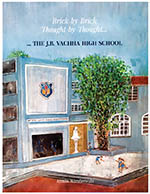
An edited and abridged extract from the book Brick by Brick, Thought by Thought… The J. B. Vachha High School by Armin Wandrewala has been reprinted with permission from the author.
As per the trust deeds the J. B. Vachha (JBV) School could only admit Parsi Zoroastrian children. Initially, the School received a grant-in-aid from both the state and the municipality. After India’s independence in 1947, while the Indian Constitution was being drafted, educational authorities of the then government decided not to give grants to communal schools. The Inspectress of Girls’ Schools, Bombay, and the Superintendent of Gujarati and Aided Schools, sent letters dated March 12, 1948, June 28, 1952, January 8, 1953 and January 31, 1953 to the then trustees of JBV, to the effect that no grant would be paid unless the management moved the competent court to modify the trust and admit students from all communities.
The Bombay Public Trust Act, 1950 had incorporated the doctrine of cy pres, a term derived from the old French phrase, cy pres comme possible (as close as possible) which is used in legal parlance to suggest that the wishes of a donor, testator or settlor of a trust be carried out as closely as outlined, whether in a will or part of a charitable trust or estate, and can, if necessary, be changed to suit the next best beneficiary so that the bequest or charitable disposition does not go unutilized in the absence or unavailability of the exact beneficiary or beneficent purpose as set out.
The trustees made the requisite application to the Charity Commissioner (CC) for permission to move the Bombay City Civil Court (BCCC) to amend the terms of the trust deed to enable them to admit pupils of other communities. The CC in his notice of March 27, 1953 directed the trustees to file a petition within three months in the BCCC to obtain the requisite directions.
Accordingly, the trustees filed the requisite petition in the BCCC in a record three days on March 31, 1953 through solicitors Jehangir, Gulabbhai and Billimoria. Notice of the petition was given to the CC who naturally had no objection to the petition. However, two Parsis, Drs K. K. Dadachanji and Homi Ratanshaw Bana, filed an intervention application on September 9, 1953 opposing the petition. They contended that it was not necessary for the School to avail of the grant and that funds could be raised from the community, including from the Bombay Parsi Punchayet. They further submitted that if the School was thrown open to all communities, Parsi girls and boys would be "swamped,” because the government may ultimately require that admission should be on a "population basis.” In that case there would be only one Parsi to 40 others and so the community would not get any benefit from the charity.
They also contended that if the trustees were of the unanimous opinion that the School was "not working to the advantage of the Parsi community,” they would be at liberty to "remove the same to any other suitable locality or even to close down the School and hand over or leave the premises to any Parsi educational institution,” as provided in the trust deed. Other schools and institutions were mentioned.
Reference was made in the judgments to the trust deed of May 24, 1933. The principal judge of the BCCC, Justice M. B. Honavar, hearing the matter, permitted the intervention of Dadachanji and Bana and joined them as defendants. No oral evidence was led and the matter was decided on affidavits.
Armin Wandrewala: loyal Vachhaite
Honavar held that by applying the doctrine of cy pres the conditions restricting admission to only Parsi pupils could be altered to authorize the trustees to admit pupils of all communities. This judgment and order of November 16, 1953, was stayed for a period of three weeks, as is generally done, to enable the aggrieved parties to go in appeal, if they so desired.
The trustees/School were legally represented by senior counsel M. L. Maneksha together with H. D. Banaji, instructed by solicitors Jehangir, Gulabbhai and Billimoria. Maneksha (original surname Khergamwala) was a legal giant of his time, the senior of later legal stalwarts like Kharshedji (Khattu) Cooper and Anil Divan, among several others. His son, Nariman Maneksha, a solicitor, was initially with the firm of Merwanji Kola and Company which later became Romer Dadachanji Sethna and Company, where co-incidentally I myself took initial legal training before moving over to counsel practice. It was said of the elder Maneksha that the law flowed through his veins like blood.
The interveners were represented by equally formidable counsel: the legendary constitutional expert and author Hormasji Seervai, the towering Sir Jamshedji Kanga, the very competent Messrs Chiniwala and Bhabha, instructed by Gandhy and Company N. K. Petigara appeared for the CC. All were legal stalwarts of their time, still remembered and admired.
The interveners did file an appeal in the Bombay High Court, which came to be heard by the division bench comprising the first Indian Chief Justice of the Bombay High Court, M. C. Chagla and Justice Y. V. Dixit. The judgment, dated January 11, 1954, was authored by Chagla in his inimitable lucid style. The then Advocate General M. P. Amin appeared for the CC in the High Court. Counsel for the other parties remained the same.
Their lordships recorded that "the trustees felt that if this grant were not to be paid to the school, financially it would become impossible to run this institution, and therefore they made an application to the CC for the amendment of the trust so that the doctrine of cy pres should be applied and the trustees be permitted to admit to the school students who were not Parsis.”
The apprehensions of the interveners, as put forth by Seervai, were given due weightage to, especially the fear that if the trustees admitted non Parsis, the Parsis would be swamped, which would defeat the object of the trust, and the intention of the settlor/s.
An affidavit filed by Lady Hirabai Jehangir, who "has been intimately associated with the working of this institution and who has rendered innumerable and distinguished services” pointed out that formerly the School used to have 780 pupils, but that the number has now dwindled to about 550. There is "no possible basis for the apprehension that the Parsis in this School will be displaced by non Parsis,” stated Jehangir, and gave the example of other Parsi schools which had thrown open their doors to non Parsis and where no Parsis were displaced. She also rightly pointed out, records the judgment, the great benefit that Parsis will receive being educated in association with non Parsis, instead of being cut off from the national mainstream.
Seervai contended that notwithstanding what he called the "robust optimism” of Jehangir, he felt that the apprehensions of the interveners were justified. He also projected a possible scenario where the School may not want to continue with the state grant, for whatever reason. Once the provisions of the trust were altered applying the cy pres doctrine, the School would have to continue admitting non Parsis, even if it did not avail of the state grant.
The judges stated: "To safeguard this position we have considered whether a way should be found whereby the essential interest of the Parsis should not be in any way prejudiced or affected and at our suggestion both the petitioners and the respondents have put their heads together and have come to a compromise which in our opinion is a very wise compromise and is both in the interest of the Parsis themselves and in the interest of charity.”
It was resolved: "Instead of the cy pres doctrine being applied and the trust being altered, we are going to give directions by consent to the trustees in the administration of the trust itself. The position therefore is that the trustees have come to us and pointed out to us the difficulties in the way of running the institution and want us to give them directions which would entitle them to admit non Parsis for the purpose of getting a grant from the state and the municipality. In giving these directions we are in no way altering the object of the trust or amending or altering the trust. The trust remains as it was made by the settlor. We are giving those directions to the trustees to administer the trust in one way rather than another…the authority given to the (original) petitioners does not constitute any variation of the trust relating to the said School.”
On the application made by Seervai, the original interveners — or indeed any members of the Parsi Zoroastrian community — were given the liberty to approach the Court, if necessary, for suitable orders and directions, which would be decided then on merits. The judgment further recorded that "it is unnecessary to give liberty to the trustees under this provision because all that this order does is to confer an authority upon the trustees to accept a grant. It is always open to them without coming to Court to discontinue the grant or to wind up the institution as provided under clause 21 of the trust deed.” The judgment also sanctioned "a general discretion to the trustees as to admission of students,” adding that "this general discretion is a discretion which the head of every institution must possess in order to work that institution properly. This discretion has to be exercised in the interests of the institution.”
Chagla and Dixit thus left the discretion regarding the admission of students to the trustees and the management of the School, to be exercised in their wisdom! This judgment shows the pragmatism of the justices, litigating parties, the trustees as also the interveners. The parties came together in a spirit of cooperation to safeguard the institution and to provide for future eventualities. The judges who heard the matter brought about an acceptable and wise compromise between the parties, taking into consideration the apprehensions of all. A seminal judgment indeed!
Later, from around June 2002, the School voluntarily stopped accepting any state or municipal aid or grant, but continues to admit non Parsi students, all of whom are loyal Vachhaites and have done their alma mater proud.