The Poona Parsee Panchayat explores
alternative uses for their boys’ hostel
Delshad Karanjia
The three-storey building housing the boys’ hostel in Poona has a prime location on one of the city’s busiest streets — Mahatma Gandhi (M. G.) Road, also known as Main Street. The signboard spanning the front of the building declares in faded lettering "Seth Dadabhoy P. B. Jeejeebhoy Hostel for Zoroastrian Students,” which in the late 1990s became a hostel for boys run by the Poona Parsee Panchayat (PPP).
An elderly watchman stands guard by the gate and as one enters the main door it becomes painfully obvious that the Hostel has seen better days. The large room is unfurnished, with a notice board on one wall, while on another hangs a broken clock next to a faded sepia-toned photograph of a building festooned in Union Jacks and banners and captioned, "The Burjorji Manockji Talukdar Building. Photo taken on the occasion of its opening ceremony. 15th February 1918.” As the property changed hands a few times during its long life, a plaque positioned next to the washed-out photograph informs us that thanks to the grace of Lord Ahura Mazda and the generous donation received from the trustees of the Bai Maneckbai P. B. Jeejeebhoy Deed of Settlement Funds, Seth Dadabhoy P. B. Jeejeebhoy Hostel has been built by the Poona Parsee Panchayat for the welfare of Zoroastrians (Parsees & Iranis).
More than a century later, the building housing the Hostel is a ghost of its former self, dilapidated and desperately in need of sprucing up. The problem, as always, is lack of funding. PPP has been struggling to maintain the boys’ hostel, which has been running at a loss for several years — with a deficit of Rs 2,25,226 in 2018-2019 alone. The Hostel has 10 spacious rooms, with three beds per room, across two floors, covering an area of approximately 6,000 sq ft. Students pay Rs 2,000 per month for their accommodation. With an average occupancy of nine students per year over the past six years, the expenses incurred on maintaining the property (cantonment taxes, salaries for watchmen and cleaning staff, upkeep and repairs) have far outstripped the revenue, leading to heavy losses.
In April 2017, Polly Patel, chairman of PPP, wrote to the trustees of the Jeejeebhoy Fund, explaining that the property was incurring losses because it was not being fully utilized, and therefore sought the Fund’s permission to use the M. G. Road premises for some other purpose. On behalf of the Jeejeebhoy Fund, trustee Scylla Vatcha, who passed away recently, replied, "Our trustees have no objection to your Poona Parsee Panchayat using the premises in any way, keeping in mind the needs of the poor Parsis, preferably.”
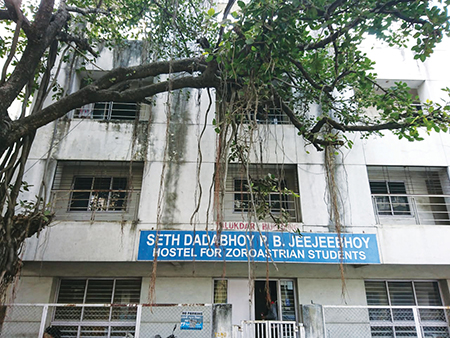
Boys’ hostel on Poona’s M. G. Road
Consequently, "Change of purpose of Boys Hostel, M. G. Road” was included as an item on the agenda of the PPP’s annual general meeting (AGM) held on September 30, 2019. PPP felt that the property had served its purpose to the fullest when adequate numbers of outstation students from various educational institutions in Poona were housed there during their student years. However, the trend has now changed. Most medical and engineering colleges are located in faraway places, many on the outskirts of Poona. Most of these colleges have their own hostel facilities which students prefer to use because of their convenience and proximity.
Given the Hostel’s dire financial situation and unsustainability, the secretary’s report for the AGM informed members that "this trust has now arrived at an understanding that these premises can be put to alternate use and can be commercially exploited, subject to statutory approvals from government authorities.” Boys requiring accommodation would be shifted to the PPP-run Bai Maneckbai P. B. Jeejeebhoy Buildings in Poona’s Lullanagar area.
"What other purposes are under consideration for the premises?” was the first question from members. Patel stated that no decision had been taken, nothing had been put in writing, but "one possibility is setting up an old-age home-cum-medical facility.” This led to members voicing their concern that the M. G. Road property might eventually be lost to the community if it is given out on a renewable three-year lease to outside investors. The trustees explained that anyone putting in lakhs of rupees to refurbish the property would insist on some surety and an adequate time frame to recover their investment. They assured members that all documentation pertaining to the lease would be vetted by legal experts and the Charity Commissioner’s office before any decision is taken.
"Will it be for Zoroastrians only?” was the next question, to which Patel candidly responded that the home would be open to non-Zoroastrians too, to make it financially viable. This did not go down well with a section of members who felt that the old-age home or any other institution set up on the premises should be run by Zoroastrians for community members only.
Eventually, the chairman put the proposal for "change of purpose of Boys Hostel, M. G. Road” to the vote by a show of hands, and the motion was carried with 44 votes in favor and 17 against.
Advertisements were subsequently placed in the Jam-e-Jamshed and Parsi Times inviting expressions of interest in establishing and running an old-age home from individuals, associations or trusts from the Zoroastrian community. At the end of the 30-day period, not a single proposal had been received, but a Parsi gentleman had taken the trouble to send an email pointing out that if the home is intended only for the Zoroastrian community then "the venture is not viable at all.”
Although the response to the advertisement was disappointing, Patel, along with the committee comprising vice chairman Homi Kaikobad, secretary Roshan Chindhy, joint secretary Farokh Irani, treasurer Hoshang Jamshedji and trustees Kaizad Bhaya and Bahram Pashutanizadeh, did not give up. They discussed the matter with a few prominent members of the community, including Tehmasp Bharucha and Viraf Deboo of the World Zarathushti Chamber of Commerce-Pune, and Freddy Godrej, a well-known businessman. "All three were unanimous in their opinion that the trust was working on the correct path and in the interests of the trust and the community at large,” Patel reveals. Subsequently, after consultation with the Charity Commissioner, PPP placed an advertisement in The Indian Express, this time inviting proposals from the general public, but specifying that preference would be given to Zoroastrians. To date, only one response has been received — that too from a non-Parsi — expressing interest in the scheme.
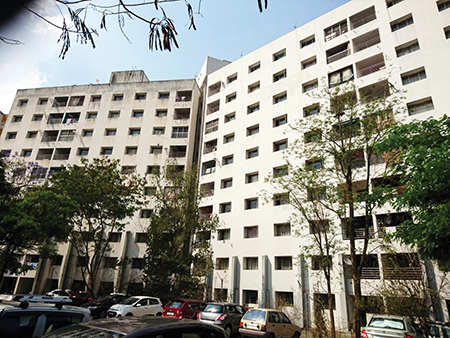
Bai Maneckbai P. B. Jeejeebhoy Buildings in Lullanagar
PPP trustees pointed out that when a similar move had been initiated in the past, the Grant Medical Foundation had expressed their willingness to set up a diagnostic center on the M. G. Road premises which would be open to all communities but free for Zoroastrians. "Some people created such a cloud of negativism that the Grant Foundation withdrew their offer. They did not want their name involved in any kind of controversy,” Patel added.
This is not the first time that the community has looked a gift horse in the mouth only to frighten it away. It is evident in the case of the Poona boys’ hostel that PPP has incurred huge losses for several years. Detractors who are determined to maintain the status quo point out that the Hostel is not required to make a profit. While that may be true, the question remains as to where the money is going to come from to sustain it.
Pashutanizadeh sums up the situation succinctly, "What we are proposing is to utilize these premises for a more workable project which will primarily benefit our community. Boys requiring hostel accommodation in Poona are not going to be stranded. They will be relocated, for the same fee, at the Jeejeebhoy Buildings in Lullanagar, where PPP oversees 232 single- and double-room flats. We Parsis need to come out of our shell and be progressive in our thinking.” A case in point: the dharamshala run by the Delhi Parsi Anjuman that has opened its doors to non-Parsis.
Many believe that with dwindling numbers, high running costs and low revenues, sustaining some of our institutions on a Parsi-only basis may not be viable. They feel it is not only the fittest who survive but the most adaptable.