Group Captain Dara Chinoy (retd) recalls the days of danger in a
49-year flying career
Beyniaz Edulji
It was on September 10, during the early days of the 1965 war with Pakistan that Flying Officer Dara Phiroze Chinoy found himself in trouble. He had been commissioned in the Indian Air Force (IAF) just two-and-a-half years earlier. His unit was targeting a Pakistani artillery position just across the border in Pakistani Punjab. Pakistan was not letting the Indian army cross the Ichhogil canal and he was part of the group of Flying Officers who had been given orders to destroy one of these targets, Chinoy narrated in a series of conversations over the telephone from his home in Bangalore in September-October 2016 followed by an exchange of emails.
So eager was he to go into battle that he left for his second mission of the day without eating or even drinking water, he recalled. Flying solo over the heavily defended target, his aircraft was hit by an anti-aircraft shell. To his horror, the aircraft’s engine flamed out. The cockpit caught fire. There was dense smoke. Visibility was zero. He decided to eject. As he floated down with his parachute, Chinoy made an easy target. He was fired upon, contravening the rule that banned shooting of an unarmed airman, the pilot explained. Once on ground, the enemy soldiers pursued him in vehicles and on foot. He managed to dodge them running through sugarcane fields, heading west instead of the easterly direction that the enemy perhaps expected him to take. He destroyed all identification papers and threw away any shiny objects on him.
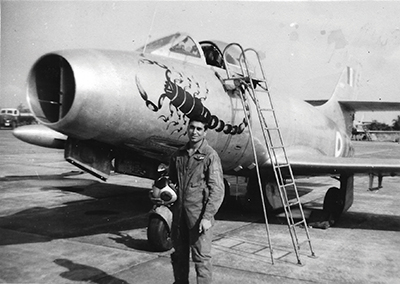
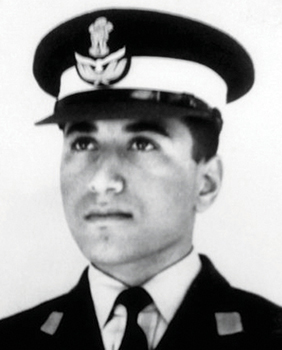
Dara Chinoy (left) and above in front of a Toofani fighter
For seven to eight hours he walked, ran and swam, avoided humans and stray dogs. He was dehydrated and felt faint. Luckily he came across a well. "My dread was being taken prisoner by the Pakistani army or even by the fierce Pathans of that region. Had I been found unconscious from fatigue and dehydration by anybody — Pak army, Pak civilians, or even someone from our side — I could have been killed!” He ultimately reached the Amritsar-Batala highway where Indian soldiers made him kneel and asked for identification which he had already destroyed. He was finally returned to his unit and started flying once again behind the enemy lines. His escape from Pakistan during the 1965 Indo-Pakistan War was broadcast by NDTV recently.
Chinoy claims, "The Pakistan Army has neither respect nor regard for rules, regulations and conventions laid by international forums like the Geneva Convention. Prisoners of war (POW) are to be treated with the regard and respect accorded to their rank and seniority. In contrast, when we shot down two Pakistani Canberras attacking our airbase at Adampur and captured the crew, we placed the POWs under close arrest in a room in the officers’ mess and at their request even fed them special tandoori chicken and dal-makhani brought all the way from Jallandhar!”
Before this misadventure Chinoy, who was a trainee pilot in 1964, had ejected from an Ouragan (Toofani) fighter over the Brahmaputra river after his jet developed problems. On another occasion Chinoy faced a grim situation when he had to eject from an MiG-21 after a bird hit. "I have looked into the face of death and death looked away many times, very many times!”
After retiring from the IAF as a Group Captain, Chinoy clocked thousands of hours as a civilian pilot operating corporate aircraft belonging to the Tatas and Ambanis.
He plans to write a book on his days in the IAF and in civil aviation spanning a flying career of 49 years.
Born on January 9, 1946, at Vijayawada (erstwhile Bezwada) to Gool and Phiroze, Chinoy studied at Sacred Heart High School, alias Saint Anne’s High School and Loyola College. He decided to join the IAF after "attending an (NCC) National Cadet Corps (Air Wing) camp, at Air Force Station, Tambaram in Madras. I witnessed air force aircraft carrying out aerobatic maneuvers and formation flying. I decided there and then that I would join the IAF and be a fighter pilot. I applied for and took the (Union Public Service Commission) entrance exam for direct entry into the IAF and passed… I was doing my second year BSc at Loyola College when I got a call to report to the Air Force Flying College, Jodhpur for flying training. On November 30, 1961, I reported to the College with the 83rd Pilots’ Course. I subsequently completed my MSc from the IAF.”
Chinoy has three siblings. "My sister Yasmin married into the IAF, to Air Marshal Maneck B. Madon and they now reside in Secunderabad. An older brother Adi lives in Canada and a younger one, Behram, in Visakhapatnam. All are senior citizens, retired and well settled.”
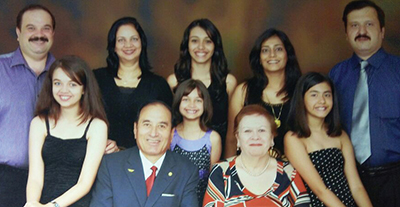
Dara and Margaret, seated foreground, with immediate family
Dara decided to settle in Bangalore because his brother-in-law, "paralyzed from age seven, was living alone in Bangalore, having lost both parents. I had promised to look after him once I retired.” Chinoy is married to Margaret (née Stephenson) and has two sons — Rohinton who is married to Anu (née Aakhaury) and Cyrus who is married to Monica (née Kothawala) — and four granddaughters, Tanya, Simone, Shenia and Sara. "For many years we have had dachshunds for pets.”
Post retirement, Dara admits, "Yes, I miss the excitement and thrill of flying — the challenges. If I could, I’d live my life the same way all over again. After leaving the Air Force, I worked for 16 years for the Tatas as chief of aviation and chief pilot. At the age of 60, I had to retire from there.” The very next day he joined as Anil Ambani’s chief pilot and worked for five years. "After a tense, challenging, intense, exciting, adventurous and unforgiving flying career, I think I have earned my ‘rest,’” he says. "I play chess online, spend time at my computer, keep in touch with friends and family, read, travel, watch TV and go for movies. I have fully and finally retired!”
Being a Zoroastrian is important to him, but "I am not a fanatic about religion. In my 28-year career in the IAF, there was absolutely no distinction or differentiation whatsoever regarding religion, caste, creed, color, language, state, region or dress. We were all Indian brothers in arms, sworn to serve our motherland, India, unto death. Our work was worship.”
Chinoy thinks of himself as cosmopolitan because "nearly all the places I was posted/ stationed at were ‘forward’ air bases, where there was no agiary or fire temple… Our community has much to be proud of: our heritage, our reputation, our contribution and service to our country and society. We need to secure that and protect it zealously. Each one of us must live up to those high values and standards set by our forefathers.”
He feels that the Parsis in Bangalore are narrow-minded. Elsewhere, they are more broad-minded and practical. "Within the next few generations we will dwindle to a mere handful and disappear from India unless we soon change our mindset, our rules regarding disposal of the dead and conversion, among many others.”