A soliloquy on the legendary missionary
Dr Albert Schweitzer, authored by Dr Farokh Udwadia, will be staged at the Tata Theatre
Firdaus Gandavia
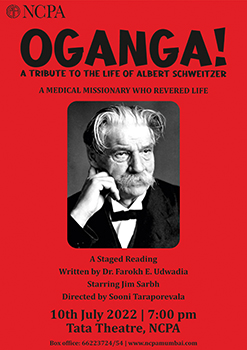
To describe Dr Farokh Udwadia as a "renaissance man” sounds trite and clichéd, but how else can one define a man who is certainly one of the most eminent doctors of the country, an author not only of scholarly medical books but also of those for the common man, a lover of history, music and poetry… The list of his achievements and interests is never-ending. Now he has written a soliloquy "Oganga! A Tribute to the life of Dr Albert Schweitzer, a medical missionary who revered life.” "Oganga” refers
to witch doctor, as Schweitzer was addressed. The word has several connotations, one of which is giver of life and death. A staged reading by actor Jim Sarbh, directed by Sooni Taraporevala, will be held on July 10, 2022 at the Tata Theatre.
Udwadia chose Schweitzer as a subject for a dramatic work as he was convinced that he was an amazing man, he said in a Zoom call with Parsiana on June 9, 2022. "Many people don’t know much about him so I thought I should put forth the life of the man who was a great humanist, a remarkably intelligent person, a doctor of philosophy, music, and theology.” A polymath who was awarded the Nobel Prize, he founded and sustained the Albert Schweitzer Hospital in French Equatorial Africa and later Gabon. How many people know that by sheer chance the German Lutheran minister opened a journal and read an advertisement for a doctor to serve in Equatorial French Africa? inquired Udwadia.
At the age of 30, Schweitzer decided to become a doctor; he studied at the University of Strasbourg and seven years later made his way to Africa. "He valiantly fought against the superstitions and the odd beliefs of the local people and started his practice in a henhouse operating with the help of a hurricane lantern, assisted by his wife, Helene, who was a trained nurse and anesthetist, as well as a black Frenchman, Joseph,” a cook who became a nurse and an interpreter as he "knew several African dialects.” Thanks to his own efforts he finally established a reasonably well-equipped hospital looking after a large number of patients.
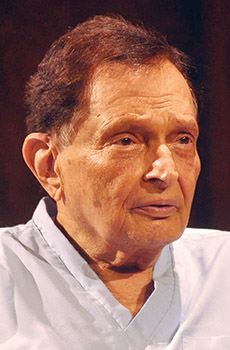
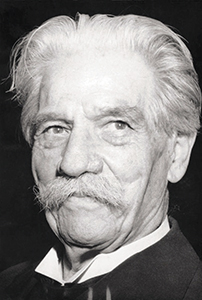
Dr Farokh Udwadia and (top, r) Dr Albert Schweitzer: common concerns
There are several common interests in the lives of the author and the protagonist which give an added nuance to the play. Schweitzer was a prolific writer and, in spite of a very busy schedule, managed to write 18 to 19 books. Udwadia too has written several academic medical books as well as two books for the lay reader: The Forgotten Art of Healing and Other Essays and Tabiyat: Medicine and Healing in India and Other Essays in spite of an equally busy schedule. He is presently revising the fourth edition of Principles of Critical Care, a volume of 700 pages, most of which he has written himself.
An organ player, Schweitzer was at that time probably the best known performer of Johann Bach. The doctor "would work for three years, and go back to the West and perform on the organ or the piano, give numerous lectures, gather money and go back to Africa,” said Udwadia who is also passionate about music. A violin player, Udwadia held small soirées merely for the love of playing the instrument. His taste in music is eclectic ranging from WolfgangMozart, Frédéric Chopin, Johannes Brahms to Sergei
Rachmaninoff, Dmitri Shostakovich and SergeiProkofiev. "Musings on Music,” a discussion between National Centre for the Performing Arts (NCPA) director Khushroo Suntook, former Supreme Court Justice Rohinton Nariman and Udwadia can be viewed on YouTube. In the discussion Udwadia mentions his love for music started when he was five years old. His mother, Perin, was appearing for the Fellow of the Trinity College of Music exam and he was compelled to hear her practice on the days he had school holidays.
A common philosophy binds the two medical men together — both are humanists and believe in universal love. Schweitzer’s seminal works Civilization and Ethics and Reverence for Life link ethics with the march of civilization. This certainly struck a chord in Udwadia because in the third act he writes about his concerns with good and evil and with reason and thought. He confesses that this was the first act he wrote and took him the least time to complete. "Schweitzer believed that if mankind had to prosper, we should have a reverence for all life — not just human beings and animals but also plants — and then people would get along better and the ecology of this planet would be saved,” said Udwadia.
Though Udwadia enjoyed reading playwrights Samuel Becket’s Waiting for Godot and English playwright John Osborne’s Look Back in Anger as well as the plays of Englishmen William Shakespeare and George Bernard Shaw, he was not influenced by them. "The greatest influence is my work with people who need help, who are extremely distressed where there is a total lack of empathy, of humanism. In the world people pursue wealth and power and are not concerned about anything else,” says Udwadia. This probably is another resonance between the thoughts of the two doctors.

Sooni Taraporevala (far l) and Jim Sarbh
Udwadia has a deep empathy for the Parsi community who he terms "remarkable.” He is all admiration for the disadvantaged Parsi who he finds gentle, kind, generous and honest. Most people would agree that the Parsis are great fun to be with. Though there are no Parsi characters in his play there is a Parsi actor, as well as a Parsi director. Taraporevala felt that she was privileged to help Udwadia achieve his long-standing dream. "For me this is about one legendary doctor’s admiration for another legendary doctor,” says the director. "He has written a loving, deeply felt tribute that will convey to the audience what an amazing man Dr Schweitzer was and why his philosophy of ‘reverence for life’ is as relevant today as it was when he came upon it all those years ago.”