A course for orthopedic surgeons in the UK is renamed
after consultant Jehangir Mahaluxmivala and his colleague
Parinaz M. Gandhi
Orthopedics is a line which gives you direct results. It is one of the specializations where patient satisfaction is most after surgery, especially for knee and hip replacement and hence it is a very gratifying line to be in,” states UK based Jehangir Mahaluxmivala who derives as much satisfaction performing surgeries as he does in teaching relevant skills to registrars and
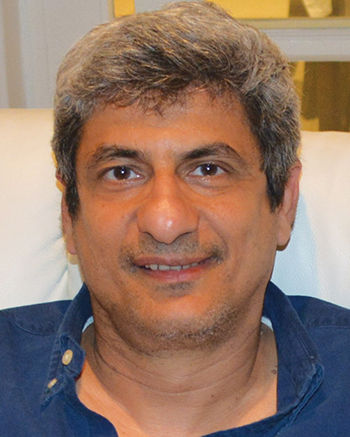
candidates preparing for the Fellow of the Royal College of Surgeons (FRCS) Trauma and Orthopedics examination. Co-founder and co-director of the Royal College of Surgeons of England FRCS (Orth) Course that had been running for over 10 years, beginning 2019 its new moniker is the Mahaluxmivala-Sherman FRCS (Orth) Viva Course for Orthopaedic Surgeons. While the course content remains the same, "it is now branded” in the name of Mahaluxmivala and his colleague Kevin Sherman, says the unassuming consultant with a smile.
Mahaluxmivala is also on the faculty of the Cambridge FRCS (Orth) Course and the Harlow Knee Replacement Course. "Thousands of surgeons — established surgeons from all over UK or surgeons becoming consultants — have done this course with me,” says 53-year-old Mahaluxmivala who is a consultant surgeon at Rivers Hospital and also at Princess Alexandra Hospital (PAH). On an average he performs 10 joint replacements a week, with knee surgery being his forte. "After a long time knee replacements do wear off,” admits the consultant who performs complex revision surgery too. "We, in England, have been doing replacement surgery for many more years; 20 years before India started… (although) the advanced surgical skills and implants currently in use would be on par” between the two countries, says Mahaluxmivala. He comes to Bombay around three times a year to meet with family and friends but does not perform surgery here. Familiar with orthopedic surgeons in the city, he has high regard for their surgical skills.
"The UK has been in the forefront of obtaining patient outcome details and ensuring that all surgeries are documented on the national data base. Hence data collection for all UK surgeries is mandated,” he reports on their efforts.
"Before I operate, to help the patient understand how the hip or knee replacement will be surgically done and what is expected of patients post surgery, I show them a short, three-minute animation video clip,” states the surgeon-designer who had collaborated on this animation with Comart, the processing and printing house in Bombay. This video was shortlisted for the National Health Service (that provides healthcare to all UK citizens) Innovation Awards.
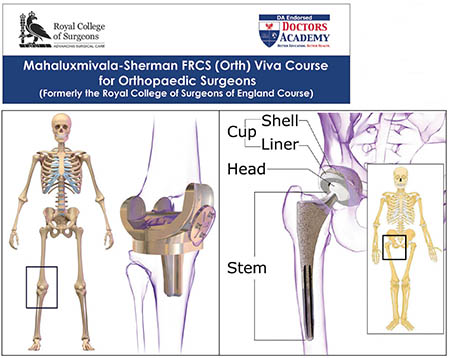
Top: banner announcing the course;
above: images of total knee replacement and hip prosthesis
Courtesy: BruceBlaus/Wikipedia
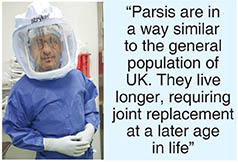
"Parsis are in a way similar to the general population of UK. They live longer, requiring joint replacement at a later age in life,” observes the doctor. But whilst Indians and Parsis seem to have more knee problems, in the UK, hip arthritis is common, requiring Mahaluxmivala to perform numerous hip replacement surgeries. He further differentiates how a fracture of the hip requires a half hip replacement as against a technically demanding full hip replacement undertaken for a person with severe arthritis. "Someone who needs a hip replacement for arthritis would potentially be a very active person and in a completely different patient group,” he explains.
He seeks to clarify the misconception that "knee arthritis is common in India because of lifestyle reasons.” Knowing that Parsis, too, suffer from arthritis despite having a "non-squatting” lifestyle similar to those in the West, Mahaluxmivala explains that the cause of this disease is "genetic and familial.” Ever the teacher, he further elucidates, "Rheumatoid arthritis or rheumatism is a manifestation of a condition which affects all joints including the upper limbs but the majority in India and in the UK have hip and knee replacements done because of a condition called primary osteoarthritis which mainly affects the large joints of the body like the knee and hip. It is genetically more common in the knees in the Parsi/Indian population. Those with generalized joint pain cannot be successfully treated by knee replacement surgery. The best results are obtained when the pain is completely centered in that joint with severe change of arthritis as noticed on X-rays and significant symptoms like pain in the knee at night and walking ability limited to about 10 minutes.” Through information gathered from many years of knee replacements orthopedic surgeons know that patient satisfaction is dependent on such factors before surgery.
Parsis who enjoy their food would be happy to hear from the good doctor that "diet and change of lifestyle is not going to influence whether you get arthritis of the knee.” But before they get too elated he cautions, "Certainly being overweight is not advantageous. Everything should be done to reduce being overweight for the risks of knee replacement surgery are higher. In the UK there is a drive to not sanction or finance knee replacements for those who are overweight unless the patient demonstrates a bare minimum 10% loss of body weight before surgery.”
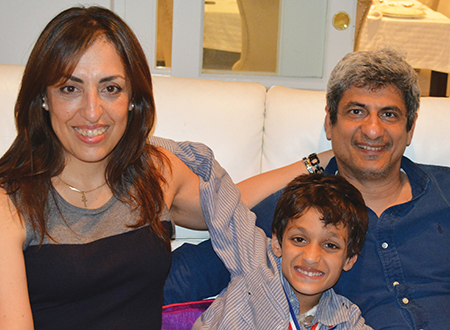
Anamaria, Sam and Jehangir Mahaluxmivala
In his individual capacity he is known to pay attention to minute details starting from pre-operation planning, patient positioning, to meticulous and reproducible surgical techniques that he shares with his juniors. A recipient of the Clinical Excellence Award from PAH, as noted in a post on yourharlow.com, "PAH is very fortunate to have some of the best surgeons in the country. Mahaluxmivala…also comes into this category of excellence. My wife and I are walking proof of that.” Another patient portal, iwantgreatcare.org had carried a feedback from a police officer for whom Mahaluxmivala had performed total knee replacement making him write at length on why he considered Mahaluxmivala and his team "excellent.”
Working conditions for surgeons have greatly improved following the introduction of a convenient surgical hood with a helmet, visor and battery-operated pack that controls temperature and air flow during an operation, appreciates Mahaluximivala. "Orthopedics is technologically very advanced so there is a combination of surgical skills as well as use of advanced engineering technology that appealed to me,” states Mahaluxmivala, admitting that although he had grown up in Bombay with his father Dr Sam who is a plastic surgeon and mother Dr Narges who is a consultant in clinical development research, "I knew early on that I wanted to do orthopedics or I wouldn’t pursue medicine.” A former national level badminton player, Mahaluxmivala understands the complications that could arise from sports injuries and his ability to counsel athletes requiring surgical intervention.
After his early education at Campion School, he completed his MBBS and Master of Surgery in Orthopedics from Nair Hospital in Bombay. He then proceeded to the UK in 1994 for higher studies. An additional MSc qualification was obtained from the University of Teeside. He earned his FRCS (Tr and Orth) from the Royal College of Surgeons of England and qualified as a consultant in 2005. And thus the ‘Dr’ prefix before his name, changed to ‘Mr’ as per the practice in UK. For his orthopedic training he was at the Royal National Orthopaedic Hospital (Stanmore) Rotation, got a consultant job at PAH and started private practice at Rivers. Clinical and educational supervisor for specialist registrars in orthopedics, North East Thames (London) and East of England (Cambridge) Rotation, three years ago he was named Trainer of the Year by the Royal London Hospital Rotation. Author of several peer reviewed scientific papers and on the editorial board for the Journal of Surgical Simulation, he has even written a chapter for the prestigious Oxford Textbook of Surgery.
Settled in the UK for the last 25 years, Jehangir is married to Anamaria, a family physician in London and they have an 11-year-old son Sam who is coping with an autism problem. During his visits to Bombay, Jehangir is happy to be in the company of his parents, elder sisters Zareen Kotwal and Pervin Poonawala, the extended family and circle of Parsi friends from P. V. M. Gymkhana and the medical fraternity.
"I am very proud to be a Parsi,” affirms Jehangir who professes liberal views. Wearing the sudreh-kusti every day is routine for him as is saying a Yatha Ahu Vairyo before every surgery. He has close friends from the Zoroastrian community in the UK, too, and assures us that if any community member "needs medical advice, I am available.”