"It is time for these to be shared,” erstwhile doyenne of the advertising world and keeper of the Wadia Movietone (WM) legacy Nargis Wadia told Parsiana on October 10, 2021. Added her son Roy, "We wanted to tell the world there is more to WM than stunt films (that they were most known for).” Meticulously collected by Nargis’s son and Roy’s late brother, filmmaker Riyad (1967-2003), the sale of WM memorabilia will be conducted online by auction house Prinseps in two phases.
Their brochure states that 157 lots of posters and lobby cards, some hand painted, and song books from WM and related production houses will be available for live bidding from November 16-18. Also from Riyad’s collection, the second phase consisting 86 lots of posters and song books from production houses other than the Wadia’s will be up for bidding between November 20 and 21. Each lot is labelled with the release date of the movie, the dimensions of the artefact and the expected range of prices, which depend on age, quality and the intricacy of the artwork involved. Some lots also carry a synopsis of the plot of the movie. The classics of WM are well represented: The Court Dancer, Diamond Queen, Miss Frontier Mail, Captain Kishore, Mela and Saaz aur Sanam.
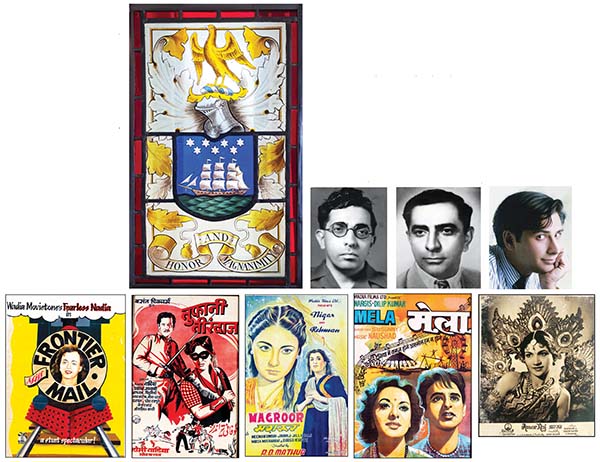
Top, from l: stained glass window from Lowji Castle; Jamshed (JBH), Homi and Riyad Wadia;
above: iconic posters from Riyad’s estate
Clockwise from top l: Vinci, Nargis, Riyad and Roy Wadia
Roy told Parsiana that much of the remaining memorabilia associated with WM is preserved at the Film Heritage Foundation, a not-for-profit organization dedicated to supporting the conservation, preservation and restoration of the moving image. "We wanted to make it available to anyone who wants to research films.”
Possibly the pièce de résistance for history buffs is a 25” x 14” stained glass window from Lowji Castle. Built by master shipbuilder Lowji Wadia in Parel, the structure reportedly had an imposing entrance hall and a wide oak wood balustrade leading to the living area. "Lighting up the entrance lobby were several colorful stained-glass panels with the family crest and motto, ‘Honor and Magnanimity,’ along with the sailing ship at the center of the design,” states the brochure. Ownership of the property passed on to Nargis’s father-in-law Jamshed (JBH) in the early 1900s. He "established his company WM there, adopting the Wadia leitmotif of the sailing ship in its logo.” Price for this artefact in shades of blue, yellow and grey is available on request.
JBH established WM in 1933; he was soon joined by his younger brother Homi in the business. Homi eventually founded his own banner of Basant. "Both siblings work(ed) side by side well into the 1970s.” Their films included the first Indian movie without songs (Nav Javan), the first Indian film produced in English, Hindi and Bengali (The Court Dancer), the first Sindhi language film (Ekta) and "numerous films with landmark special effects (Toofani Tarzan, Aladdin and the Wonderful Lamp and Sampoorna Ramayana).”
The brochure states that Riyad acknowledged that his grandfather was the greatest influence in his life: "He taught me about cinema and fuelled my passion for it.” After studying film craft in Australia, he set about recording the outstanding career of stunt queen Fearless Nadia (Mary Evans), long time star of WM and also his grand aunt (Evans was married to his grand uncle Homi.) Fearless: The Hunterwali Story was exhibited in over 100 film festivals worldwide. "Riyad scoured the country collecting… memorabilia... He held exhibitions in Bombay, New York and curated an exhibition in Zurich… He aimed to make the public realize the value of cinema poster art.”
The brochure highlights a lesser-known aspect of JBH’s world: "As the Indian independence movement grew and JBH became more involved in it, he saw the stunt movie genre as an opportunity to move beyond entertainment for its own sake, to encompass ‘Education Through Entertainment,’ which became the studio’s motto,” as notes veteran filmmaker Shyam Benegal in a write-up. "Nadia’s films often conveyed multiple social messages — the need for gender equality, literacy for the masses, ethnic and religious harmony, and other essentials that an eventually independent India would need to build and prosper as a fledgling nation.”