The ’70s was the decade in which an unusual pair controlled the Bombay Parsi Punchayet (BPP). Boman K. Boman-Behram (BKB), rent control lawyer, career politician, the only independent to be elected mayor of Bombay, mercurial, bachelor, controversial. Dr Nelie Noble, a dour doctor, ultraorthodox, spinster, not to be shunted while loose, avowed Pundolite (Minocher Pundole was a minor guru of orthodox hues; he was said to have miraculously produced the exact number of cutlets for his stunned red capped disciples from the refrigerator of an Udvada hotel, and preached vegetarianism though he himself reportedly ate meat due to the purportedly more refined vibrations of his divine self). It was a marriage of convenience; the doctor needed the lawyer’s networking and manipulative skills; the lawyer claimed to be orthodox by associating with the fanatical doctor though he was liberal at heart in more ways than one. He merrily participated in song and dance in Kannadiga temples in the Fort to please his municipal constituency. There were other salacious tit-bits which this editor will not print. Noble was too busy building a cone shaped agiary in Udvada to notice her colleague’s extra religious propensities.
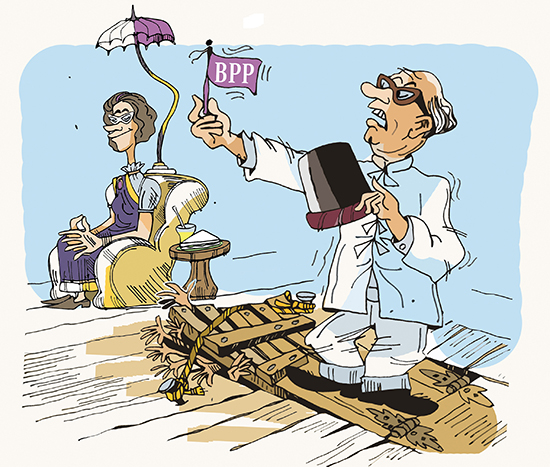
Illustration by Farzana Cooper
The BPP trustees were then elected by a cabal called Sau nu mandal (originally, a group of 100) which comprised of six registers classified from A to F. A was of graduates; F of donors to the BPP, and so on. The duo controlled most of these registers; and without their nod, it was said that even if Zarthost Saheb contested he would have lost. Noble’s brothers ran a cycle shop in the Fort and were reportedly not averse to occasionally flexing a muscle to browbeat voters. BKB added finesse to the exercise.
There was a long waiting list for BPP flats and, to put it mildly, all was not kosher in allotting homes. BKB had succeeded Erach Nadirshaw as BPP chairman. A former chief hydraulic engineer with the Bombay Municipal Corporation, Nadirshaw wore a felt hat and a three-piece suit on May afternoons; and had memorably informed the visiting Shah of Iran that they shared a surname. His brother-in-law, Minoo Nariman, finest of gentlemen and a writer of hilarious comedies [in his book, Hitler Saathé Mulakaat (Meeting with Hitler) he described how his fuiji (father’s sister) from Navsari stuffed kéra per eedu (eggs on bananas) into the dictator’s mouth to extricate a fish bone stuck in the latter’s throat] penned a Parsi New Year play called Howdaas Chowdaas about corruption and nepotism in Parsi charities, to the acute discomfiture of the perennially assured Nadirshaw. BKB and Nadirshaw were neighbors and often shared a sundowner.
Most affluent and well placed Parsis were then utterly indifferent to the BPP. This made matters easy for the combine. A young Indian Administrative Service officer, a budding senior counsel and the owner of a reputed engineering outfit, decided to stir matters. Jamsheed Kanga would later be the municipal commissioner of Bombay, Tehmtan Andhyarujina, a foremost constitutional lawyer of India and Noshir Sidhwa owned Grindwell Norton. They were soon joined by professionals like Arnavaz Sethna, Dadi Engineer, Minoo Shroff and Fali Poncha. You cannot stop an idea when its time has come, and many joined the movement. Zal Contractor, a most hospitable man, threw open his large Colaba residence including serving sumptuous dinners and single malt. He ran a cold storage at Sassoon Dock and served large lobsters to this group which grew exponentially (that is, the group). Like any movement, it was soon divided into leaders and followers. The former styled themselves as the Core Committee and the body was christened the CER or Committee for Electoral Rights. Thus over Contractor’s crustaceans and free booze, BKB and Noble’s downfall was planned.
Noble hardly spoke or smiled or commented (she occasionally grunted) but the easy-going BKB was amused. What do they (CER) know about the common Parsi in the colonies, he said. Elitist busybodies doomed to failure. His supporters alleged that CER comprised many who never wore the sudreh and kusti, smoked cigars, had immediate family married out of the faith, wanted to convert and throw open fire temples to non-Parsis. Radical reformists, said the wily BKB. To Noble, even the high priests were reformists. They must be prevented from taking over our august Parsi institution.
In contrast, the Core group of the CER was overtly polite and gentlemanly. We are only a ginger group, they stuttered. We are just seeking transparency and a democratic way of life in the BPP. Over countless cups of tea and very thin cucumber sandwiches in the offices of Grindwell Norton they endlessly debated as to how the trustees could be persuaded to see reason. BKB humored them and made a few meaningless concessions to amend the election system. These gentlemen had little stomach for a fight and simply could not fully understand the psyche of the common Parsi in the colony. BKB toyed with them and wasted time, knowing that the combined money and mind power of the elite could end his reign soon. As a non-party affiliated candidate, he was already finding it difficult to finance his political ambitions including an unsuccessful bid at becoming a member of the Maharashtra Legislative Assembly.
The catalyst provided by the CER leadership attracted a much wider circle of grassroots workers from the colonies. Initially, there was a clearly visible divide between the more hawkish and hardcore followers and the sophisticated leaders. The former urged direct action; the latter demurred and were confident that BKB would surely relent.
The CER’s objective was to make more Parsis register themselves as voters. There was no adult franchise, but the registered voters elected the Anjuman Committee (AC) which, in turn, voted for the trustees. The drive to register the maximum number of Parsis as voters was successful. BKB was worried. Thus the elections for the AC became important though not critical. Noble controlled the A register for graduates and BKB had a hold over the other registers. The General Register had to elect more than 100 odd members. After much cutting and chopping, the CER slate was announced. It looked like a walkover. Then BKB rallied the orthodox like the Khshnoomists, the Pundolites and Athornan Mandal to form a new body to counter the CER. It was unimaginatively called the Committee of United Zoroastrians or CUZ. They too conjured up a slate of 100 odd candidates.
The Parsi media joined the fray. Jam-e-Jamshed supported the CUZ; the fire spewing Jehan Daruwala of The Bombay Samachar supported the CER. Parsiana too was for electoral reform but not as strident as the Samachar. BKB reportedly used to tremble every Sunday morning while reading the Samachar.
The elections were announced. The CER leadership sensed that this was not going to be a level playing field; every day BKB obstructed the process. Reluctantly, the CER moved the court. After several skirmishes, a few safeguards were introduced to prevent electoral malpractices but they were not adequate. Voter impersonation was possible as there was no indelible ink or photo identity. Remember there were no computers. For the average Parsi to vote for 100 candidates was a laborious task.
BKB declared that the names of all candidates would be in alphabetical order, making it impossible to know who belonged to which slate. Again the Court intervened and the two slates appeared separately on the ballot paper. BKB was nervous. He raised the famous cry of religion in danger. These reformists will destroy our unique identity, he alleged.
The CER did not stoop to the level of the disinformation being spread by the establishment. However, its grassroots followers were becoming increasingly restive. It was time to pay back in the same coin. Election meetings were held at night in various colonies. Parsis came in large throngs to listen to the elite who had descended to deliver them. The CUZ too held meetings. At a heated Dadar meeting, a solicitor who presided said that the Parsis now had their own Circus: the CERCUZ. He was right. There were ringmasters and clowns, musclemen and acrobats who swung both sides.
Noble famously assuaged BKB that these novices would meet their Waterloo at the trusteeship elections, even if they managed to capture the General Register. She was right but she did not know that her opponents were no longer only the polite professionals who were sweet and gentlemanly. The CER now included some street fighters and they were a thousand times deadlier than Noble. A slugfest was on the cards. The BPP would no longer be anyone’s backyard. Or so we thought. To be continued
Berjis Desai, lawyer and author of Oh! Those Parsis, and recently Towers of Silence, is a chronicler of the community.