An imaginary interview with
the mascot evokes nostalgia
Geeta Doctor
The Air India Maharaja is an iconic character that always resonates with us, reflecting the airline’s past glories. This piece was written for the airline’s newly launched in-flight magazine but not printed because the management said it is trying to erase the mascot as he does not represent current day India.
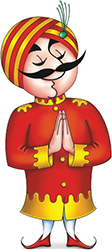
A familiar figure lies stretched out on the slatted wooden recliner by the pool of Bombay’s most iconic hotel in South Bombay. His portly mid-section is hidden by a large white Turkish towel. His eyes remain half closed beneath the familiar onion dome of the red and gold ribboned turban.
Clearly visible however under the bulbous nose is the Maharaja’s moustache. It is black and shiny, wing tipped in a straight line, a permanent salaam to the world at large.
Interviewer: Excuse me, Sir. May I interrupt your siesta for a couple of minutes? Are you really AIM, the famous Air India Maharaja?
AIM: My dear young lady, and what may I do for you? I notice that you are a PYT — Pretty Young Thing — and I can assure you, I have known many. Yes, I am indeed him, the mascot as I am often called.
PYT: It’s your moustache, Sir. It’s the first thing I noticed. It’s extraordinary.
AIM: In the world of moustaches, mine ranks along with that of M. Hercule Poirot. You’ve heard about him, the Belgian detective? And the artist Salvador Dali. Poirot twirls his moustache to tune his little grey cells, as he calls them. Dali points them upwards like rapiers to catch the attention of the world. Whereas mine is the Maharaja of moustaches. It’s desi and pardesi — local and glocal. A moustache with wings designed to fly you around the world.
PYT: Oh, wait a second. Is that how it all began? First came the moustache and then came the man?
AIM: I started life on an in-flight memo pad, a logo created by Umesh Rau, an artist working at J. Walter Thompson. It was inspired by S. K. Kooka, ‘call me Bobby,’ Air India’s commercial director and Jal Cowasji, in charge of publicity.
Air India, the airline had already been launched. Everyone knows how a young 28-year-old Parsi aviator made history by flying a De Havilland Gypsy Moth, a single engine plane from Karachi to Bombay in 1932. When he stopped to refuel the tank at Ahmedabad, the gas was brought in cans on bullock carts. There was no stopping J. R. D. Tata after that; or the airline he launched a few years later — Air India. It made short runs to Colombo, Prague, Damascus and Istanbul via Delhi.
On June 8, 1948 Air India’s Malabar Princess soared into the international aviation arena with its first intercontinental flight from Bombay to London, stopping at Cairo and Geneva. It was a landmark event marked by a first day Indian stamp created by the Philatelic Bureau.
Above, from l: J. D. Choksi, J. R. D. Tata, B. W. Figgins, Sohrab (Bobby) Kooka and A. C. Guzder,1948,
on the arrival of Air India’s aircraft Mughal Princess; top: Kooka (l); Jal Cowasji Photo: Todywalla Auctions Mumbai
Top: Salvador Dali (l) and Hercule Poirot; above: Maharaja in Paris poster
They flew a gleaming Lockheed L. 749 Constellation. It was a 40-seater that had besides Jehangir Ratanji Dadabhoy Tata and his wife Thelma (née Vicajee) and a couple of Maharajas, the Jam Saheb of Nawanagar, Rajpramukh of Saurashtra as he was known, Duleepsinhji, famed cricketer, Bobby and myself. They needed a mascot. Suddenly there I was in my Maharaja regalia, a red bandhgala (closed neck jacket) with matching striped turban, curving toed slippers, eyes half closed in ecstasy and my hand over my heart in a traditional Indian way of saying, "Welcome to our world. You are an honored guest.” It was love at first flight.
PYT: But what about the Air India air hostesses? They became so famous that I have seen calendars devoted just to their elegance. Weren’t they known as havayi sundaris (flying beauties)? And nannies on heels? I know it’s no longer permissible to speak of ourselves in such terms. Maybe there was a golden era of flying when such fantasies were the norm.
AIM: Oh my dear! How can I put it? Bobby was in charge of selecting the air hostesses in his time. At first they were regimentally dressed like Florence Nightingales on the flight deck. It was around the 1960s that they started wearing the beautiful silk saris, long sleeved blouses with severe necklines and upswept hair in neatly coiled buns.
PYT: Were you the brand?
AIM: The brand was always India. Bobby insisted that what I signaled was the warmth and hospitality represented by the idea of India. All the artefacts, the giveaways like the famous calendars, the art that decorated our offices, the food, the music and decor all had one aim — to celebrate the Indian aesthetic in all its exotic abundance. Why, even Salvador Dali designed an ashtray for Air India!
PYT: Didn’t people object to some of the calendars?
AIM: Well, there were questions raised in Parliament about an in-flight booklet we presented to our valued guests. In one frame I was shown in a close embrace with a topiwalla (local man/politician wearing a cloth cap), while craftily taking out all the Air India cutlery that he had stashed in his back pocket. We apologized and replaced the freeloading desi guest with a bowler-hatted chap. And yes, the one where I go water skiing with two lovely lasses in Sydney that raised eyebrows, or the one with me in Paris, opening my jacket in a sleazy manner and whispering: "Pssst! Naughty pictures!!” I could go on. I was Bertie Wooster to Bobby’s Jeeves. He always managed to get me out of a sticky situation by his charm. Or maybe, it was my charm that got him out of a spot with the censors.
PYT: What happens in a world that no longer recognizes a Maharaja?
AIM: They ghosted me once 1989. There was such an uproar that I bounced back. Here I am today, saved by the length of my moustache. Legends never die. They are born again and take flight on Air India.