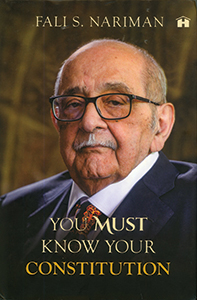
This extract from the Introduction of the book You Must Know Your Constitution by jurist Fali S. Nariman has been reprinted with the permission of the author and Hay House Publishers (India) Pvt Ltd.
In 1947, the British hurriedly left us somewhat in pique, leaving Indians to fend for themselves as best as they could. And only recently, we got to know the reason why.
On a visit to Calcutta in 1956, the former (British) Labour Prime Minister, Clement Attlee, had told the Chief Justice of Calcutta — then acting as governor of West Bengal — that it was the mutiny in Bombay (in February 1946) by a section of the Royal Navy that led to Britain’s hasty departure. "It made us realize,” Attlee said, "that Indian armed forces could no longer be trusted to protect the British in India.”
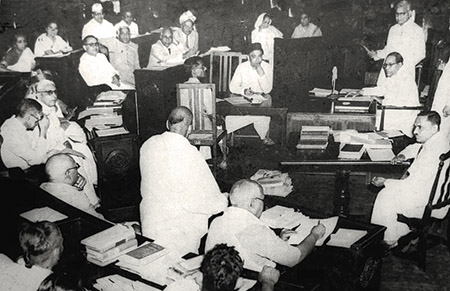
Whatever may have been the true reason for the hurried exit of the British in 1947, members of India’s Constituent Assembly took it in their stride. Charged with the task of preserving the political and cultural unity of India, they proceeded to put together a written Constitution for the people of India — a Constitution that has now lasted more than 70 odd years.
However, no one has any idea of how long a written constitution would last (or for that matter, should last). Thomas Jefferson, American statesman, Founding Father, and third President of the United States from (1801 to 1809), thought that 19 years was about right! Around the world, many written constitutions have lasted, on an average, only 17 years before being scrapped. But not the US Constitution: with less than 8,000 words, it has so far lasted — with only 27 amendments — for more than 200 years! India’s Constitution has endured for over seven decades, with more than 100 amendments (the last being in 2021).
The life of a written constitution — like the life of the law — is not logic (or draftsmanship), but experience. Seventy-odd years of experience on this subcontinent has shown that it is easier to frame a constitution than to work it. In the same subcontinent, Pakistan and Bangladesh had crafted written constitutions at different times, but they were interspersed with periods of martial law, and civil and military dictatorships. We will never be able to piece together a new constitution in the present day and age simply because innovative ideas, however brilliant and howsoever encouragingly expressed in consultation papers and reports of commissions, can never give us an ideal constitution.
In constitution-making, there are hidden forces that must not be ignored, viz, the spirit of persuasion, of accommodation, and of tolerance. In India — as in the rest of the world — all three are at a very low ebb today. According to the World Bank, Chile is one of the fastest growing economies in South America. In October 2020, 78% of all Chileans approved of a proposal to have a new constitution for the country, but when it was put together and presented in a referendum in the year 2022, it was unhesitatingly rejected by the people! Commenting on this in The New York Times in September 2022, Benjamin Appelbaum (on the editorial board of Time magazine) observed: "Writing a new constitution strikes many Americans as a transgressive idea. The US Court is the oldest in the world and it has come to seem immutable. The last really substantive change was a 1971 amendment lowering the voting age to 18. Instead of updating a text written more than 200 years ago, Americans have come to rely on the imagination of its nine justices who decide what they think it should say.”
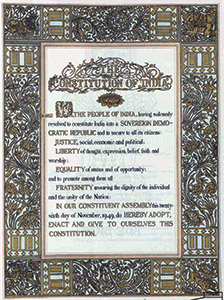
Top: Preamble to the Constitution of India;
above: Constituent Assembly at work Photos: Wikipedia
The Constitution of India (1950) opens with the words: "We the people of India… do hereby adopt, enact and give to ourselves this Constitution.” If this means the people of India who were born before 1950 (as were the Constitution’s Founding Fathers), then it must surely be out of tune with the vast majority of the people of India who have been born since then. But there is some magic in the words "We the people.” The same three words are also the opening words of the world’s oldest constitution — that of the United States of America. And the answer to the conundrum as to what relevance a written constitution has for the overwhelming majority of its people — who were not born before its promulgation and therefore, not included in the phrase "We the People” — was offered by Congresswoman Barbara Jordan. On July 24, 1974 (referring to the US Constitution) she said: "‘We the people’ is a very eloquent beginning. But, when that document was completed on September 17, 1787, I was not included in that ‘We the people.’ I felt somehow for many years that George Washington and Alexander Hamilton just left me out by mistake.
"But I realize that it is through the process of interpretation and court decision that I have been finally included in ‘We the people.’”
Well put. In a nutshell it describes the role of India’s Supreme Court. By interpretation in court decisions it has broadened the reach of the provisions of our Constitution. It has included within the range of its beneficent provisions those who were not born when Indian got independence. Judges — past and present — have interpreted and helped sustain a Constitution that had been framed for only 350 million people, most of whom are not even alive today. This is one of the ways in which a written constitution is made to grow into a dynamic living document.
But why have a written constitution? Perhaps the answer is: because it fosters respect for "The Law”: a sentiment captured in a heart-warming passage in the play A Man for all Seasons, about the life of Sir Thomas More (1478-1535), scholar and saint, who was also Lord Chancellor of England during the reign of King Henry VIII (1509-1547), a monarch known for his radical changes to England’s unwritten constitution. In the play (written by Robert Bolt), one of the King’s spies, Richard Rich, approaches More to extract an admission from him that he regards his church even higher than his own sovereign (not in order to carry the treasonable tale back to the King), at which More’s son-in-law, William Roper, asks him to arrest Rich forthwith, since he is the very devil, adding: "As Lord Chancellor, you have the power to do so.” But More demurs, only because the man has not broken any law. And then there follows a fascinating exchange between the two:
"Roper: So now you’d give the Devil the benefit of law!
"More: Yes. What would you do? Cut a great road through the law to get after the Devil?
"Roper: I’d cut down every law in England to do that!
"More: (roused and excited): Oh? (advances on Roper) And when the last law was down and the Devil turned round on you — where would you hide, Roper, the laws all being flat? This country is planted thick with laws from coast to coast… Do you really think you could stand upright in the winds that would blow them? (Quietly) Yes, I’d give the Devil the benefit of law, for my own safety’s sake.
"Roper (weakly responds): I have long suspected this — the law’s your God.”
But in the end — ideally — how should a written constitution be framed?
Justice Louis Brandeis, who served in the Supreme Court of the United States from 1916 right through until his retirement in 1939, believed that an ideal constitution was one that expressed the will of the people, to be ascertained by living with the people. He illustrated this with a story about Montenegro (one of the smaller nations in Europe). After it had secured its independence in the 19th century its ruling prince wanted his country to have a code of laws like other civilized nations. So, he requested the Czar of Russia to lend him the services of a scholarly professor of law at the University of Odessa to prepare a code for Montenegro. The professor was duly authorized and undertook the task. But instead of relying on law books or his own knowledge of the law he went to Montenegro, lived with its people for two years studying their customs and practices (to familiarize himself with their "roots”), and only then did he draft a constitution from all that he had learned from the people. And (as Brandeis always used to say) "they respected it because it expressed the will of the people.”
Incidentally, this is how Mahatma Gandhi wanted India’s constitution to be written. And in 1946, before the first meeting of India’s Constituent Assembly, economist Shriman Narayan had already written a book which he proudly called: The Gandhian Constitution for Free India. It introduced for the first time the complete draft of an indigenous "Indian Constitution” with decentralized legislative, executive and judicial bodies based on village panchayats. It also laid down a set of fundamental duties to go along with fundamental rights. Gandhi endorsed Narayan’s proposal by contributing a foreword to the book.
But, I am afraid, this was not the way India’s Constitution was written — neither the Brandeis way, nor the Gandhian way. You will simply have to read the book to know how India’s document of governance had been framed, and how it has evolved.