A kibbutz is democratically governed and everyone has a voice
Ardeshir Mehta
Ardeshir Mehta’s "My Experience of Kibbutz Life in Israel with particular reference to Behram Irani’s doctoral dissertation on communes” offers an insightful look at life in Israeli kibbutzim (plural of kibbutz) from the years 1968 to 1976. A kibbutz is a communal farm or settlement in Israel. Mehta was studying and living in Israel at the time. Parsiana reprints with permission some extracts from Mehta’s memoir forwarded to us by his cousin, the poet Adil Jussawalla.
A kibbutz, as one of the members of Tsor’ah once said, is basically people. It is not buildings, equipment, land — though all these count. But it is the people that are the most important.
In this period I got to understand the working of Tsor’ah as a kibbutz in great detail. I found out that in addition to the categories of people mentioned earlier (see "Life in a kibbutz - I,” Parsiana, February 21-March 6, 2022), there were other categories as well. There were for instance, parents of members who were not members, and did not participate in the democratic process of running a kibbutz. They were for the most part aged people who were retired. They did some work — according to their capacity — but not necessarily full time. They were not required to. Some of them wrote. Others just lived on the kibbutz. Then, there was a doctor living on the kibbutz who was not a member. He had no desire to become one. He was paid by the kibbutz to look after the health of everyone living there. He had a nice cottage in the kibbutz and a car. He used to go to Jerusalem also.
Many Arabs worked at construction jobs, but they hardly touched the social side of the Kibbutz and I never got to know them. Two or three Arabs worked at one time or another with the sheep branch. One was a Bedouin named Muhammad. He left not long after my joining. I remember a conversation I had with him. He asked me if I knew how and why rain fell. I gave him a long explanation about how water evaporates from the sea, condenses into clouds and then into droplets of rain and so on. He listened in silence — a very reproachful silence. In the end he asked me: "Have you never heard of Allah?”
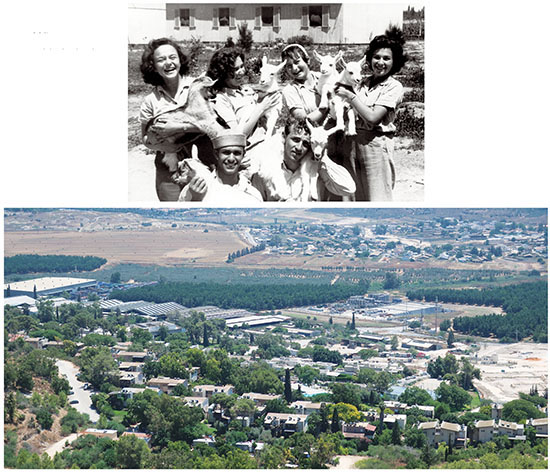
Top: Sheep rearing at a kibbutz; above Kibbutz Tsor’ah as seen from the forest Photos: Wikipedia
Most of the children on the kibbutz were, of course, the natural offspring of the members, but some had been adopted. These could barely be distinguished from the others. At least I could tell no difference between the way an adopted child was treated and a natural child. Once a family had adopted a child, the kibbutz considered him or her no different from the natural children.
Candidates for membership at Tsor’ah were of two types: those who came individually and those who came in groups called gar’inim. Gar’in is a Hebrew word for nucleus and the suffix im signifies the plural. The gar’inim were generally young high school graduates from Jerusalem who wished to try out the kibbutz way of life with a view to ultimately settle on one. A couple of gar’inim had come from abroad. The members of the gar’in were therefore all young and presumably dynamic. A few of them stayed on as members after about a year or sometimes more. Others found that the kibbutz way of life was not for them, and left to start a life in town. It was a matter of personal choice.
Those candidates who came individually — or sometimes as couples, with or without children — were somewhat older as a rule. Some were members of another kibbutz who wanted to change their kibbutz for one reason or another. One of the reasons people came to Tsor’ah was that it was close to Jerusalem, the holy city. Even people who were not in any sense religious were attracted to Jerusalem. Other candidates were from South Africa who found the politics of their country inhumane even though they were part of the favored white minority. They gave up a lot of material comforts to live on the kibbutz which, comfortable as it was, could not compare with the luxurious villas, servants, country clubs and posh cars of South Africa. Other candidates had married members and so wanted to join.
As I have said, most work was done by teams. There were teams for the dairy, kitchen, dining room, laundry, and so on. Not all work, however, was necessarily done by teams. One member was a professional photographer. He worked alone. He had an excellent darkroom and equipment which the kibbutz had purchased for him. All his earnings, of course, went to the kibbutz treasury. When he was not working as a photographer, he did casual work in some branch or another.
There were also a sculptor and a painter who spent part of their time working in fairly well equipped studios provided by the kibbutz.
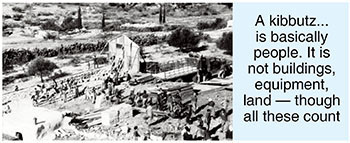
The first buildings coming up at Kibbutz Tsor’ah in 1948 Photo: Wikipedia
Other members were students at the university. They would study during the week and work at the kibbutz on week-ends. One was a student at the faculty of agriculture where I was studying. He was one year my senior. When he finished the course he became the merakez (manager) of the field crops branch and made it very profitable, growing record yields of maize and cotton. Another was studying farm economics. He later became estate manager. While they were studying they drew money from the kibbutz treasury for their university and other expenses in town. Members had to get permission of the general meeting to study. This was not so much because of the expense involved but because hands were needed to do work on the kibbutz. There is no such thing as unemployment on any kibbutz; there were always too few hands and too much work to be done. So if the general meeting felt the person wanting to study was needed more at the kibbutz, they would ask him to wait a year or two before going to the university. No one was actually denied a university education, however. It was just a question of how long he would have to wait. If people had their own money for a university education they were expected to use it for that purpose. If they did not have money, however, the kibbutz would foot the bill. (This applied to universities in Israel only. If a person wanted to study abroad he had to leave the kibbutz or at least take leave of absence and find his or her own way of financing the education.)
The kibbutz considered the investment on education well spent. As a general rule those educated at the kibbutz’s expense easily made up for the money spent on them by becoming experts in one branch or another, thereby increasing its productivity. Also, it was not necessary to study only farming or industry. One could take up psychology or the arts. Moreover, one could study at institutions other than the university, like for instance the Bezalel Academy for Art in Jerusalem or the Rupin Institute for Farm Management which was wholly financed by kibbutzim from all over Israel. One could even study sports at the Wingate Institute for Sport and Physical Education. These institutions did not necessarily offer a degree. A person’s degree did not matter in the least to the kibbutz.
Members’ children were educated till the age of 18 in the kibbutz’s own institutions — kindergartens, primary schools and high schools. Thereafter, like all Israelis, they had to spend two-and-a-half (for women) and three (for men) years of Shalat (service) in the armed forces. After this, if they so desired, the kibbutz would finance university education for them up to a bachelor’s degree. If they wanted to study further, it was not difficult to get scholarships. So in actual fact one could study as much as one was capable of. Daniel Barenboim, one of the world’s greatest musicians, had a kibbutz education in music till it was fairly coming out of his ears.
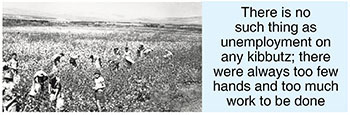
Cotton fields at a kibbutz, circa 1958 Photo: Wikipedia
At Tsor’ah, as at Kfar Ha-Nassi and possibly at Deganiya (the first established kibbutz), children slept with their parents. However, this was uncommon in most kibbutzim where children had their own quarters; in fact the kibbutzim belonging to the Hashomer Haza’ir movement had a sort of mini-kibbutz -within-the- kibbutz for children, with their own dining rooms and little farm and schools and clubs and all sorts of facilities which people in town might go a begging for and never find in the richest countries. I had several friends who had grown up in this fashion. They assured me that their youth had been the best time of their lives. At one time I was not in favor of this system of bringing up children but after speaking with those who had been brought up this way I have changed my opinion; I think there can be nothing like it for educating youngsters through the very process of living itself. It is not as if they are cut off from their parents (as are children at a boarding school) because the parents live in the same area just a stone’s throw away and there are no walls, boundaries or fences. Parents and children can see each other at any time. Yet it has all the advantages of the best boarding schools.
Children of members can only apply for membership after having completed high school education and army service. Not all apply. Many want to "see the world” before they decide. Some even want to go to other countries. Nevertheless, a large number eventually go back to the kibbutz — not necessarily the one they were born in. Deganiya, the first kibbutz, established (by, among others, the parents of Moshe Dayan, former defense minister of Israel) around 1905 near the Sea of Galilee, now has the fourth generation of its founders living there.
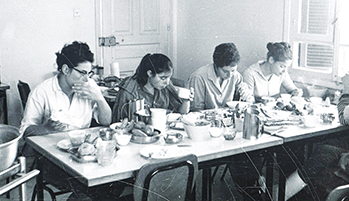
Dining hall in a kibbutz, circa 1968-72 Photo: Wikipedia
When a child born on a kibbutz applies for membership, it is not automatically entitled for selection, but it would be strange indeed to find such an application turned down. At Tsor’ah, however, I do not recollect any child born there being old enough to apply while I was a resident.
The educational system of kibbutzim is freer than that in towns. At one time, I am told, kibbutz children of high school age did not even sit for the Bagrut, the official Israeli school leaving certificate examination. They were encouraged to study any subject they found themselves best suited for. Barenboim, I am told, studied hardly any subjects other than music. Children were encouraged, but by no means compelled, to attend class. I recollect one case during my later years at Tsor’ah. A boy, Yonathan (Yoni for short), who was at the time about seven years of age, used to come to my room quite often and I became very friendly with him. He would turn up at all hours and I discovered that he never went to classes. I also found out that he did not know how to read or write. I was told he could not concentrate in class and was considered to be mentally challenged. I was surprised because I had found him extraordinarily intelligent — far more than his age warranted. He was one of the few persons on the kibbutz — whether child or adult — who was capable of repairing my Norwegian-made 10-speed bicycle. I was fond of Chinese calligraphy and had some examples in the Zen style displayed on the wall of my room. He took an interest in the ideograms and asked me what they meant and copied a few quite well. So he learnt Chinese before he learnt Hebrew! (This was before I found out he could not read and write Hebrew.) He found the proceedings in the class boring and slow, so he would cut classes and go where he could actually learn something, which often as not would be in my room.
Another child was genuinely mentally slow; the members encouraged him in every way and took particular care of him. I was for a while working as a metapel with the children — the word means "nurse” literally but it is much more that that. To be continued