Sir Dinshaw Petit hailed from one of the earliest Parsi families that
contributed to the growth and prosperity of Bombay
Sir Dinshaw Manockjee Petit (above) and (below) the Petit coat of arms
The following edited extract, reprinted from Memoir of Sir Dinshaw Manockjee Petit, First Baronet (1823-1901), Late Member of the Legislative Council of the Governor-General of India and Pioneer of the Textile Industry in Bombay written by S. M. Edwardes and published in 1923, highlights the life and times of an extraordinary Parsi and his family. Parsiana wishes to thank Diana Ratnagar for sending us a copy of the book which decades ago was also gifted to Parsiana by Dinshaw and Homa Petit.
Gerald Aungier, governor of Bombay, in a letter of December 15, 1673 to the directors of the East India Company (EIC), mentions the presence in Bombay of "Percees (Parsis), an industrious people and ingenious in trade, wherein they totally employ themselves.” These words describe the salient characteristics of the race which during the last two centuries and more has played a leading part in the commercial progress and development of the city and island of Bombay.

During Portuguese dominion, one or two representatives of the race appear to have resided in Bombay, for a reference is made to them in 1538 by the physician Garcia da Orta: but it was not till after the secession of the island to the English that the Parsis commenced to arrive in appreciable numbers. In 1673 they built the first Tower of Silence, which still stands on Malabar Hill, and by the end of the 17th century had proved themselves valuable allies of the Company’s government during its struggles with the Sidi and other powers. The great increase in their numbers took place, however, during the 18th century, particularly in 1790 when a severe famine devastated Gujarat; and by the close of the first decade of the 19th century they had become the possessors of much landed property, were shipowners and shipbuilders of repute, and were partners in most of the leading mercantile firms in Bombay. Aungier’s estimate of their character had been amply justified by their later achievements in the sphere of commerce, and was indeed corroborated by Sir John Malcolm, who laid stress upon their "intelligence and enterprise,” and by William Milburn, author of Oriental Commerce, who wrote in 1812: "The Parsis are an active, industrious, and clever people and possess considerable local knowledge. Many of them are very opulent, and each of the European houses of agency has one of the principal Parsi merchants concerned with them in most of their foreign speculations. Once again in 1863 we find the Bombay government referring publicly to them in a resolution on the report of the Parsi Law Commission as ‘an enterprising and sagacious community.’”
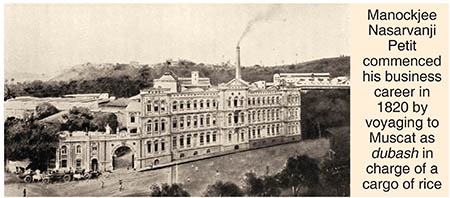
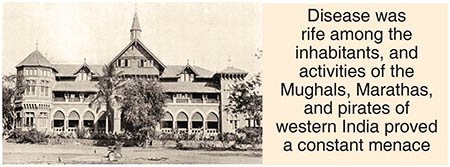
Whether an ancestor of the Petit family was resident in Bombay during the closing years of the 17th century cannot be accurately determined. But certain old manuscripts in the possession of the family seem to indicate that this may have been so. The closing years of the 17th century were fraught with danger for Bombay. Disease was rife among the inhabitants, and activities of the Mughals, Marathas, and pirates of western India proved a constant menace to the Company’s government and its subjects. The lack of direct evidence connecting the Petit family with Bombay during these early years is not, therefore, a matter of surprise.
Nearly a century elapsed before the permanent connection of the family with Bombay was definitely established. In 1785 came from Surat Nasarvanji Kavasji, the grandfather of Sir Dinshaw, and commenced his career as a shipping agent and dubash (one who speaks two languages). At this date, and for nearly 30 years later, the EIC and its servants monopolized Indian trade; and most of the commanders of the Company’s ships found it necessary and advantageous to employ members of the Parsi community to manage their investments and assist them generally in their mercantile ventures. But British ships were not the only vessels that made Bombay a port of call. French merchantmen anchored there also, and like their English rivals, the French officers found it necessary to utilize the services of Nasarvanji Kavasji, whose small stature — so runs the family tradition — led them to describe and speak of him as "le petit Parsi.” The nickname "Petit” (small, in French) stuck to him, and was eventually adopted as the surname of his descendants. In 1804 Nasarvanji was working as a freight-broker, but apparently relinquished this line of business in favor of trade with Calcutta, whither he went in 1810 to take possession of the property left by the father of his second wife. This venture, unfortunately, proved a failure, and in 1819 Nasarvanji died in Bombay before he had time to recoup fully the loss caused by this stroke of ill-fortune.
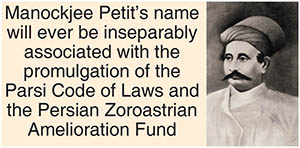
Manockjee Nasarvanji Petit
He left behind him an only son, Manockjee Nasarvanji Petit, born in 1802, who commenced his business career in 1820 by voyaging to Muscat as dubash in charge of a cargo of rice. Manockjee was fortunate in marrying about this date Hamabai, the daughter of Jijibhai Dadabhai who was a banker and merchant of wide repute and acted as guarantee broker to several European mercantile houses. Besides carrying on a successful trade with Europe, Egypt, and the East, Jijibhai was one of the pioneers of steam navigation on the west coast of India, being chief owner of the first steamer thus employed; and he also assisted in establishing three banks in Bombay. Widely known and respected as he was by all communities, Jijibhai had little difficulty in obtaining for his son-in-law, Manockjee, an apprenticeship in the firm of Messrs Sutton, Malcolm and Company and not long afterwards, in 1825, he assisted him still further by entrusting him with his own business as broker to the well-known house of Dirom, Carter and Company. From that date Manockjee’s career was one of unclouded prosperity. He, in his turn, became guarantee broker to various English business houses, and by this means and by trading on his own account soon raised himself to the front rank among the merchants of his day.
He played a prominent part in the formation of the Colaba Land Company, which undertook the reclamation of the foreshore, the erection of the well-known Grant buildings, so named after Sir Robert Grant, governor of Bombay, who died in 1838, and the provision of godowns and storage places for cotton. Associated with him in this enterprise, which cost £ 100,000, were three English merchants, John Skinner, M. F. Brownrigg and Thomas R. Richmond. He was connected with the formation of the Fire Insurance Company in 1840, with the Colaba Press Company established in 1842, and in 1848 purchased a large merchant vessel, the Charles Grant, of nearly 2,000 tons, which traded between India and China and brought him a handsome profit.
More important perhaps than these activities was his work as a pioneer of the cotton spinning and weaving industry, which has since formed the real foundation of Bombay’s commercial prosperity. The first mill in Bombay was projected by Kavasji Nanabhai Davar in 1851 and commenced work in 1854 under the name of the Bombay Spinning and Weaving Company. The Suez Canal had not at this date been opened, and all machinery had to be imported by the Cape route in sailing vessels. Trained mill operatives were unknown; and the mill products had to face keen competition with the cloth imported from England. Manockjee, however, was a man of foresight, and despite these difficulties, established in 1858 the Oriental Spinning and Weaving Company with a capital of Rs 25 lakhs. In a sense he may be said to have been responsible for the creation of the Gujarat mill industry also: for it was the success of his enterprise which encouraged the late Rao Bahadur Ranchodlal Chhotalal to set up the first cotton mill in Ahmedabad.
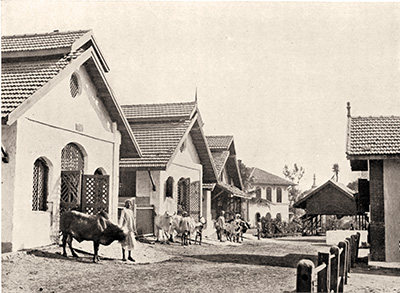
The cattle wards at the Lady Sakarbai D. Petit Hospital for Animals
One of the wards (l) and the bacteriological laboratory at the Lady Sakarbai D. Petit Hospital for Animals
In the midst of his various business activities, Manockjee was not unmindful of his duty towards his co-religionists. His name will ever be inseparably associated with the promulgation of the Parsi Code of Laws and the Persian Zoroastrian Amelioration Fund. In consequence of difficulties arising from the absence of any statute regulating marriage and inheritance of property among the Parsis, a public meeting of the community was convened on August 20, 1855, for the purpose of deciding upon a code which should bind those of the Zoroastrian faith. Manockjee was chosen as the first chairman of a committee charged with the task of preparing a draft code and obtaining the sanction of the Indian legislature to its enactment; and he was also elected president of the Parsi Law Association, which ultimately secured the promulgation of the Parsi Succession Act of 1865 and the Parsi Marriage and Divorce Act XV of the same year. Much of the success of the community in thus obtaining its own laws was due to the zealous efforts of Manockjee himself.
During the first half of the 19th century the Zoroastrians of Persia, who resided chiefly in Yezd and the surrounding villages, were subjected to very great hardships by the Persian government. Justice was denied to them in the courts of the country, and they were compelled to submit to a jizya or poll tax, which the majority of them were wholly unable to pay. Reports of their unhappy circumstances reached Bombay and aroused the deep sympathy of their more fortunate co-religionists. In 1854 a fund was opened by the Parsis for their benefit, and one Manekji Hataria was dispatched to Persia to investigate the subject and prepare a report on the social, political and intellectual condition of the Zoroastrians in that country. His report was considered at a meeting held in 1855 under the chairmanship of Manockjee, at which it was unanimously resolved to open the Persian Zoroastrian Amelioration Fund and to take all possible steps to obtain relief from their disabilities for their Persian co-religionists. Up to the hour of his death in 1859, Manockjee was chairman of the society which controlled the fund, to which he subscribed handsomely, and took active part in the struggle on behalf of the oppressed.
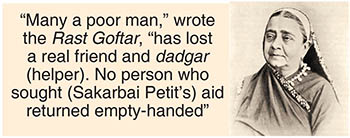
Lady Sakarbai Dinshaw Petit
The Victoria Jubilee Technical Institute
Manockjee’s wife Hamabai bore him two sons, Dinshaw and Nasarvanji, both of whom were destined to leave their mark upon the city of Bombay. While Dinshaw unquestionably inherited his father’s talents for business, it is probable that he acquired from his mother that generosity towards others less favorably circumstanced which was his chief characteristic. Hamabai was a deeply religious woman with strong philanthropic impulses; and when she died in 1851, the income of her personal estate or Rs 20,000 was largely devoted, as she herself desired, to the support of various charitable institutions. Manockjee did not long survive his wife’s death; for he died on May 23, 1859, at the age of 57, when Dinshaw was 36 years of age. Widespread regret was felt at his demise as he had for so long occupied a position of importance in the commercial life of the growing city, and the Parsi community in particular felt deeply the loss of one who had spared neither time nor money in the advance of their interests. Manockjee was the pioneer of the movement to build fire temples and places of worship for the poorer Parsis of outlying districts, and his labors on behalf of the Persian Zoroastrians would alone suffice to keep his memory green among a people who, throughout a chequered history and in the face of great difficulties, have ever struggled to keep the faith of their Persian forefathers inviolate.
At the uthamna ceremony, held on the third day after his death, a sum of Rs 56,000 was provided out of his estate for charitable objects, in accordance with a time-honored custom. This fund was increased by donations of Rs 25,000 apiece from Manockjee’s two sons. From the income of this fund, after defraying the cost of certain religious ceremonies, an annual grant of Rs 600 was made for the support of the lame and the maimed, Rs 150 a year was credited to the fund of the Persian Zoroastrian Society, and Rs 1,500 a year were to be expended in cash grants to poor Parsis to help them in meeting the charges of domestic ceremonies such as marriages, funerals and the investiture of their children with the sacred thread. In the year following his death the shareholders of the Oriental Spinning and Weaving Company, of which Nasarvanji became chairman, voted for the erecting of a statue in his memory.
Dinshaw was born on June 30, 1823, in the house of his maternal grandfather, Jijibhai Dadabhai in Bohra Bazaar Street, one of the chief streets of the old town which grew within the Fort walls during the 18th century. It was in this locality that the Parsis first commenced to settle in 1675, and here also, at the junction of Bohra Bazaar and Gunbow Street, the first Court of Justice was established by Aungier in 1677. Little is known of the early years of Dinshaw, but it may be assumed that before his seventh birthday he was duly invested with the sudreh or garment of fine muslin and the kusti or sacred woollen cincture (girdle), which are the outward symbols of a child’s initiation into the Zoroastrian religion. His education in the Gujarati language, the home tongue of the Parsis in India, was entrusted to a native pedagog of the old school.
Sir Dinshaw Petit Hospital for Women and Children
At this date there was no official department of public instruction, and even the Board of Education, which preceded the Educational Department, had not yet come into existence. The majority of Indian boys were therefore compelled to attend indigenous schools owned by so-called Mehtajis, penurious men of limited intellect, who often held their classes on the verandah of a house, free of rent. Chairs and tables were unknown, and very few people possessed slates or pencils, their place being supplied by a portable wooden board, on which the pupil wrote with a reed pen dipped in a chalky fluid, and which was repainted each Diwali by the Mehtaji for a small consideration. Bombay also contained a few private academies of an exclusive character, attended by the sons of the rich, in which the fees were high, discipline was lax, and the pupils studied or not according to their own fancy. Having learnt all that he could from his Indian teacher, Dinshaw was sent by his parents to an English school conducted by a certain Sergeant Sykes, one of several retired soldiers who opened schools in Bombay at the commencement of the 19th century, and after that to a well-known institution managed by Mr Mainwaring, where he completed his English studies.
Dinshaw’s school career terminated around the date of his marriage in 1837, when he was in his 14th year. According to ideas current among the Parsis of today, this would be regarded as an unusually early age for marriage: but at the date of which we are writing, the old custom of early marriages, which the Parsis probably adopted after their first arrival in India, was still in vogue, and remained so until about the middle of the 19th century when the general opinion of the community favored the discontinuance of the practice. The community has now reverted to the views which it undoubtedly held before it fled from Persia and came into contact with the Hindus in Western India: for among the Zoroastrians in Persia a boy is not married before he attains his 20th year, nor a girl before the age of 15, and this rule must originally have been observed by the Parsis before persecution drove them to seek a new home in India. At the present time marriage is often postponed to a still later age.
The bride, Sakarbai, who was destined to be the faithful ally of Dinshaw in his manifold charitable works, belonged to the well-known Panday family which traced its history back to Kharshedji Pochaji Panday, one of the earliest Parsi settlers in Bombay. He is known to have contracted for the building of fortifications in 1664 and was in all probability resident on the island at the time of its invasion by the Sidi of Janjira. Abhaiji, afterwards better known as Lady Sakarbai Dinshaw Petit, was the daughter of Framji Bhikaji Panday and Gulestan Banu, a Persian lady, daughter of Kai-Khusru Yzdiar, who emigrated to India in 1805. Born in 1826, and 11 years of age on the date of her marriage, Sakarbai had been carefully brought up and proved a model housewife.
Sakarbai’s brother, Merwanji Framji Panday, who died in 1876, is well remembered in Bombay as the founder of the Panday Sanatorium for poor Parsis at Colaba, which cost him nearly Rs 5,00,000 (£ 33,330). He also spent Rs 50,000 in the provision of the much needed Dharamshala in the city, and founded a trust fund of Rs 1,50,000 (£ 10,000) for the benefit of needy members of his community. Like the Petits, he had very much at heart the happiness and welfare of the Zoroastrians in Persia, and during his lifetime devoted considerable sums to providing buildings of a religious character for their use in Yezd. His philanthropy, like that of his sister Sakarbai, was not confined to his own co-religionists; misfortune, wherever it was to be met, was a sure passport to his sympathy.
While actively participating in her husband’s charitable work, Sakarbai devoted herself with more than ordinary success to the management of her home and the careful upbringing of the large family of sons and daughters whom she bore to Dinshaw. Her kindliness, no less than her ability, was widely recognized in social circles, and many a small dispute was submitted to her for arbitration to the benefit of the people concerned. It is no exaggeration to say that at the date of her death, March 6, 1860, she was universally recognized by the Parsis and other residents of Bombay as one who in her private life had offered a shining example of wifehood and motherhood, and in public matters had established a standard of religious conduct and philanthropy to which all might with advantage aspire. "Many a poor man,” wrote the Rast Goftar, "has lost a real friend and dadgar (helper). No person who sought her aid returned empty-handed. She was the guide, philosopher and friend of many an indigent soul, as also her husband’s large and far-reaching charities.” It was with this wise and beneficent lady as partner of his house that Dinshaw commenced a career destined to place him high upon the illustrious roll of those who by their activity and liberality have contributed to the welfare and progress of the city of Bombay.
It has already been mentioned that Manockjee became broker to the European firm of Messrs Dirom, Carter and Company through the influence of his father-in-law; and it was in this firm that his son, Dinshaw, commenced work as an apprentice on a salary of Rs 15 a month. By dint of steady application and his natural aptitude for commerce, he was gradually promoted to a salary of Rs 100 per mensem, and having mastered the details of the export and import business commenced a little trading on his own account. In 1845 Mr Richmond, one of the partners of the firm of Dirom, Carter and Company severed his connection with the business and opened a firm of his own with Dinshaw Petit as general manager. In this position, Petit’s capacity found wider scope and he took full advantage of it.
In company with his brother Nasarvanji he also found time to conduct his father’s brokerage business and continued his connection with it until 1869 when his own affairs demanded all his attention. It is interesting to remember that Messrs Dirom, Carter and Company was one of the few European firms which gave their support in 1836 to the foundation of the Bombay Chamber of Commerce, and that one of the original members of the Chamber was Dinshaw Petit’s maternal grandfather, Jijibhai Dadabhai, who helped to found the Oriental and Commercial Banks, and became one of the first trustees of the original Great Indian Peninsular Railway Company, established in 1845.
Up to the date of his father’s death in 1859, Dinshaw appears to have carried on the business of broker both on his own and his father’s account, and to have acquired gradually during those 12 or 14 years the experience and money which enabled him to launch out on his own account in 1860 and become the doyen of industry to which Bombay owes her great commercial importance. It was fortunate for Dinshaw that at the commencement of his career he should have had the guidance of so practical a man of business as his father, Manockjee. That he inherited his talent for commerce is unquestionable: but even so, he might not perhaps have attained the predominant position in Bombay which he held for years, had he not acquired an unrivalled practical acquaintance with commercial problems by dint of several years’ steady work under the eye of his father.
Dinshaw possessed in a preeminent degree those racial qualities which have aroused the admiration of officials and travellers during the last two centuries. The activity, industry and business acumen which distinguished his career were moreover combined with a genuine philanthropy which recognized no barriers of caste and creed and prompted him to support any movement designed to further the welfare of Bombay and her heterogeneous population. Posterity is justified in claiming for him very high rank among those leaders of the Parsi community whose personal achievements have done so much to secure the commercial, industrial and social importance of the capital of the western presidency.