Words and purity are the cornerstones of Zoroastrian rituals. Prayer itself becomes a ritual when it is not spontaneous or unrehearsed. Intoning every carefully syntaxed word in a Zoroastrian prayer results in energy vibrations which are highly beneficial, both materially and spiritually, contend the ritualists. Dr Mary Boyce, a traditionalist Oxford scholar, states that such invocation is like practicing white magic. The potent capsule prayers of Ashem Vohu, Yatha Ahu Vairyo and Yenghe Hatam, are said to be interspersed in most prayers (barring Vanant Yasht and Atash Nyaish), according to careful numerological considerations, in order to spice or pepper up the efficacy of the main prayer. The Khshnoomists go so far as to assert that the karmic burden of a devotee praying before the holy fire in a fire temple is lightened considerably; provided he or she recites from a printed prayer book and not a digital device like Kindle or a cell phone. The prayer book itself continues to emit protective vibrations and, therefore, must be treated with respect, say the Khshnoom followers.
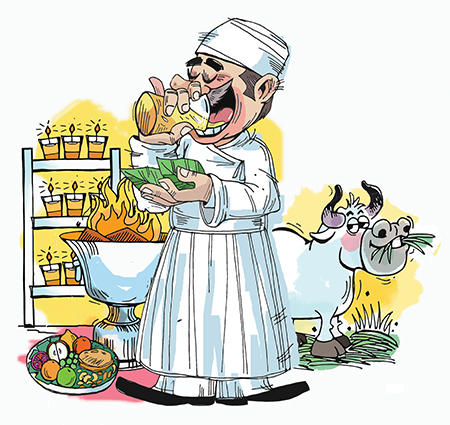
Illustration by Farzana Cooper
Mechanically reciting prayers without knowing their meaning is meaningless, counter the reformists. Literal translations of some prayers, composed centuries ago, sound bizarre, preposterous or even outright absurd (an oft given example is the potent Vendidad containing among other things detailed instructions to a householder how many times to change his undergarments during the night). Dastur Maneckji Dhalla’s translations of the Yasna and other prayers were never therefore literal but modern renditions of the free flowing message of the Prophet. Priests are babblers for money, creating cacophony on a busy morning in an otherwise serenely peaceful agiary, grumble the liberals who wish to attune with the sacred fire. Chanting mantras is ritualistic; dialog with the god within is not. Reformist priests like Dhalla and Dastur (Dr) Framroze Bode grudgingly conceded that rituals may increase devotional fervor but are not an essential part of the faith. Of course, they too recited the prayers, and obviously untied and retied the kusti, which is itself a rite.
On the other hand, the expert on rituals, Dastur (Dr) Firoze Kotwal, insists that ritual purity is integral to Zoroastrianism, in the absence of which the soul cannot get the protection of the holy fire and archangels like Sroasha, during life and even after death. The granular details of performing the great services like nirangdin and vendidad in Kotwal’s papers is astonishing for the sheer expanse of its research. The central purpose in laying the foundation of purity is to establish a close communion between man and what is holy, observes Kotwal. His co-author of several papers on rituals, Boyce, stated that the blessings received, both material and spiritual, from observing the strictest ritual purity, are immense. Even today, the all night ceremony of the vendidad is performed to exorcise negative or evil energies from homes and other places emitting "bad or heavy” vibrations.
Children and adults are repulsed and flinch when administered nirang, popularly called taro, during a navjote or a wedding ceremony. Most avoid it, and priests, barring a few diehards, look the other way. However, the consecrated urine of an uncastrated albino bull called the varasyo is the central purifying agent in all Zoroastrian ceremonies and rituals. The high priests have opined, time and again, that unlike that of humans and other animals, the urine of cows and bulls does not become putrid immediately upon excretion but remains pure for 72 hours, when sanctified by an 18-day-long ritual ceremony called the nirangdin. The varasyo is wrapped in a sudreh and kusti and accorded full Zoroastrian honors, when he attains transition to the higher worlds.
Consecrated urine was reportedly found to be bacteria free when analyzed in a Munich laboratory. From the solar plexus chakra of the ox, vibrations emanate to magnetize the urine, claim the ritualists. To the disbelieving lot, however, the unpleasant smelling liquid can never be a cleansing agent, and it is all bull.
There is undoubtedly a rationale behind every Zoroastrian ritual. However, at times some of these practices are difficult to fathom. Take, for instance, the use of goat’s milk called jiwam in several purificatory ceremonies requiring a cleansing period of seclusion for the priest. Dastur Erachji, an old authority on ritual strictness, cited in several respected journals, states as follows:
"It is also necessary that the goat whose jiwam is taken should remain alive if the efficacy of the ritual is to remain intact. ‘We must take care of the goat whose jiwam is taken, because we can use jiwam for three days, and if in the meantime the goat dies, the kriya is vitiated, and one who acts as zot (priest) vitiates his barasnum (purification rite) (because he takes into use the jiwam of a dead goat). So, we must look after the goat well.’ It should also be noted that the raspi, after taking jiwam from the goat, wishes her good health.”
Reformists ask what constitutes the fundamental religious purpose of Zoroastrian rituals. Purists like Kotwal assert that ritual activity is symbolic of inner existential realities. He draws parallels with the Buddhist tradition and Jewish, Christian and Islamic mysticism; reformist scholars like Bode and Pilloo Nanavutty see this as a fundamental tinkering with the far more intricate and sophisticated Zoroastrian tradition.
Controversy over the ritual processes and methods has been bitter and at times abusive, not only between the orthodox and the reformists but also among the orthodox themselves. Over centuries, the Bhagaria mobeds of Navsari, who were the bastions of orthodoxy and scrupulously adhered to the letter of the ancient Iranian Khorasani practices, clashed violently with the Bombay priests who were regarded as upstarts. The issues were such as: can a non-mobed slaughter a goat on the fourth day after death (chahrum nu botu) for ritual offerings of animal fat to the fire, in an ancient ceremony called Atas-Zohr (according to Kotwal, this practice resulted in the surname Bakra-kapoo). The Bombay Parsi Punchayet (BPP) too got involved in this melee, supporting the Bombay priests. The miffed Navsari establishment, called the dharam-ni-tekri, dismissed the Bombay priests as fatwa issuing mobeds who hardly practiced the higher liturgical ceremonies. Kotwal, currently the high priest of the Wadia Atash Behram, takes legitimate pride that he "could perform an entire yasna ritual within two hours and 20 minutes without unfolding his legs, the hallmark of a proficient priest.”
Disputes have ensued about how many times the bells should be rung during the boi ceremony (tending the holy fire). There was a long-standing superstition that if the high priest altered the number of times the bells were rung, bad luck followed including "the boiwala’s arm withering away, or the death of a trustee.” Despite this fear, Kotwal, in 1980, reinstated the tradition of ringing the bell nine times. Certainly, no arm withered, though we do not know if any trustee died.
Even the liberals have to admit that Zoroastrianism is certainly not a simple religion founded on ethics. Zoroastrianism, with its painstakingly consecrated fire temples, circuit protected towers of silence, prayers replete with magical formulae, elaborate rituals of purification and initiation, the most complex liturgical ceremonies involving countless processes with their minutest details and its pantheon of cosmological entities of varying grades and hierarchies, is without the slightest doubt one of the most ritualistic faiths known to mankind. The next time you flinch from savoring that golden liquid, think twice; you may be spurning salvation.
Berjis Desai, lawyer and author of Oh! Those Parsis, and recently Towers of Silence, is a chronicler of the community.