Oorvazi Irani’s film Anahita’s Law explores the ordeals faced by women
Firdaus Gandavia
"History has been blind to the fate of womankind,” stated director and actor Oorvazi Irani in her film Anahita’s Law. The 21-minute movie premiered at the National Gallery of Modern Art (NGMA) on May 31, 2019. The film is thought provoking, packed with ideas, and artistically conceived and executed: a second viewing is a must.
The film is in the form of a monolog with a remarkably crisp and poetic script created by Farrukh Dhondy. Irani is director, producer and actor, performing all her roles with consummate skill and subtlety. Whether it is Anahita, the ancient, popular fourth century BC Persian deity who is associated with fertility, healing, wisdom and represents the spirit of all women, the young or older Khurshed, or Bakhtawar, the lawyer, all the voices are differently modulated. Irani shows her skill as a director by choosing to shoot Bakhtawar almost entirely through shadows and close-ups, as Irani wanted to present in her a world of abstractions, not so much a real life character but through concepts, ideas and the law.

Oorvazi Irani portraying the character of lawyer Bakhtawar Patel
Why should women have second place? At the very outset, Irani states that in the beginning was the womb from which arose the universe, the womb was woman and the woman was Anahita. The main story alternates between the protagonist, Khurshed, as a young girl married to a bookshop owner and later as an older woman reviewing her life. Khurshed laments the injustice meted out to her and her baby who is obviously not her husband’s child. The mother-in-law is appalled to see a baby with blue eyes and golden hair and the family rejects both the mother and the child without giving Khurshed a chance to defend herself.
Irani moves to her second theme: the difficulty of getting Khurshed’s child accepted as a Parsi. The navjote ceremony is aborted due to the intervention of an angry crowd and Parsi charities refuse to assist her when she loses her jobs and is left penniless. Her son eventually migrates to the USA and, in need of a religion, becomes an Evangelical Born Again Christian, suggesting that it is the Parsi community which, on account of its conservative and narrow outlook, is finally the loser.
A further strand is the story of Bakhtawar, a brilliant lawyer married not to a Parsi but to a Hindu named Patel. She supports the proposal to bring all women in India under a unified Uniform Civil Code (UCC). "I no longer want Hindu women to be treated as inferior to their brothers. I no longer want Muslim women to be divorced at the whims of their husbands, or suffer the humiliation of sharing a bed with three extras in a marriage, so to speak.” Bakhtawar resents the fact that her children have been barred from entering a fire temple.
Irani has no doubt that women, the weaker and meeker sex, will soon come into their own and, in the words of the Bible, "shall inherit the earth.”
Human relationships
The film was followed by a conversation between Irani and Bhawana Somaaya, film journalist, critic, author and historian who was awarded the Padma Shri in 2017. Somaaya praised the film because it is "different,” is shot in close-ups and portrays a woman’s journey as well as the complexities in human relationships. Irani expanded on the significance of the title of the film. Anahita, of course, is the deity referred to earlier. The "law” is the UCC which, it is hoped, will greatly improve the status of women in the country. It was Irani’s intention to represent women as deity (Anahita), the victim (Khurshed) and the rebel (Bakhtawar). When Somaaya rightly pointed out that if Khurshed chose to have an affair with another man, she should have left the marriage, Irani explained that she had to deliberately keep open the supposition of whether the child was the result of an affair or a rape. There is also a suggestion that Khurshed’s husband is complicit because he stands to gain from his wife’s friendship with the British soldier in charge of the regimental library.

From l: Mannu Sandhu, Irani, Bhawana Somaaya and Kiran Manral
When asked about the commercial viability of the film, Irani said that she was well aware that Anahita’s Law would not be a money spinner; much of the funding had come from the community and by individual donors who were very supportive of her work. To expect the film to be commercially viable was never the plan.
The conversation was followed by a panel discussion where Irani and Somaaya were joined by Mannu Sandhu, international actress, model and president of the Vancouver International South Asian Film Festival (VISAFF), and Kiran Manral, a popular author and consultant ideas editor at SheThePeople TV. Manral felt that the message of women’s empowerment came across particularly strongly since the film was shot in a theatrical style. What was critical for her was the subtext that every woman should be treated as a normal human being and should have the choice to terminate her pregnancy. Ninety percent of the people who work behind the scenes in Hollywood are white males and Sandhu feels that exposing Canadian audiences to more women-centric films — the VISAFF has even tied up with the Women’s Economic Forum — may encourage women to take courses that will enable them to enter this predominantly male domain. When Manral asked Irani why she chose to make the film in English as she felt this would limit her audience, the filmmaker paid tribute to Dhondy, her scriptwriter, who is a "great collaborator,” who writes in English and whose powerful lines would lose their impact in translation. English, she believes, enhances the appeal and makes the film more universal.
One can Google Anahita’s Law and watch the film on the humaramovie channel on YouTube.

Farrukh Dhondy; below: Irani as the Persian deity Anahita
Zoroastrian identity
Speaking to Irani after the screening, it is apparent that she is deeply committed to exploring her roots as a member of the Parsi community as well as her Zoroastrian faith. Her first independent film, Mamaiji, which she scripted and directed in 2011, is a sensitive cinematic portrait of her maternal grandmother. It is an evocative and artistic portrayal of her subject rather than a realistic one. "My last feature film, The Path of Zarathustra (see "A game of Chinese whispers,” Parsiana, August 21, 2015), was a journey to discover the essence of my religion.” However, in Anahita’s Law she turned her gaze to focus on her identity as a Zoroastrian woman with the spirit of the deity Anahita representing the universal essence of womanhood and the feminine force in Zoroastrianism.
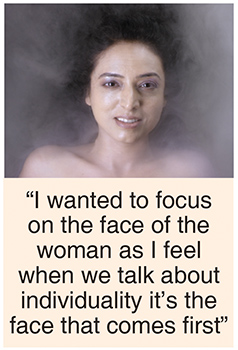
Close-ups seem to dominate the film and when asked why she chose to do this Irani replied she wanted to redefine the way we look at women. "I wanted to focus on the face of the woman as I feel when we talk about individuality it’s the face that comes first. When we interact with anyone we communicate with the eyes of a person.” Hence, throughout the film she treads a fine line, maintaining a delicate balance. On one hand, she did not want to focus on the body and objectify the woman on screen and on the other she did not want to negate the woman’s sexuality. Hence, the bare shoulders.
There are long close-up shots of the eye and this, for Irani, was extremely torturous. "We could not get a very high-end lens for this macro shot due to budget constraints and I had to keep my eye open for a long duration of time without blinking.”
How difficult was it for her to play three such diverse characters and modulate her voice and her character? She replied that her greatest concern was playing the character of Khurshed in old age. "Beside the voice modulation, the makeup of an old lady was critical as it could not look fake.” She praises her makeup team which performed wonders. The old lady’s prosthetic makeup took almost three hours to create.
For the character of the young Khurshed, makeup was important, though the lights and camera played an important role in making her look younger.
Shooting the deity Anahita was a big challenge and a laborious process. "I decided to film her with a top angle and had to get a mini crane to provide a larger than life perspective and dimension to the character. A lot of dry ice (to create the sense of primordial water mixed with steam) with quite a few men in attendance dancing to the tunes of the element got the perfect shot.”
By presenting the film in a way where the characters directly confront the audience, Irani attempts to diminish the barrier between the audience and actor. "The audience soon realizes it is not just an objective viewer but also another character in the unfolding drama.”