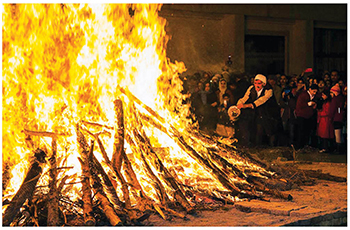
Having read the item "Salute to Sadeh” (Zoroastrians Abroad, Parsiana, January 7-20, 2024), I would like to point out some misinformation which has unfortunately found its way into the archives of UNESCO (United Nations Educational, Scientific and Cultural Organization). The agency has recognized Sadeh (pictured) as an Intangible Cultural Heritage of Humanity, for which we should be grateful, but I do hope they correct their records.
To claim that the 100 of Sadeh refers to the 50 days and 50 nights before Navroz is incorrect. It is sad to see how so many scholars and prestigious institutions repeat an incorrect narrative without bothering to check whether the math is accurate.
The 10th day of mah Bahman is the traditional day for celebrating the Sadeh festival. Every four years, there is a leap year. The year 2024 is one such. If we go by this wrong assumption, it will be 51 days and 51 nights this year, so should we change the name of Sadeh or else celebrate it a day later?
It has been celebrated by the Iranians from the time they lived in Aryana Vaejah in the Arctic region. The land warmed up from the 100th day of the Arctic winter and people began to prepare for the approaching spring. As it was still cold, they lit fires to keep themselves warm and to party around.
The Arctic winter starts on the first day of mah Avan. Thirty days each of Avan, Adar, and Dae plus the 10 days of Bahman add up to 100 after which the festival is named. This 100 is stable and leap years do not affect it.
While located in the Arctic, the Iranians also celebrated three other festivals, which continue to this day. The first is Sal-e-Now, the New Year, now called Navroz and two seasonal gahanbars for the two seasons of the Arctic. In the Arctic, there are 216 days (Fravardin to Meher) of summer and 149 days of winter. Mid-summer (Maidhyo-Shahem) was celebrated on the 108th day (15 Tir) when they had finished planting their fields, and winter the day before it set in on the 216th day (30 Meher). The latter was called Ayeh-Threm, or the coming-of-winter.
When the Iranians migrated to the temperate region, they continued to celebrate all these four festivals and added other ones to mark the seasons of their new homeland. These included the first day of the temperate season, Navroz, which falls on the first day of spring, Tirgan on the first day of summer, Mehregan on the first day of autumn and Yalda on the first day of winter. They also added farming related festivals called gahanbars for the four temperate seasons, namely Maidhyo-Zarem (mid spring), Paiti-Shahem (end of summer), Maidh-Yarem (mid-winter), Hamas-Path-Maedem (equal day and night), all mathematical names.
This proves the wisdom of our ancestors long before Galileo and the Western world realized the truth. Misinterpreting these facts and relating the festivals to myths or superstition would dishonor their memory. FARIBORZ RAHNAMOON
Vancouver, Canada
fariborzr@hotmail.com
Sadeh, popularly known as Jashan-e Sadeh, is a mid-winter festival celebrated by Zarathushtis. In Iran it is the third largest celebration after Navroz and Mehergaan. For some reason, this festival is not widely celebrated in India.
In Farsi, saad means 100. There are several different traditions as to when to celebrate the festival. In Yazd, it is celebrated on roz Astad, mah Adar, which is 100 days before Navroz, the onset of spring, placing the festival on December 11. In Kerman, this festival is celebrated on roz Avan, mah Bahman, which is the 100th day after the Ayathrem gahanbar, the beginning of winter. Yet others celebrate it on January 29, 50 days and 50 nights before Navroz. Most organizations in US celebrate it on the weekend closest to January 29.
The Shahnameh refers to Sadeh as a celebration of mankind’s discovery of generating fire. As per legend, King Hushang saw a snake and threw a stone to kill it. Missing the snake, the stone hit another rock. The friction between the stones created a spark and a fire. Fire caused by natural phenomena (lightning, volcanoes, etc) had been known to mankind for ages, but for the first time man discovered how to create fire at will and control it for practical use, a big step in the history of human civilization.
The traditional celebration of Sadeh involves lighting a big fire outdoors. Priests perform a jashan followed by people singing and dancing around the fire. Everyone is expected to participate in the festival by bringing wood for the fire. A folk song in Farsi translates as: "Whosoever offers a branch,/ May God grant their wishes!/ Whosoever does not offer a branch,/ May God not grant their wishes!”
The outward significance of participating in the festival and offering wood to light the physical fire is to counter the cold of the winter by providing heat and warmth. The deeper significance is to remind us to feed and light the inner fire to fight evil in our minds, so that with the good mind our souls can progress and fulfill the mission of life.
In our religion fire — Atar or Adar — has a deep significance as seen in several references in the Gathas and other scriptures. Each time we offer sandalwood, let us remember that fire is the visible symbol of the invisible divine light or spark and the Fravashi (soul) within us. It is this internal flame that needs to be kept burning by living a useful, meaningful life by practicing humata, hukhta and huvarashta (good thoughts, good words and good deeds) and following the path of Asha or righteousness.
KAYOMARSH P. MEHTA
Chicago, USA
kayomehta@aol.com