Parsis squabbling over internal matters is not surprising. Be it religious rituals, Parsi politics, intercommunity marriages or baug battles, it’s never a dull day in the life of a Parsi.
This, however, is the first time that the mercury spilled out of the community’s thermometer because of some other faith’s place of worship. As it always happens when tempers flare, the first casualty is nuance. The fracas started with Dastur Khurshed Dastoor, high priest of Udvada Iranshah sharing his photograph against the backdrop of the newly constructed (and not yet fully-finished) Ram Mandir at Ayodhya in Uttar Pradesh. The community was split down the middle, though, to be fair, Dastoor had more comments in his favor on social media. A majority of members made peace realizing that not being there when you are invited by Prime Minister Narendra Modi wouldn’t just be seen as lack of grace and etiquette but could potentially create problems for a community whose voice is insignificant.
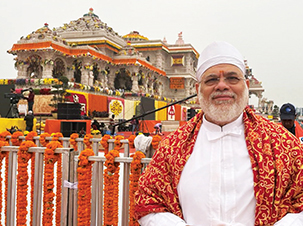
Also, given the proximity and the general bonhomie between Dastoor and Modi, it would have been impossible for the high priest to refuse when other religious heads were in attendance. As for the orthodox argument that Dastoor should not be attending a temple ceremony in the first place because of his religious standing, it is illogical, bizarre and retrograde, and would have only stigmatized us as fanatics out of tune with the multicultural environment we live in.
But a larger controversy erupted on Facebook when two atash behrams in Surat and one in Navsari, and some agiaries decided to hold jashans to commemorate the Mandir’s pran pratishthan (consecration) ceremony. Many of us saw it for what it was: an act of utter unwarranted servility. The temple’s creation may ostensibly project the ideals of unity but as informed political observers of the last few decades know, it’s a political project that has been founded on the principles of hostility, vandalism and majoritarian bullying that has no parallel in independent India’s history.
Taking nothing away from the faith of crores of Hindus, we can agree that a significant number of Hindus also viewed it as a political ploy and were conscientious dissenters. That the Supreme Court of India ruled in favor of the temple construction on the same piece of land where a mosque once stood does not make it more palatable. The judges in their wisdom also prefaced their ruling by concluding there was no actual evidence of Lord Ram being born at that spot. In the same breath they however "settled” the matter saying this was a question of faith for crores of Hindus. While the judgment may have assuaged the guilt of those who refuse to see the seamier side of our nation, there’s no getting away from the fact that India, founded on the principles of a modern democracy, has slid considerably over the years.
We have missed a historical opportunity to abide by the unwritten laws of civility and tolerance, the only true marker of humanity’s progress. Worse, to turn this moment of national embarrassment into an occasion for flagrant flag-waving should ideally have given a supposedly enlightened community like ours a moment to reflect — if not recoil in disgust. We have often been projected as a model minority, along with the Bohris, to cater to a majoritarian agenda that has been in vogue for the past 10 years. So many of us are unconcerned about the brutality unleashed by a divisive regime that has targeted churches and mosques, fuelled by the passion to right historical wrongs. As I write this, efforts are being made to reclaim the Gyanvapi mosque, also in Uttar Pradesh.
The Parsis, because of their historical antipathy towards India’s largest minority may conveniently want to look past this agenda for the present. But the core principles of nation-building cannot be compromised. We may come to regret our misguided indulgence someday.
VISTASP SAM HODIWALA
Thana
vistasphodiwala@gmail.com