After writing several successful novels
Boman Desai has turned to composing music
Firdaus Gandavia
What makes a successful novelist who has written several, well received books turn to composing music relatively late in his career? But then music had always been a vital part of his life. "My mother (Vera), a piano teacher, asked if I would like to learn to play the piano. I knew the basics but I was never interested in learning scales and arpeggios.” At the age of five BomanDesai imagined he would be playing Mozart in a couple of weeks. When that didn’t happen, he lost interest, but continued lessons, however haphazardly, for a few years. Meanwhile, he heard melodies in his head and wanted to learn to play them by ear. His mother found him another teacher, Manuel Nunes, who played at nightclubs. During lessons the lad would play songs on his record player for Nunes who would scribble the tunes into manuscript books; at the age of 11, Boman was composing his own melodies. Shortly after that, his younger brother, Ronnie (who was later to make a name for himself as the Bob Dylan of India with his group called People), began strumming chords on the guitar and writing songs, which influenced his older brother who added lyrics to the melodies Ronnie had written.

But there remained a chasm between pop songs and the classical music he wished to compose. "If my novel was eight years behind schedule, my symphony was 28!” It is perhaps not surprising the music followed in the wake of his literary magnum opus: TRIO, a Novel Biography of the Schumanns and Brahms. During a weekend visit to Columbus, Ohio he purchased a biography of his favorite composer, Johannes Brahms, but on returning to Chicago, he put the book on the shelf and forgot about it for five years. Later, coming across another book on the composer, he recalled the first, and made a pact with himself: "If I bought the second book, it would be with the intention of writing something about Brahms — but even as I made the pact I realized that if I didn’t buy the second book immediately I would be back for it later.” The decision to write about the German composer had been made subconsciously during those five years the first book had been gestating on his shelf. He read every book in the English language published on Brahms and soon realized no book on Brahms would be complete without an understanding of his relationship with both the Schumanns (he was very much in love with Clara, and was no less indebted to her husband Robert who got Brahms’s first six opuses published within weeks of their meeting).
During the three years it took to write the first draft (1,800 pages), Boman lived off his savings losing almost 10 kilos (saving on groceries) and growing a ponytail (saving on haircuts). "I familiarized myself with the music of Brahms and Schumann, not merely listening but reading liner notes, educating myself regarding forms of music, and following the music with the score in hand. I understood, increasingly, how songs could be developed into large movements. The melodies of my own songs began to sprout the fangs and claws of symphonic movements in my head, but it wasn’t until I discovered Finale (a software that allowed him to create music on the computer) that I realized I had a portal to release the music in my head into the world,” he revealed. He didn’t intend to become another Beethoven or Brahms, but listening to piano quartets by French composer Gabriel Fauré, he realized he might be able to accomplish something along the same lines. He has now composed a full-length symphony and piano concerto. His teenage dreams bore fruit. At 73, he has given up on his last dream of becoming a painter but has painted the covers of his three CDs — "and that,” he claims, "will have to do.” TRIO was listed among Kirkus Reviews’ best books of 2016, transcribed to a chamber opera and endorsed by conductor Zubin Mehta who inscribed Boman’s copy of the book with a "BRAVO!” Boman feels he has made his mark with TRIO, but that is not to indicate that his other books do not matter.

Above: Compact disc covers of music by Boman Desai (top)
If there is one word to sum up his literary output, it is "diverse.” No two novels are similar; each might have been written by a different person. "I’m not consciously trying to do something different. I just get ideas and go along with them. I don’t like treading the same territory a second time and tend to gravitate towards authors who reinvent themselves in every book” he observed.
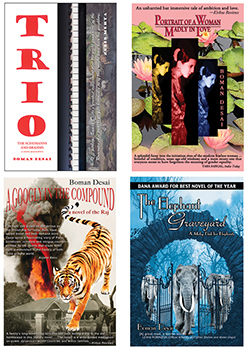
The Elephant Graveyard (2022) is his spiritual novel and perhaps his most problematic. It defies easy explication. The author resolves the problem by enclosing his most abstract thoughts within his most concrete frames. A synopsis on the back cover of the novel mentions, "Amid the sawdust and spangles, the jitters and jangle of a circus unfold scenes both horrific and exotic: a king cobra loose in a Chicago penthouse; a black boy trampled to death in a Toledo city square; slaves riddled with smallpox left on West African riverbanks awaiting crocodiles; a white elephant in musth (testosterone overdrive); a striptease on elephant-back.” How successfully he has conveyed his belief system will depend on how the reader interprets Graveyard — which won the Dana Prize for Best Novel of the Year.
Two of his novels have been recently republished with substantial changes: A Woman Madly in Love (2004) now retitled Portrait of a Woman Madly in Love and Servant, Master Mistress (2005), now A Googly in the Compound.
He likes to say A Googly in the Compound (2022) is his political novel because it takes to task (among many other things) both communism and capitalism. The entire novel is structured around a single breakfast in the compound of the Sanjana home on September 25, 1945, concluding in a confrontation with an enraged tiger. The stories of the breakfasters wander from rural Navsari to cosmopolitan Bombay to 1930s London, to war-torn Burma and Mesopotamia. Boman was not happy with his portrayal of Rustom, one of the characters at the breakfast table. When the author met one of his mother’s friends during a visit to Bombay, she told him the story of her father who had been caught up in the evacuation of Rangoon when the Japanese invaded in February 1942. "The moment I heard this, I realized that this was Rustom’s story. I somehow had to get him to Burma. I began researching the Burma end of the war and the role of the Indian soldiers and as a result managed to make Rustom a more interesting character,” mentioned Boman.
From l: parents Vera and Phiroz; Boman and brother Ronnie; inset: Boman, aged 19
Portrait of a Woman Madly in Love (2005) is his personal novel because his protagonist, despite being of another gender, is modeled more closely on himself than any of his other characters. This novel, too, has a fractured structure, telling the stories of four periods in the life of Farida Cooper (her childhood, marriage, affair, and reconciliation), but not chronologically, the climaxes to the marriage and affair are organized to run one into the other so that the last quarter of the book reads like a thriller.
In his first novel, The Memory of Elephants (1988), which could be considered his Parsi novel, his protagonist, Homi Seervai has been dumped by his first love. He invents the "memoscan,” a machine designed to scan the brain to allow him to relive his most precious memories. He tries to isolate and to relive the ecstatic moments he spent with his beloved. But the experiment goes horribly wrong and Seervai finds himself swimming through ancestral memories instead: to the time the Persians first came to India together with his personal memories of his childhood. But though The Memory of Elephants has Parsi characters, one seldom finds Parsi ritual and dogma. "I’m a racial Parsi not a religious one and I’m not interested in proselytizing. I wrote about Parsis because that is my background. I am a Parsi,” stated the author.
Born and raised in Bombay, Boman’s ambitions as a teenager vaulted the moon: a novel by 30, symphony by 40, and painter by 50. He was young enough then to dare to dream — but life got in his way. He arrived in Chicago at 19 to study architecture and won the creative writing competition during his freshman year. It was a story about an accounts executive who leaves his social-climbing wife and job to seek a more meaningful life. A few years later, Boman followed the lead of his character and abandoned his career in market analysis. He went against the grain of a conventional life and, in doing so, created turmoil in the family. Boman does not enjoy the visibility of many Indian writers despite his output, but after reading his novels and listening to his music one feels he has certainly accomplished much of what he desired.