The President of India Dr Abdul Kalam released a biography of Jamsetji Tata on his death centenary
Parinaz M. Gandhi
It is important to dream for only then will one work towards its fruition, impressed the President of India Dr Abdul Kalam when paying tribute to the "indomitable spirit” of the great industrial leader Jamsetji Nusserwanji Tata on the occasion of his death centenary. "Just as Tata fought the Britishers and paved the way for setting up a steel plant, a power generating station and a research institute and dreamt of a modern, independent India, the country should on his death centenary dedicate itself to solving the drinking water problem,” the President was quoted in The Hindu of July 24, 2004.
Presiding over the function at Bangalore’s Indian Institute of Science (IISc) on July 23, Kalam suggested that the IISc, founded by Jamsetji who envisioned it over a 100 years ago, and the Tata group of companies both work towards making water available by developing technologies to reduce costs of desalination as "a fitting tribute” to the pioneer.
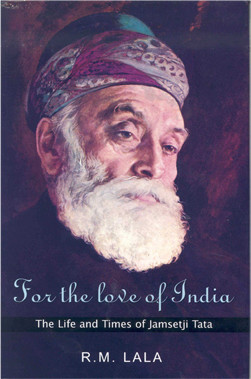
The President also released a biography, For the love of India — The Life and Times of Jamsetji Tata. In this new biography the author Russi M. Lala was searching for the secret of Jamsetji’s life which enabled one man to achieve so much for India. He found the answer in the words of the British Chief Justice of Bombay who commented that Jamsetji "loved with a love that knew no bounds the land that gave him birth.” When he observed the poverty of the Mysore farmers who were unable to eke out a living from their mulberry trees, at his personal expense he invited two Japanese experts to train young people in the latest technique of refined silk-making. Before him was a business interest which he refused to exploit. "He sought no honor, he claimed no privilege but the advancement of India and a myriad peoples was... an abiding passion,” Lala quoted the eulogy paid to Jamsetji by The Times of India when he died in 1904.
"In an era when advanced education was unknown, Jamsetji put his faith in young people,” commended Tata Sons chairman Ratan Tata.
The nation was his
business
The values of the subsequent generations of Tatas were all imbibed from their revered founder Jamsetji. "The consciousness of his own wealth in the surrounding sea of poverty abided with him and with it came not just a desire but what The Times of India called ‘an abiding passion’ to elevate his land and his people to a higher standard of life,” wrote Lala, sending Parsiana some excerpts from the book. Known for his simplicity, one of Jamsetji’s eight nephews had commented, "He was utterly unassuming. For all his great wealth, J. N. Tata was among the most unostentatious of men. He dressed simply and his only indulgence was his perfectly appointed brougham; in his fine horses and their equipment he took genuine pride. An occasional game of ‘Chowpat’ at his club was his sole recreation.”
Another relative remarked, "Direct in his manner and speech, he hated cant; anything savoring of the shoddy and insincere he abhorred. He was widely travelled... Nothing perhaps was more remarkable about him than his endless thirst for knowledge and the passion for studying every detail of a problem which absorbed him. Yet it is typical of his finely balanced nature that his obsession with details never prevented him from conceiving projects on a magnificent, even grandiose scale.”
One of his other traits was "his disciplined habit of reading and contemplation at set times of the day. This he did late morning and after dinner when his own family would be hesitant to disturb him in his library...” Apparently the booksellers Taraporevala and Company had a standing order from Jamsetji, who had been ordained as a priest in early childhood, to send him every book published on the Zoroastrian faith, irrespective of the language.
The leader never mistook activity for achievement which many tend to do...
"Norman Redford who went on drives in Jamsetji’s carriage said, ‘Never did I see him impatient, intolerant or critical of another’s shortcomings.’ So much of the creative energy of most people goes in judging and blaming others. Jamsetji was more interested in what he had to do than in what others did. He could reach out and understand why others behaved as they did but did not dwell on it,” elaborated Lala.
"Charity may begin at home but it does not end there,” believed Jamsetji who, according to a colleague, "was of the opinion that service to the needy could no more be made without brains, without investigation, without the selection of right men, without concentration on particular aspects than the production of any species of goods.”
"In these as in other projects he undertook, Jamsetji revealed the unerring instinct of a man who knew what it would take to restore the pride of a subjugated nation and help it prepare for a place among the leading countries of the world,” sums up Lala in this his fourth book on the Tatas. After The Creation of Wealth came Beyond the Last Blue Mountain: A Life of J. R. D. Tata, The Joy of Achievement: Conversations with J. R. D. Tata and his latest For the love of India where he honors Jamsetji as "a man of fortune” to whom "business was not his business, the nation was his business.”
(L to R): Jamsetji Tata, wife Heerabai and father Nusserwanji
Century of Trust
The year 2004 holds a special significance for the Tata group for besides marking the death centenary of its founder it also coincides with the birth centenary of both J. R. D. Tata and Naval Tata.
An exhibition, Century of Trust which narrates the story of Tatas over the last nearly 120 years was inaugurated in Bangalore and was due to travel to Hyderabad, Madras, Bombay, New Delhi, Poona, Jamshedpur and Calcutta in the subsequent months. "It is called ‘Century of Trust’ because over the decades the Tatas have become synonymous with trust,” said managing director of Tata Services Limited, T. R. Doongaji.
"The panels on Indian history illustrate the growth and development of the Indian economy while the alcoves on Tata history describe Jamsetji’s vision for the Tata empire, Sir Dorabji Tata’s contribution to the nation through various trusts and J. R. D’s first foray into entrepreneurship. Through pictures and wall projections the core values of the Tatas such as adventure, enterprise, nationalism, passion, trust and integrity has been brought to the forefront,” reported the Deccan Herald of July 26.
As chairman of the group, J. R. D. had insisted on tax compliance, refusing to consider tax evasion which is illegal or even tax avoidance which is permissible, recalled Lala in an article in The Hindu of July 29, 2004. "Towards the end of his life he often said, ‘We don’t smile enough.’ When I was writing The Creation of Wealth, he told me about his dealings with his colleagues: ‘With each man I have my own way. I am one who will make full allowance for a man’s character and idiosyncrasies. You have to adapt yourself to their ways and deal accordingly and draw out the best in each man. At times it involves suppressing yourself. It is painful but necessary... To be a leader you have got to lead human beings with affection,’” reported Lala.
Thirty-two days younger than J. R. D. was Naval Tata, deputy chairman of Tata Industries and chairman of three Tata Electric Companies, four textile mills of Tatas and of the Sir Ratan Tata Trust, it was recounted in The Creation of Wealth. Repeatedly elected as employer’s representative to the 18-member governing body of the International Labour Organisation (ILO), its director-general Wilfred Jenks commented of Naval in 1971, "His was the first insistent voice in the ILO to urge that effective social policy cannot be divorced from a courageous approach to the immediate urgency of the pressure of population. He was among the first to urge us to embark on an active program of management development. Indulgent towards human frailty, he has been tolerant of diversity of outlook and divergences of view and interest always, tolerant of cant, evil or meanness never...These are the qualities which have left their impress on Indian industry and which have given him his distinctive stature in the ILO.”